


This page has been archived and is being provided for reference purposes only. The page is no longer being updated, and therefore, links on the page may be invalid.
|
|
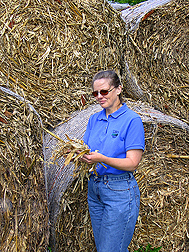

In Producing Ethanol, Some Cornstalks Should be Left in the Field
By Don ComisApril 25, 2007
If conservation of soil organic matter is taken into account, the United States at best has to cut in half the amount of cornstalks that can be harvested to produce ethanol, according to an Agricultural Research Service (ARS) study.
Jane Johnson, a soil scientist with the ARS North Central Soil Conservation Research Laboratory in Morris, Minn., found that twice as many cornstalks have to be left in the field to maintain soil organic matter levels, compared to the amount of stalks needed only to prevent erosion.
This doesn't mean harvesting cornstalks for cellulosic ethanol isn't feasible—just that when you add soil organic matter concerns to erosion concerns, it slashes the amount of cornstalks available for conversion to ethanol. For example, 213-bushel-per-acre corn yields leave farmers an average four tons per acre of cornstalks after harvest. Farmers could then harvest about two tons of cornstalks per acre for conversion to ethanol—but only from land with low erosion risks, using little or no tillage.
If the same farmers rotate with soybeans as recommended, they can only remove half again as much biomass for ethanol production, or just one ton per acre, to compensate for the lower biomass left by soybeans.
Johnson's estimates are part of the Renewable Energy Assessment Project (REAP), formally created in 2006, although she and a core group of colleagues have worked on these measurements for several years prior.
REAP was formed to ensure that cellulosic ethanol programs will be sustainable. Most participants work with corn, but others work on switchgrass for cellulosic ethanol. When cellulosic ethanol is made from corn, it uses cornstalks as well as grain.
There are nine ARS locations participating in REAP in eight states, from Alabama to Indiana to Oregon.
The new program also aims to compare the economic value of biomass for bioenergy versus its value for storing soil carbon. REAP will provide guidelines on harvesting biomass to corn farmers, land managers, the biomass industry and action agencies.
Johnson also explored the use of a byproduct of ethanol fermentation as an organic additive to soils. This is an example of the innovations needed to support residue removal.
ARS is the U.S. Department of Agriculture's chief in-house scientific research agency.