


This page has been archived and is being provided for reference purposes only. The page is no longer being updated, and therefore, links on the page may be invalid.
|
|
|
|
|
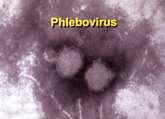
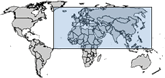
Top: Particles of Phlebovirus, the causal agent of Rift Valley fever. Bottom: The map links to a website that provides detailed geographic distribution and other information about the disease. The website is hosted by the Food and Agriculture Organization. Images courtesy FAO. |
|
|

Model Successfully Predicts Rift Valley Fever Outbreak
By Kim KaplanFebruary 16, 2007
A Rift Valley fever outbreak was successfully predicted several months in advance for the first time with a model developed by a team assembled by an Agricultural Research Service (ARS) scientist.
In October 2006, when the model predicted that Rift Valley fever would flare up within three months in sub-Saharan Africa, a warning was sent to the United Nations Food and Agriculture Organization and the World Health Organization, which then passed on the warning to countries such as Kenya, Ethiopia, Tanzania, Uganda and Somalia.
The early warning allowed the countries most likely to be in harm's way to step up surveillance and control of insect vectors for the disease--actions that may have mitigated the outbreak. Rift Valley fever is primarily spread to livestock and humans by biting insects such as mosquitoes.
An outbreak of Rift Valley fever was blamed for the deaths of hundreds of people in Kenya in 1997-1998. Twenty years earlier, in 1977-1978, a Rift Valley fever epidemic in Egypt involved 200,000 human cases and 600 fatalities. The disease also attacks cattle, sheep, camels and goats.
So far, Rift Valley fever has not reached the United States, but having a model that can predict outbreaks allows the U.S. to know when to step up its own watch to prevent its spread to this country, according to entomologist Kenneth J. Linthicum, director of the ARS Center for Medical, Agricultural and Veterinary Entomology in Gainesville, Fla., who established the team. The team included researchers from the Department of Defense's Global Emerging Infections System and the National Aeronautics and Space Administration's Goddard Space Flight Center.
For the U.S. livestock industry, a Rift Valley fever outbreak would be devastating because the World Organization for Animal Health imposes a four-year ban on exports of beef, sheep or goat products from any country that has an outbreak.
The model is based on analyzing satellite images to find when vegetation is growing at a rapid rate in an area as a surrogate for weather conditions that include heavy rainfall, elevated humidity and heavy cloud cover. Such conditions give rise to major increases in the number and longevity of insects that spread the disease.
The model also can help predict outbreaks of other diseases of livestock and people such as malaria and cholera.
ARS is the U.S. Department of Agriculture's chief scientific research agency.
