


This page has been archived and is being provided for reference purposes only. The page is no longer being updated, and therefore, links on the page may be invalid.
|
ARS Awards Scientist for Wheat Gene Proposal
By Jan SuszkiwOctober 26, 2005
Proposed research to decipher a gene leading to humankind’s domestication of wheat has won the Agricultural Research Service's T.W. Edminster Research Associate Award for 2006.
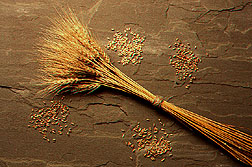
ARS plant geneticist Justin D. Faris won the award for his proposal to study the “super” Q gene. In cultivated wheat, Triticum aestivum, the Q gene is something of a master switch that regulates many different traits, most notably the "naked” (hulless) grain characteristic. Born of a genetic mutation occurring 8,000 to 10,000 years ago, such grain significantly advanced the way in which early farmers threshed their wheat.
Faris' was the top-ranked proposal for the 2006 ARS Postdoctoral Research Associate Program. The program enables postdocs to work closely with an experienced researcher in their field of interest, as well as conduct high-priority research on pressing agricultural issues.
Faris will receive $120,000 in funding for a two-year postdoc assignment to identify genes regulated by the Q gene in wheat. The assignment will also examine how the Q geneinteracts with other genes at the molecular level. Such work will broaden science's understanding of the functional processes associated with wheat and set the stage for novel ways of improving its productivity, according to Faris, with ARS' Red River Valley Agricultural Research Center, Fargo, N.D.
In 2003, he led a team at the Fargo lab in using "chromosome walking" to identify the Q gene. This method involved using large fragments of cloned wheat DNA to bridge gaps between molecular markers residing within the crop's 21 chromosome pairs. The team then analyzed nucleotide sequences between the markers in order to pinpoint the Q gene and its locale on chromosome 5AL.
From 450 submitted proposals for postdoctoral studies, ARS officials selected 50 for funding. Besides Faris’ winning proposal, others include use of a pig-based model for studying food allergens, use of bacteriophages in aquaculture, methods for remotely detecting fire ants in sod-production areas, and methods for incorporating soluble fiber into foods to prevent insulin resistance and obesity.
ARS is the U.S. Department of Agriculture's chief in-house scientific research agency.
