


This page has been archived and is being provided for reference purposes only. The page is no longer being updated, and therefore, links on the page may be invalid.
Read the magazine story to find out more. |
|

Pumpkin's Tantalizing Carotenoids Scrutinized
By Marcia WoodOctober 11, 2005
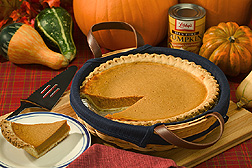
Cans of cooked, pureed pumpkin on the pantry shelf, ready to make into a rich, creamy pumpkin pie or a hearty soup, probably have more beta-carotene than any other food in the cupboard. Our bodies can convert this healthful carotenoid and antioxidant into vitamin A, a nutrient essential for good eyesight and proper growth.
Until now, there hasn’t been a fast, simple and environmentally friendly way to precisely measure the beta-carotene and other carotenoids in pumpkin. Studies led by Agricultural Research Service chemist Betty J. Burri help fill that technology gap by showing that a process known as supercritical fluid extraction, or SFE, efficiently draws out significant amounts of carotenoids from pumpkin samples.
Also, pairing SFE with another technology--reversed-phase liquid chromatography--to identify and measure the extracted compounds is less-labor intensive than some other options; doesn't require harsh chemicals; and provides rapid, reliable, reproducible results.
Nutrition and public health researchers worldwide want to learn more about beta-carotene and other carotenoids, the natural plant compounds responsible for the orange hues of pumpkins and carrots and the deep reds of tomatoes. That's because some carotenoids are thought to help reduce incidence of cataracts, cardiovascular disease and particular kinds of cancer.
Beta-carotene is still the most-studied carotenoid. But the importance of other carotenoids, such as cryptoxanthin, lutein and lycopene--and the amounts in which they occur--isn't well known, according to Burri. She's based at the ARS Western Human Nutrition Research Center in Davis, Calif.
Neither SFE nor reversed-phase chromatography is new. But Burri and colleagues are apparently the first to provide detailed guidelines for using these techniques to more precisely measure carotenoids in pumpkin and other squashes. Their work, which they reported in theJournal of Chromatography earlier this year, is highlighted in an article in the October issue of Agricultural Research magazine.
ARS is the U.S. Department of Agriculture's chief scientific research agency.
