Soil Chemistry
The soil chemistry program is focused on interactions between soil, water, plant and atmosphere. The overall goal of this program is to improve our understanding of biogeochemical processes and anthropogenic environmental change. Our main objectives are: 1) assess impacts of agricultural practices on carbon (C) and nitrogen (N) cycling in agroecosystems, and 2) develop management practices to improve soil C accretion, N and water use efficiency, soil structure, and reduce plant nutrient losses.
The research leads to advanced concepts of organic C and N transformation, C accretion or sequestration in soil aggregates, and their effect on surface soil physical properties. Results are expected to produce a series of additions and modifications to the knowledge of C and N dynamics in dryland cropping systems and improve models predicting biogeochemical processes within agroecosystems nationwide.
Associated Personnel:
- Hero Gollany, Research Soil Scientist (Soil Chemistry)
- Wayne Polumsky, Physical Science Technician
- Rachel Chambers,
- Victor Fernandez-Alos, Chemist
Collaborators:
- ARS-CPCRC, Pendleton, OR
- Stephen DelGrosso, USDA-ARS-SPNR, Fort Collins, CO
- Michel Cavigelli, USDA-ARS-SASL, Beltsville, MD
- Upendra Sainju, USDA-ARS-ASRU, Sidney, MT
- Luiz Leite, Embrapa Mid-North, Teresina, Brazil
- Paulino Boas, Embrapa Instrumentation, São Carlos, Brazil
- Beata Madari, Embrapa Rice and Beans Research Center, Goiás, Brazil
Note: For details and downloadable publications related to these projects, see Hero Gollany.
Associated Projects:
GRACEnet (Greenhouse Gas Reduction through Agriculture Carbon Enhancement network)
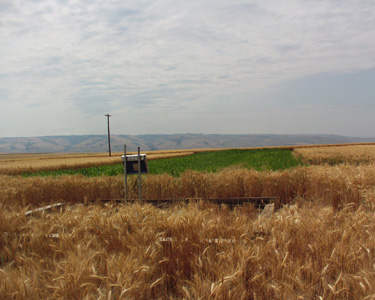
A continuous winter wheat under direct seeding (NT) experiment was established in 1997 and became a part of the GRACEnet project in 2003. In 2021 the plots were divided into two subplots. One subplot with starter fertilizer added during seeding and additional N fertilizer added in mid-season depending on status of N in each plot, while the other subplots were inter-seeded with winter pea cover crop and terminated in mid-season.
The objectives of this project are: 1) evaluate soil carbon (C) and nitrogen (N) status and direction of change of soil C in existing typical and alternative farming systems, and 2) determine which cropping system increased soil organic carbon (SOC) and N from inter-seeded legume cover crops.
Our approach involves field-scale comparison of soil C and N monitoring in a conventional winter wheat-summer fallow rotation and alternative management practices (continuous winter wheat, wheat-pea and winter wheat-winter wheat-sudan grass rotations with direct seeding) intended to increase soil organic matter and associated soil organic carbon, and increase N from inter-seeded pea N fixation.


Left: Sudan sorghum growing while winter wheat heading after inter-seeded wither pea was terminated in the adjacent plot.
Right: Back in the lab, soil acidity (pH) and salt content (EC) are measured with a robotic analyzer.
CQESTR: Process-based soil carbon model
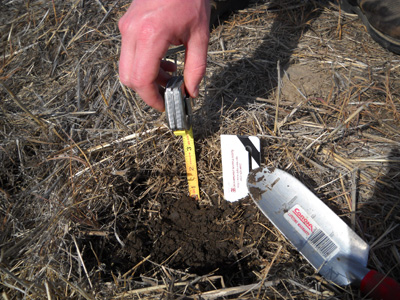
Soil carbon (C) models are important tools for examining complex interactions between environmental, crop and soil management practices, and to evaluate the long-term effects of management practices on C-storage potential in soils. The CQESTR, pronounced "Sequester", model was developed to evaluate changes in soil organic matter (SOM) at the field scale, and was initially calibrated in the Pacific Northwest. We have modified and calibrated the model for use across North America. A major modification was to quantify soil texture and drainage effects using calibration datasets with a wide range of soil properties. Secondly, the terminating point for organic residue decomposition and residue-to-SOM transfer was changed from calendar-based time to growing degree-days (thermal time). A third modification of CQESTR was to separate the surface residue into two compartments, each with a different water coefficient. This was based on the non-uniform decomposition of accumulated surface residue in a no-tillage cropping system as a result of annual residue layering. A fourth modification involved the inclusion of partially decomposed residue with stable simulated SOM when compared with SOM observations, since SOM determination unavoidably includes some partially decomposed residue. Finally, a soil organic carbon capacity algorithm was added to account for carbon saturation in some soils due to changes in management practices. The current version of the CQESTR model (v. 2.0) was validated with SOM databases from various regions of North and South America, Indonesia, Italy and Africa.
Resilient Economic Agricultural Production (REAP)
This is a multi-unit, cross-location project. The objectives of this project are: 1) determine the amount of crop residue that must remain on the land to maintain soil organic carbon and sustain production, and 2) develop algorithms to guide the amount of crop residue that can be sustainably harvested for biomass and bio-based products without degrading the soil resource, environmental quality, or productivity. Our approach involves using measurements taken in plots with residue either removed or returned at different rates (from across North America) and applying the CQESTR model to predict how much crop residue can be sustainably harvested while maintaining soil organic carbon.
Long-term No-tillage and Conventional tillage experiments
The long-term direct seed or no-tillage A (NTA) experiment was established in 1982, and the NTB and the conventional moldboard tillage (CT) experiments were added in 1997. The NTA and NTB consist of five N treatments (0, 40, 80, 120, and 160 lb N/acre) and four replications, in a winter wheat-fallow rotation with each phase of the rotation represented each year. The CT plots are four replications of two N rates (0 and 120 lb/ac). A cover crop of Austrian pea replaced the fallow phase in the rotation in the NTB experiment in 2010. The objectives are: 1) assess soil carbon and nitrogen (N) status and direction of change in presence of cover crop, and 2) determine nitrate (NO3) leaching under dryland conditions, and 3) evaluate changes in microbial community structure and diversity with N fixing legume, 4) determine changes in N and water use efficiency, and 5) effect of NT and CT on soft white wheat grain nutritional characteristics.
Interseeded legume Cover Crop to Reduce Weeds and Nitrogen Fertilizer Rates
A continuous winter wheat under direct seeding (NT) experiment was established in 2021The objectives of this study are to: 1) assess winter wheat yields response to different N fertilizer application rates while inter-seed with legume nitrogen fixing cover crops, and 2) determine impact of four inter-seeded cover crops on weeds population, herbicides use and crop yields.


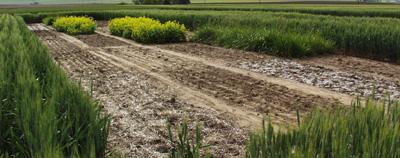
Left: Winter wheat is inter-seeded with vetch to reduce weed populations and herbicides and nitrogen fertilizer inputs.
Right: Winter wheat inter-seeded with four legumes cover crops to reduce weed populations and herbicides use while reducing nitrogen fertilizer inputs.
Carbon source quality influence on soil properties
This research will provide a process-based understanding of how the quality of different organic residue sources and the plant affect soil chemical, biological and physical properties. A small plot experiment was set up with two main treatments (continuous winter wheat, and continuous fallow) and a variety of carbon sources having specific chemical properties applied annually to the surface soil of individual plots for five years. Treatments included wood (lignin), wheat straw, sucrose, cotton (cellulose), alfalfa pellets (high amino N), manure, municipal biosolids (humic substance), composted wheat residue, perennial grass, winter brassica residue, winter brassica crops, and a check (no addition). The objectives are: 1) evaluate soil carbon (C) status and direction of change of soil C in the presence of source C materials, and 2) determine if quality of organic material entering the soil is more important than the quantity of organic matter in stabilizing soil aggregates. Temporal dynamics of soil organic C and soil aggregates and their stability are determined, and their correlation to different C sources will be developed.