


This page has been archived and is being provided for reference purposes only. The page is no longer being updated, and therefore, links on the page may be invalid.
|
|
Insect Virus Could Spell Doom for Potato Pest
By Jan SuszkiwAugust 25, 2006
The potato tuber moth is quickly earning a bad reputation among potato growers in Washington, Oregon and other Northwest states. But like an over-exposed Hollywood star, this pest is destined for a serious meltdown.
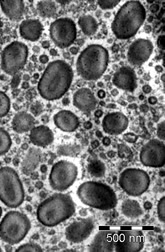
It won't come from fame, though, but from exposure to a type of insect pathogen called a granulovirus. In July, Agricultural Research Service (ARS) scientists in Wapato, Wash., began testing the granulovirus' potential to biologically control the moth's caterpillar stage, which feeds on both the potato plant and its tubers.
Once ingested, the granulovirus could put a stop to such feeding by liquefying the caterpillar's tissues—starting from the inside out—in 10 to 20 days. Except for a few other potato-tuber-moth relatives, this highly specific pathogen doesn't infect other insects, or humans and other mammals, according to Lawrence Lacey. He's an entomologist with the ARS Yakima Agricultural Research Laboratory, Wapato.
There, Lacey and ARS colleague entomologist Steven Arthurs are studying ways to biologically produce and formulate the granulovirus as a biopesticide product that potato growers could spray on their crops before harvest, when synthetic insecticides aren't used. Another potential use is on stored potatoes. Lacey is leading the studies as part of a three-year cooperative agreement involving scientists at Oregon State University's Hermiston Agricultural Research and Extension Center, and the International Potato Center in Lima, Peru. The Washington State Potato Commission is helping fund the effort.
Although the granulovirus is already used in other countries to protect stored potatoes from infestation, it's not commercially available to U.S. growers, and limited research has been done investigating the pathogen's preharvest potential.
Besides the granulovirus, which is now being field-tested under a federal experimental-use permit, Lacey's group is also examining the biological control potential of the bacterium Bacillus thuringiensis, two species of insect-specific nematodes, and the fungus Muscodor albus. In earlier potato-storage studies at Wapato, Muscador's release of natural volatile compounds killed both adult potato tuber moths and their larvae.
ARS is the U.S. Department of Agriculture's chief scientific research agency.
