


This page has been archived and is being provided for reference purposes only. The page is no longer being updated, and therefore, links on the page may be invalid.
|
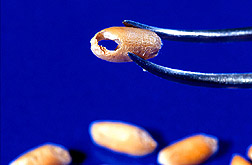
How Wheat Kernels “Sing” Is a Sign of Their Quality
By Erin PeabodyMarch 30, 2006
How do you find the “bad” seeds in the bunch? According to Thomas Pearson, a scientist with the Agricultural Research Service (ARS), you listen very closely.
Pearson--who’s an agricultural engineer at the agency’s Grain Marketing and Production Research Center in Manhattan, Kan.--has developed an acoustics-based sorter that can distinguish between “clean” wheat kernels and those that have been nibbled on and spoiled by insects.
The idea behind the novel technology is simple. A wheat kernel that’s whole and intact will make a slightly different, high-pitched “ping” when striking a steel plate than the sound made by a kernel that’s been tunneled through by an insect.
|
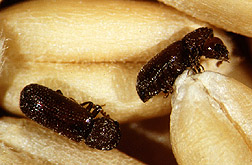
Because individual kernels are so small, lightweight and hard, any acoustic energy they emit is inaudible to human ears. So, Pearson made sure to outfit his sorting system with a special microphone that can pick up ultra-sonic sounds at exceptionally high frequencies.
After assessing the kernels’ acoustic qualities, the sorter will shunt the insect-damaged wheat kernels from a random sample into one bin, and send “acceptable” kernels into another. It can even pinpoint kernels with tiny insect larvae hiding inside them, a feat that, for grain inspectors, is like trying to find a needle in a haystack.
Every year, more than $1.5 billion worth of U.S. wheat and other grains must be discarded or downgraded because of post-harvest damage by insect pests. Despite preventive measures, the pests—ranging from moth larvae to small flour beetles—still manage to find their way into grain storage facilities.
Now, most grain inspectors must laboriously sift through samples of grain by hand, relying on the naked eye to spot wheat kernels that have been spoiled by insects. It can take more than 20 minutes to examine a 100-gram sample, or one weighing about one-quarter of a pound.
Pearson’s sorter can analyze the same sample in about 75 seconds, or at a rate of 40 kernels per second. And it successfully detects damaged kernels 87 percent of the time.
The technology—which would undoubtedly lead to more accurate estimates of insect damage in wheat loads—is now ready for a private-sector partner to help bring it to market.
ARS is the U.S. Department of Agriculture’s chief, scientific research agency.
