


This page has been archived and is being provided for reference purposes only. The page is no longer being updated, and therefore, links on the page may be invalid.
|
|
Advance May Help Mobilize More Wasps Against Grape Pest
By Jan SuszkiwSeptember 28, 2005
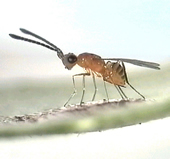
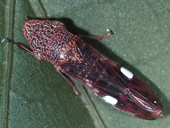
Gonatocerus wasps don't bug people. But these tiny parasites can put a real hurt on glassy-winged sharpshooters, leaf-hopping insects that pose a disease threat to California grape vineyards.
Now, an experimental method of refrigerating parasitized sharpshooter eggs for up to 60 days may improve the artificial rearing of Gonatocerus wasps for field release as biological control agents. Agricultural Research Service (ARS) entomologist Roger Leopold is investigating the insect-storage method along with Marion Harris and Wenlong Chen, both with North Dakota State University in Fargo.
Gonatocerus wasp releases are part of a multipronged approach California has taken to keep sharpshooters from spreading the bacterium Xylella fastidiosa, which causes Pierce's disease in grapevines and other host plants. Gonatocerus wasps reproduce by laying their eggs inside those of sharpshooters. After hatching, Gonatocerus larvae eat their egg hosts, develop and emerge 10 to 12 days later as adult wasps. In California, Gonatocerus' spring emergence lags behind sharpshooters', so fewer are around to parasitize the pests' eggs. Fall attacks, though, can inflict sharpshooter losses of up to 90 percent.
Releasing insectary-reared wasps can help close that gap, but the practice is expensive and time-consuming since live plants and sharpshooter eggs must be used. Refrigerated storage could cut production costs and furnish more time to amass the wasps for spring releases, notes Leopold, with ARS' Biosciences Research Laboratory, Fargo.
In studies there with G. asmeadi and G. triguttatus wasps, Leopold's team stored parasitized sharpshooter eggs for 30 to 60 days by adjusting three temperature settings in a stair-step fashion. Under one such regimen--starting and ending with 4.5 and 7.5 degrees Celsius, respectively--the wasp emergence rate was 60 percent. Importantly, their health and longevity were similar to wasps from untreated eggs, reports Leopold.
His team plans on submitting a scientific paper describing the results, including wasp-emergence rates from dead eggs. Leopold and Chen will also present their work at the Pierce's Disease Research Symposium in San Diego this December.
ARS is the U.S. Department of Agriculture's chief in-house scientific research agency.
