This page has been archived and is being provided for reference purposes only. The page is no longer being updated, and therefore, links on the page may be invalid.
|
|
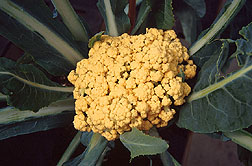
Orange Cauliflower May Help Crop Scientists Boost NutritionBy Hank BeckerJuly 7, 1999 An orange cauliflower plant, found growing in a Canadian field nearly 30 years ago, could provide important genetic clues for boosting the nutritional value of many different crops. The mutant cauliflower produces so much beta-carotene--an orange pigment in carrots and other fruits and vegetables--that normally white parts of the plant turn orange. Beta-carotene belongs to a class of compounds known as carotenoids, important to human nutrition. Plant molecular biologist David F. Garvin at the Agricultural Research Service is studying the mutant cauliflower as a model for unraveling the biochemical and molecular basis of carotenoid production in crops. Chemical analyses indicate beta-carotene concentrations in some tissues of the mutant are several-hundred-fold higher than normal cauliflower, according to Garvin at the U.S. Plant, Soil and Nutrition Laboratory in Ithaca, N.Y. The lab is part of ARS, USDA's chief research agency. Beta-carotene has antioxidant properties that may reduce the incidence of cardiovascular disease and certain types of cancer. It's also an important source of vitamin A. But many crops important to human diets contain little or no beta-carotene. Garvin hopes the research will ultimately provide information needed to genetically engineer increased carotenoid content in important crops like wheat and rice that lack the compounds. Various characteristics of the mutant have led Garvin to postulate that an altered gene in it may act as an important switch for turning carotenoid production on or off. The programming error, according to Garvin, is due to an alteration in one gene. His preliminary molecular studies suggest this gene alteration may influence other genes required for synthesizing beta-carotene. A story about the mutant cauliflower appears in the July issue of Agricultural Research magazine and on the web at: /is/AR/archive/jul99/cauli0799.htm Scientific contact: David F. Garvin, ARS U.S. Plant, Soil and Nutrition Laboratory, Ithaca, N.Y., phone (607) 255-7308, fax (607) 255-1132, dfg3@cornell.edu. |