
United States Department of Agriculture
AgResearch Magazine


Prize Plants From the U.S. National Arboretum
They’re adding a new viburnum cultivar to the list of award winners that have been bred at the U.S. National Arboretum.
Released in 1988, Viburnum x burkwoodii Conoy was recently selected as a 1997 winner of the Gold Medal Award by the Pennsylvania Horticultural Society. This annual award honors new and little known trees, shrubs, and vines of exceptional garden merit.
“The award’s purpose is to promote superior plants with the public, growers, and retailers,” says Kathleen A. Mills, who is manager of the program. “We look at how hardy the plant is, especially if it’s not picky about the environment.” Since 1988, the first year the society made the awards, 56 plants have been honored as Gold Medal Award winners
Conoy is a dense, low-spreading, compact viburnum that grows to 5 feet with a 7-foot spread. Its very glossy, fine-textured, evergreen leaves are dark green in summer and reminiscent of boxwood. In extreme cold, the leaves turn maroon or slightly bronze; in milder climates, they do not change. "Severe cold has caused no winter injury in over 17 years of testing," says arboretum horticulturist Ruth L. Dix.
"Unlike many large viburnums, Conoy is suitable for mass plantings, as a specimen plant, for hedges, or in containers. And unlike most viburnums, it can be pruned or sheared without looking like a barbershop reject," she says.
Conoy blooms in April with slightly fragrant, creamy-white flowers that appear with the young leaves. A profusion of glossy, dark red fruit follows by mid-August; they turn black in October. Resistant to bacterial leaf spot, Conoy has withstood temperatures of -23°C and is hardy to USDA Plant Hardiness Zone 7b.
Conoy is considered to be one of the best viburnum cultivars introduced by the arboretum and the first that is completely evergreen in the Washington, D.C., area. It grows best in a heavy loam soil with a pH of 6 to 6.5, partial to full sun, and an adequate moisture supply.
Arboretum director Thomas S. Elias says that Conoy is the ninth arboretum introduction named a Gold Medal Award winner and the fifth viburnum introduction chosen for this award.
Managed by USDA’s Agricultural Research Service, the arboretum was established by Congress about 70 years ago on 444 acres in northeast Washington, D.C. Since then, its researchers have developed more than 650 new varieties of trees, shrubs, ground covers, and floral crops that today landscape America’s streets, yards, and gardens.—By Hank Becker, ARS.
Margaret R. Pooler is in the USDA-ARS Floral and Nursery Plants Research Unit, U.S. National Arboretum, Washington, DC 20002-1958; phone (202) 245-4568.
The Egolf Legacy
During his 30 years of research at the arboretum, ARS horticulturist Donald R. Egolf bred, tested, and released an astonishing number of ornamental shrubs, including all five Gold Medal Award-winning viburnums. All told, 19 of his viburnums, 27 crape myrtles, 6 pyracanthas, and 4 rose-of-Sharons were released by the arboretum before his death in 1990.
ARS geneticist Margaret R. Pooler, who was recently hired to continue Egolf's research, says, "He was known throughout the horticultural world for his high standards of quality and excellence of his cultivars. His contribution to the nursery industry and the American public will be felt for years to come."
Horticulturist Ruth L. Dix, who worked with Egolf as a student from 1978 to 1981 and as a support scientist from 1986 to 1990, agrees. "Many of these cultivars have become the industry standard—like Pyracantha Mohave and some of the viburnums, like Shasta," she says.
According to arboretum director Thomas S. Elias, "Besides Conoy, Egolf introduced Shasta, Eskimo, Mohawk, and Erie—four other Gold Medal Award winners, along with the hibiscus Diana."
Previous Gold Medal Winners
- 1993—Viburnum x burkwoodii Mohawk. In late April, abundant, bright-redbuds open to white petals with red blotches on undersides. Compact growth habit, reaching 7 feet with a 7-foot spread. Very resistant to powdery mildew and bacterial leaf spot. Hardy to USDA Plant Hardiness Zone 5b.
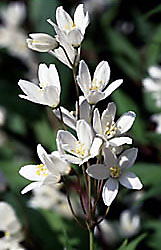 Deutzia gracillis Nikko. (K7143-7) |
- 1993—Viburnum dilatatum Erie. A large, deciduous shrub with an upright, shrubby growth habit, it reaches 6 feet with a width of 11 feet. Medium-green leaves turn red, orange, and yellow in the fall before dropping. Flowers are creamy-white in 4- to 6-inch-wide, flat-topped clusters opening in mid-May. Pest- and disease-resistant. Zones 5 to 7.
- 1992—Viburnum Eskimo. Handsome, snowball-flowered viburnum grows 4-feet tall by 5 feet wide and has glossy, dark-green, semi-evergreen leaves. In early to mid-May, masses of 3-inch, ball-shaped flowers composed of pale-cream, tubular florets appear. Zones 6 through 8.
- 1992—Magnolia Galaxy. A single-trunked, upright tree with a narrow crown, appropriate as a street or landscape tree. Profuse, slightly fragrant, dark-pink flowers open late enough in spring to avoid frost. At maturity, 30 to 40 feet tall with superior heat tolerance. Zones 6 through 9.
- 1991—Viburnum plicatum f. tomentosum Shasta—Without equal for flowering, its abundant creamy-white flower clusters cover the upper sides of horizontal branches in double rows 4 to 6 inches wide. Low growing. Zones 5 to 8.
- 1991—Hibiscus syriacus Diana. Its abundant 6-inch, waxy, heavy-textured, pure-white, single flowers bloom from July until frost. Tolerates a variety of soil types; prefers full sun. Can be cut back yearly to 2 feet to maintain a blooming height of 4 feet. Sets relatively few fruits and seeds. Zones 5 to 8.
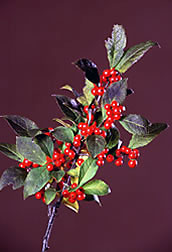 Ilex Sparkleberry. (K7561-1) |
- 1989—Deutzia gracilis Nikko. An excellent ground cover or low shrub that grows to 2 feet with a spread of 5 feet. Sports small, pure-white flowers in late April to early May and fine-textured, willowlike leaves that turn deep burgundy in autumn. Zones 5 to 8.
- 1988—Ilex Sparkleberry. A large, multistemmed, deciduous holly with aprofusion of large, bright-red fruit. In fall, golden-yellow foliage contrasts with ripening fruit that persists until spring. Grows to 12 feet with a 12-foot spread. Zones 5b to 9.
The Route to Release
"Although arboretum plant introductions are not directly available for general sales and distribution, we do make a major effort to make them available to all nurseries wishing to grow them," says Ramon L. Jordan. He leads studies in the Floral and Nursery Plants Research Unit at the Beltsville (Maryland) Agricultural Research Center.
“After we select and evaluate potential new cultivars, ARS distributes them for evaluation by cooperating growers in other U.S. geographic regions,” he says. “Plants are then named and released to cooperating wholesale nurseries, where they are propagated for sale. New cultivars are also distributed to cooperating arboretums, botanical gardens, and research institutions.”
