
United States Department of Agriculture
AgResearch Magazine


Saving Seeds for the Long Term
|
|
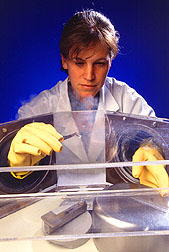
Will seeds in storage today sprout and grow when they're needed--years, even centuries, from now?
To find out, Agricultural Research Service plant physiologist Christina T. Walters is investigating little-known glass compounds in super-chilled seeds.
That's right, glass. It holds a key to keeping the seeds viable.
"All seeds contain glasses that are composed of water and other cellular constituents," says Walters. "These aqueous glasses have properties similar to the silica glass in windows--except that they form at temperatures hundreds of degrees lower. Our data suggest that they consist of a highly complex intercellular substance--perhaps a carbohydrate or protein mixture."
For 11 years, Walters has been researching optimum conditions for storing seeds at ARS' National Seed Storage Laboratory (NSSL) in Fort Collins, Colorado.
Some 300,000 germplasm accessions representing about 8,000 species are stored at the facility. It is the largest gene bank in the world and is part of the ARS-maintained National Plant Germplasm System (NPGS) that collects plants from all over the world. Curators and other scientists preserve, evaluate, and catalog the vast collections and distribute germplasm to breeders who use it to develop new varieties.
If scientists could accurately predict seed viability, the continual monitoring of stored seeds would be unnecessary. "This monitoring for viability is the most labor-intensive part of seed storage in gene banks," says ARS plant physiologist Eric E. Roos, who heads the Plant Germplasm Preservation Research Unit at Fort Collins.
"Seeds stored at optimum conditions can last for hundreds, maybe thousands, of years, obviating the need to continually regrow samples--the most expensive part of germplasm preservation," he adds.
It's critical to determine how to keep stored germplasm alive and capable of germinating and producing fruiting parts for many years. But "when stored seeds deteriorate, they lose vigor," says Walters. "They become more sensitive to stresses upon germination. Eventually, they lose their ability to grow."
Aging--It's Inevitable
|
|
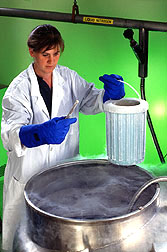
Whether stored in soil banks, warehouses, or liquid nitrogen, all seeds eventually succumb to aging. "Seed aging," says Walters, "has enormous implications for the seed industry. It defines the changes in quality that occur from the time the seed is harvested until its germinated plant emerges from the soil."
The rate at which a seed ages is determined by its initial quality, its moisture content, and its storage temperature.
"We have known for many years that manipulating these factors influences seed longevity," says Walters. "But their precise interaction is poorly understood, so we are unable to predict longevity for a particular seed lot."
A major goal is to identify seeds that are "good keepers" or to spot "bad keepers" before they begin to deteriorate and to develop predictive tools for the rate of deterioration.
Walters found that two big influences on deterioration are the nature of water binding within seeds and the effect of the bound water on seed cells. Investigating further, she applied thermodynamics and concepts from materials and food sciences to predict optimal moisture content for storing any seed at any temperature.
That's where seed glasses come in. "The glassy concept explains the role of water in food deterioration," says Walters. She uses this same concept to describe how seeds' intercellular tissue responds to changing water contents and temperature.
Seeking the Ideal
Scientists at the lab are using Walters' approach to predict optimum conditions for seed storage.
"Preconditioning seeds by holding them at 5oC and 25 percent relative humidity for a few weeks achieves optimal water content for long-term storage at -18oC," she says.
To measure changes in glass in a seed cell, Walters uses a differential scanning calorimeter. "This equipment measures the energy required for a phase transition, such as when ice melts and changes from a solid to a liquid," she says.
Walters scanned at least 30 different seed species at temperatures from -180oC to over 100oC to see what types of phase changes occur in seed cells when seeds contain different amounts of water.
"Glasses control the aging rates in seeds by controlling the rate of chemical reactions," she says. "Glasses make seed cells very viscous, so molecules move slowly. And glasses have small pores, preventing some molecules from moving at all. The slower the molecular motion, the slower the chemical reactions and the aging rate."
Dense, viscous glasses make seed last longer. But "if the glasses in seed are fluid, the seed will age faster," she adds.
Walters has studied glasses in dried and frozen beans, peas, soybeans, corn, sunflowers, peanuts, lettuce, wild rice, coffee, tea, papayas, macadamia nuts, and yew seeds. She has even studied glasses in pollen from cattails and corn.
|
|

"Glasses in seeds that have been dried too much become porous," she says. "But glasses in seeds that are insufficiently dried are too fluid. Neither will store well or long."
Each plant species has a different optimal moisture content for storage. "That value changes with temperature," she says. "It can take more than a decade to directly measure it at storage temperatures used in germplasm banks--that is, at 5oC, -18oC, or -196oC. We can't do this for each of the 8,000 NPGS species."
Still, Walters' findings have provided reliable clues as to optimal combinations of water content and temperature. She also investigates how chemical constituents in the seed affect the glasses. Some seeds form stable glasses--dense, with low porosity. "This contributes to different aging rates, even if the seed is stored at the optimal water content," she says.
Walters does not yet know what chemicals are most important for stable glass formation. But she knows they are produced in bean seeds during the final days of maturation.
Walters plans to learn more about how the glasses form and how they control molecular motion. "The knowledge will enable us to accurately predict the rate of deterioration for a specific seed lot before deterioration begins," she says.
According to Roos, "This information is vital to germplasm banks, such as the NSSL, in planning germination test schedules and choosing which seed lots are in need of closer monitoring and/or regeneration."
He adds, "Cost savings achieved when we reduce monitoring and regeneration of good seed lots allow resources to be applied to preservation of other types of seed or to clonal germplasm."--By Hank Becker, Agricultural Research Service Information Staff.
Christina T. Walters and Eric E. Roos are at the USDA-ARS National Seed Storage Laboratory, 1111 S. Mason St., Fort Collins, CO 80521-4500; phone (970) 495-3202, fax (970) 221-1427.
"Saving Seeds for the Long Term " was published in the September 1998 issue of Agricultural Research magazine. Click here to see this issue's table of contents.
