
United States Department of Agriculture
AgResearch Magazine


GEM Searches for Treasures in Exotic Maize
|
|
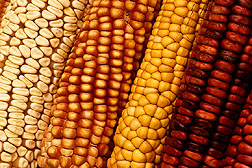
Seed companies live by their reputation when selling farmers disease-resistant and high-yielding seed corn. Now these firms are relying on ARS scientists to help them in an all-out effort to breed their elite lines using tropical or other exotic corn.
The Germplasm Enhancement for Maize, or GEM, project is a massive effort to develop commercially attractive hybrids containing germplasm that is exotic—that is, from outside the United States. There are 19 companies involved and 39 public research facilities.
For half a century, scientists have been trying to breed exotic/domestic lines for companies to cross to produce hybrids that farmers would buy. The summer of 1996 marked the first time public and private researchers cooperatively field-tested GEM breeding materials with both exotic and domestic germplasm. The tests were at Raleigh, North Carolina, and 35 other U.S. locations.
"Latin American maize germplasm has been extensively collected," says Marty L. Carson, who is in the ARS Plant Science Research Unit at Raleigh. "But until now, most of the exotic germplasm was being stored like museum pieces and helping no one."
GEM is a followup to ARS' multinational Latin American Maize Project, or LAMP, that was financed by Pioneer Hi-Bred International of Des Moines, Iowa. LAMP evaluated 13,000 Latin American and U.S. corn varieties for their breeding value and narrowed the number of candidates down to 260. The GEM program is currently using the top 51 picks from LAMP and 7 tropical hybrids donated by DeKalb Genetics of DeKalb, Illinois.
"Everyone wants their corn lines to have a broader genetic base, but developing these lines can take about 20 years—with no guarantee of success. Private companies are reluctant to allocate resources to such a long-term effort," says Randall N. Holley. He is a maize germplasm enhancement specialist in Henderson, Kentucky, working with Novartis Seeds, the seed company created by the merger of Ciba Seeds and Northrup King. "This project wouldn't be possible outside of a public/private partnership."
Holley hopes private and public financial support grows for this program because as the domestic gene pool for corn becomes more closely related, less can be done to enhance yields, and varieties become ever more vulnerable to disease. GEM received half a million in public funds in 1996, and companies gave $450,000 in in-kind contributions.
|
|
You've Got To Check 'em Out
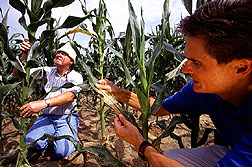
Under GEM, seed companies cross their top corn lines with promising exotic sources and send the resulting hybrids to public researchers like Carson, who can test their yields and disease resistance.
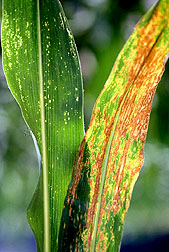
"We've been evaluating for resistance to a host of disease pathogens, including fusarium ear rot, grey leaf spot, southern leaf blight, and aflatoxin-producing Aspergillus flavus," says Carson. "We may be throwing out a lot of poor performers, but we're also finding germplasm with real value for U.S. breeding programs."
"There are 300 races of corn in the world, and the United States uses one—Corn Belt Dent," says Carson's collaborator, Major Goodman, who is a William Neal Reynolds distinguished professor at North Carolina State University. "It seems somewhat silly to say that out of all that genetic material we have the best of everything."
Corn originated in what is now Latin America. Since exotic varieties thrive in that environment that lacks killing frosts to give respite from pests and fungi, they must have evolved powerful resistance, says Goodman.
Not that crossing exotic and domestic lines is simple. Corn in Chiapas, Mexico, grows year round, relying on the sun for cues on when to stop growing and reproduce. That close to the equator, daylight doesn't extend much beyond 12 hours. But exposed to Iowa's 5-month growing season with its 8:00 p.m. summer sunsets, the Mexican corn may shoot up to 20 feet and flower late in September—just in time for killing frosts.
Previous studies by the plant science research group at NC State found that only a small number of genes control photosensitivity. This opened the door to modifying the trait by selective breeding.
New, climate-adapted corn germplasm will do more than enhance corn yields and resistance to disease. Providing a source of traits such as improved protein, starch, and oil composition and easier processing characteristics is also an important goal, says ARS geneticist Linda M. Pollakof Ames, Iowa. She coordinates the GEM program.
This year Pollak and ARS biologist Susan A. Duvick will work in the field and lab with 6,000 breeding lines derived from LAMP's and DeKalb's materials. The lines were developed for traits such as high protein, high oil, or both; high starch; and various fatty acid compositions.
|
|
The researchers analyze for fatty acid content to catalog the potential of GEM materials to change the composition of oil in specialty corns. A corn oil high in palmitic acid would be in demand for margarine production, requiring less chemical processing. And cooking oil high in oleic acid would be beneficial to consumers' health, says Mack N. Shen, an ARS food technologist working with Pollak and staff of Iowa State University's Center for Crops Utilization Research.
Development of specialty corns is an avenue for increasing the U.S. share of the agricultural export market and helping domestic users avoid buying corn as a commodity of somewhat variable quality.
A major quality trait improvement on the grain industry's wish list is kernels that are hard and less susceptible to breakage. Pollak and her colleagues have found some exotic flint corns with harder grains than U.S. hybrids that can be crossed in small amounts with Corn Belt germplasm without reducing farmers' yields.
On another encouraging note, GEM scientists have found many genes in exotic germplasm that cause natural modifications of cornstarch. These findings have bearings on issues such as storability characteristics and food product texture. Some specialty starches could help certain food products maintain a gel structure during freezing and thawing, remain unaltered by heating, or resist degradation when incorporated into acidic foods such as tomato paste, salad dressings, and lemon pudding.
Cornstarch research at Ames is moving forward with a new rapid visco analyzer that measures the ease with which starch solutions flow. Duvick, who is GEM's value-added traits specialist, is investigating the relationship of the viscosity of starch to digestibility. Breeding corn for improved digestibility, as well as enhanced protein and oil composition, would enable livestock to produce more milk or meat with less feed.
Pollak says at least two high-yielding lines with protein levels above 16 percent and oil levels of about 6 percent are being developed from GEM breeding crosses. Corn Belt hybrids typically have less than 10 percent protein and about 4 percent oil. Increasing these nutrients in corn fed to livestock could reduce the need for more expensive soybean meal used to balance rations.
"The livestock feed industry wants corn with more oil. They also want changes in starch and protein content and quality," says corn breeder David Harper, who is with Holden's Foundation Seeds.
"Many exotics were used for human consumption, so they might enhance nutrient value," he says. "Linda Pollak's been analyzing these exotics' oil and protein content. It would be great to find a promising candidate to cross with elite lines."
Raising oil from 4 percent to 6 percent would bring faster growth in swine and poultry, Harper says. That's why, he explains, feed producers would like to see the changes and why companies like Holden's are trying to meet their expectations. — By Jill Lee and Ben Hardin, ARS.
