
United States Department of Agriculture
AgResearch Magazine


Joint Venture Pays Ag Dividends
|
|
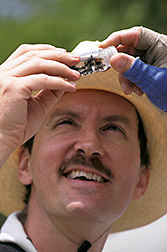
U.S.-Mexico research nets benefits in pest management, crop improvements on both sides of the border.
Pilot Rene Davis tips the black nose of the sleek Aero Commander down toward the river snaking through the pancake-flat land 1,000 feet below.
"It used to be called Rio de las Palmas, the River of Palms," his voice crackles through the headphones, barely audible above the roar of the plane's motors.
Through the early morning mist, there's no great abundance of palms to be seen lining the silvery river, but the water's span also looks a bit too slim to warrant its modern name: Rio Grande, the big river. From our bird's-eye view, the Rio Grande looks no more than a stone's throw in width, the watery equivalent of a backyard fence where neighbors lean to exchange informative tidbits.
In recent years, quite a few scientists with USDA's Agricultural Research Service have been "going to the fence" on a regular basis to talk to their Mexican counterparts about problems that affect the land on both sides of the Rio Grande.
There's always plenty to talk about, according to Edgar G. King, Jr., director of the ARS Subtropical Agricultural Research Laboratory. Pilot/photographer Davis works at this Weslaco, Texas, lab just 7 miles from the U.S.-Mexico border.
|
|

"Within about 80 miles of Weslaco, there are nine bridges and a ferry crossing that link the United States to Mexico," says King. "A lot of agricultural products go back and forth over those bridges every day.
"By working with the scientists in Mexico and sharing information," he says, "we benefit U.S. consumers by ensuring the agricultural commodities that come in are high-quality and safe, at a reasonable price, and in good supply. At the same time, our research facilitates the export of products such as apples to Mexico.
"For many years, there have been people like Whetten Reed of USDA's Foreign Agricultural Service and Luis Galan Wong of Mexico's Universidad Autonoma de Nuevo Leon (UANL) at Monterrey, who have understood the value of this cooperation and worked hard to make it happen."
Entomologist Robert W. Jones, who is working on biodiversity studies at El Colegio de la Frontera Sur in Chiapas, Mexico, concurs on the importance of cooperative efforts across the border.
"Insect pests do not recognize political borders," Jones notes. "This means that to manage insect pests most effectively and with minimal environmental impact, we must consider both sides of the border as a single environmental unit."
Adds insect geneticist Nina M. Barcenas Ortega, "Mexico is the home of many natural enemies that control native pests in their natural environment. Collaborative research with American scientists allows the discovery of potential natural enemies for the development of sound integrated pest management tactics."
Barcenas is with Mexico's Colegio de Postgraduados en Ciencias Agricolas, which is located just east of Mexico City, at Texcoco.
|
|
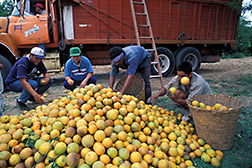
A classic example of border-crossing pests is the boll weevil, estimated to cost the U.S. cotton industry $300 million annually.
"The cotton that we grow in the lower Rio Grande Valley originated in Mesoamerica—the Mayans and Aztecs used cotton fiber in their clothing," says King. "And the boll weevil originated in southern Mexico and parts of Central America, most likely on a tree called Hampea."
When, in the early 1890's, the boll weevil migrated northward to begin gnawing its way across the U.S. Cotton Belt, it was not, unfortunately, followed by any of the natural enemies that kept it in check on its native turf.
It wasn't until 1967 that USDA scientists brought from Mexico a little wasp with the big name, "Catolaccus grandis," as a potential biological control against the weevil. [See also "Evicting the Boll Weevil," Agricultural Research, March 1994, pp. 4-10.]
Tiny C. grandis displayed an impressive appetite for boll weevil larvae. But because practical means of rearing the wasp on boll weevils appeared to pose an insurmountable problem, there was no interest in mass-rearing it.
The starting point for a workable wasp diet, King believed, was a solid biological understanding of the wasp itself. That came to the Weslaco lab via Juan A. Morales-Ramos, a Mexican entomologist who is now with ARS on a temporary basis.
The task of developing a wasp diet was first tackled by ARS entomologist Antonio A. Guerra, in collaboration with scientists and students from the Universidad Autonoma de Nuevo Leon at Monterrey.
Since September 1993, the artificial diet has been sufficiently improved at Weslaco by visiting Mexican scientist M. Guadalupe Rojas, Morales-Ramos, and King to produce wasps for field releases. This achievement is an important milestone in the biological control world.
This type of U.S.-Mexican teamwork in science isn't new. And it's not even particularly unusual, according to Charles A. Onstad, director for ARS' Southern Plains Area, headquartered at College Station, Texas.
"In the early 1990's, Floyd Horn [then director of the ARS Southern Plains Area and now USDA deputy undersecretary for research, education, and economics] asked all ARS scientists to document activity they had going on with Mexico," Onstad recalls. "He received a list of 50 or 60 projects that were already under way in ARS labs all over the country."
Among the leaders was the Weslaco lab, which has a long history of outstanding cooperation with Mexico's UANL, according to UANL Secretary General Reyes S. Tamez Guerra. "These cooperative research efforts have resulted in the training of new Mexican scientists, as well as the implementation of new technologies in the field of biological control of insect pests that damage several crops important to both countries," he says.
The flourishing U.S.-Mexico scientific partnerships became more formal, beginning in 1993 with a series of meetings between the national program staffs of both USDA and its Mexican equivalent, the Secretaria de Agricultura, Ganaderia, y Desarrollo Rural.
"Our scientists have gone to Mexico, met their scientists, and toured their facilities. Mexican scientists have come here to work with us on problems of mutual interest," says Onstad. "It's an equal partnership."
|
|
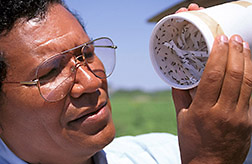
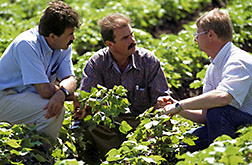
Another prime example of this partnership is the cotton breeding effort under way by ARS plant geneticist Charles G. Cook. Although Cook is based at Weslaco, he often works at Las Huestecas, near Tampico on Mexico's eastern coast.
There, in cooperation with Ernesto Salgado of the Institute Nacional de Investigaciones Forestales y Agropecuarias (INIFAP), Mexico's equivalent of USDA's Agricultural Research Service, Cook is trying to develop fast-growing cotton that might "outrun" some pest attacks.
"That far south in Mexico, they don't plant cotton until June or July. So when the cotton comes out of the ground, the insects are sitting there, waiting," Cook says. "If we could get cotton in and out quicker, we could reduce the amount of chemicals farmers have to spray to fend off those pests."
Cook and Salgado have produced several very short-season lines, including Texas 121, which offers another advantage of importance on both sides of the border.
"The leaves are hairless. This makes the plant less hospitable to whiteflies, because a plant's hairs give the insects someplace to attach their eggs and provide anchors for the larvae," Cook explains.
ARS entomologist Jimmy R. Raulston has long had his eye on a different pest: Helicoverpa zea. Also known as the corn earworm, cotton bollworm, soybean podworm, or tomato fruitworm, it costs U.S. farmers nearly $1 billion annually in crop losses and control expenses.
"There's a major migration of as many as 7 billion corn earworm moths out of Mexico's Rio Bravo area, usually in early June," says Raulston, who is based at Weslaco. "Rio Bravo is Mexico's biggest irrigated corn-growing region, with about half a million acres of corn planted each year." In Mexico, the Rio Grande is called Rio Bravo.
To gauge the threat to crops and provide an early warning to U.S. growers, Raulston and Jesus Loera, an INIFAP entomologist at Rio Bravo in the Mexican state of Tamaulipas, routinely take soil samples from up to 120 Mexican fields, checking for developing earworm larvae. When those larvae mature into airworthy moths, the corn in the Mexican fields will be too old for their tastes, so they'll head for greener crops in the United States.
Raulston and fellow ARS entomologist Dale W. Spurgeon are also spending time these days investigating the boll weevil.
|
|
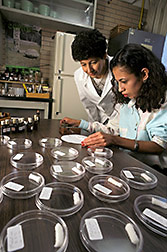
"Cotton producers in Texas plow down their harvested fields in September, and there's no cotton available for the insects until March or April," says Raulston. "So the weevils are without a host during a cool spell and go into diapause. That's a period of temporary dormancy, when normal development is arrested," he explains.
"But down in southern Tamaulipas, cotton is harvested in December and January and not planted again until June or July, so those weevils have to get through a hot, dry spell with no host plant. We need to find out the survival mechanisms of the Mexican weevils and whether they might come to the United States and interfere with efforts to eradicate the weevil here."
In cooperation with Loera, Raulston and Spurgeon have begun trapping boll weevils at 18 locations across Tamaulipas. A second set of traps is operated by INIFAP entomologist Jesus Vargas. Several of the traps are near Mexican schools where teachers and students help collect the insects for closer study at Weslaco and at ARS' Areawide Pest Management Laboratory at College Station, Texas.
High High-Tech
Craig L. Wiegand takes a broader view of Mexican agriculture—usually from about 400 miles up in space. A soil scientist in the ARS Remote Sensing Research Unit at Weslaco, Wiegand has used satellite images to determine soil salinity and agricultural potential of Mexican farm fields.
"In Mexico, there are about 14.8 million acres of irrigated land, of which about 4.9 million acres are salt-affected," Wiegand explains. "Salt is always naturally present in soil and in irrigation water. If you don't add enough water to leach the salt down, it gets left in the root zone. At the same time, if you over-irrigate soils that are poorly drained, a shallow saline water table forms."
Evidence of the salt's impact is visible in LANDSAT satellite images that register healthy plants as a deep-red color, with troubled areas depicted as progressively paler.
|
|
"We've been doing this kind of work with sugarcane in the United States since about 1992," Wiegand says. "Scientists from the Mexican Institute of Water Technology at Jiutepec saw our work and asked us to work with them."
In early 1994, Wiegand went to Mexico and helped select wheat fields there for use as benchmarks. The fields' soil salinity and grain yields were measured, then compared with satellite images to calibrate the images with the ground-level findings.
By running digitized information from the images through a production equation, the scientists translated the satellite's pictures into potential yield figures for all the wheat fields in an irrigation district.
"Being able to show the salinity in a field helps the farmer decide what to grow in that field," Wiegand says. "For example, wheat's more tolerant of salt than corn and can be grown in fields where corn won't grow."
Dirt-Poor Dirt
Leonard Lane's interest in Mexican soils is more down-to-earth. A hydrologist at ARS' Southwest Watershed Research Center at Tucson, Arizona, Lane has been studying Mexico's challenging Tepatate soils since the late 1980's.
"When the good soil in Mexico's highlands erodes, the volcanic ash that's beneath it solidifies like soft concrete—that's Tepatate," explains Lane.
"The farmers have to go in and break it up with bulldozers, then pulverize it. It will grow things, but not too well. Our problem is how to build the soil back up with long-term sustainable agriculture."
Information on the Tepatate soils of Mexico will be incorporated by ARS soil scientist L.D. Norton into USDA's Water Erosion Prediction Project (WEPP) at the ARS National Soil Erosion Research Laboratory at West Lafayette, Indiana.
|
|
"The purpose of WEPP is to predict erosion of various types of soils," says Lane. "Moving into these areas of Mexico gives us additional information for the database."
Licking the Tick—and Fruit Flies and Bee Mites
While much media attention has been lavished on the northward advances through Mexico of Africanized honey bees, those aren't the only winged denizens of Central America to capture ARS scientists' attention.
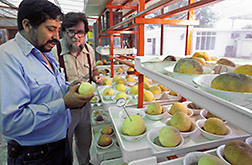
Back at Weslaco, entomologist Robert L. Mangan and coworkers in the Crop Quality and Fruit Insects Research Unit are concentrating on ways to combat fruit flies on crops ranging from citrus and avocados to more exotic mangos, guavas, and other tropical fruits.
"We have a field station at General Teran in the Mexican state of Nuevo Leon where we study the natural fruit fly population, test traps and sampling methods, and do anything that involves large numbers of insects," says Mangan.
"The Mexicans have also paid for us to build a forced hot-air chamber in Tapachula to do work on guava, which they're interested in," he says.
|
|
"You can bring citrus, mangos, and most other fruit into the United States and do the research here. But guava is so heavily infested with fruit flies that it can't be brought in, so the chamber had to be built down there. We already know hot air will kill the insects. We just don't know what the product will be like after that treatment," says Mangan.
ARS and Mexican scientists have also teamed up to combat pesticide-resistant ticks on cattle and tracheal and varroa mites in honey bees.
"In Mexico, the southern cattle tick, Boophilus microplus, has developed resistance to organophosphates and pyrethroids," notes entomologist John E. George, who is in the ARS Tick Research Unit at Kerrville, Texas.
"Right now, coumaphos is the only approved chemical for use in cattle-dipping vats at the U.S. Mexico border. If pesticide-resistant ticks were to be introduced across the border, we could lose control of these disease-spreading ticks rather quickly."
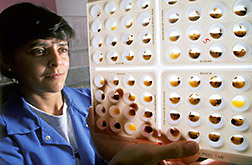
Before scientists can study pesticide-resistant ticks to see what makes them different, they must be able to quickly identify the pests. But current tests can take as long as 90 days to provide that identification.
"We started work about 2 years ago with INIFAP and Texas A&M University on developing molecular probes to detect whether a tick has the genes for pesticide resistance," says George.
"Also, the ARS Veterinary Entomology Laboratory at College Station is trying to determine the biochemical mechanisms that enable ticks to be resistant. I'm hopeful that within 3 years we'll have a probe that could give us the identifications we need in just a few days."
The Weslaco lab plays a key role in monitoring changes in populations of the much-publicized Africanized honey bee.
"We had a trap line along the U.S.-Mexican border and in central Tamaulipas, about 150 miles south of the border," recalls insect geneticist Anita M. Collins, formerly head of the Honey Bee Research Unit.
|
|

"Originally, the intent was to study the process of Africanization of a honey bee population. But the traplines also served as an early warning system for the United States, as far as the location of the Africanized bees. Now, from a scientific standpoint, we want to know how much interbreeding of Africanized and European honey bees is occurring in the Mexico-Texas area."
Body size measurements of captured bees are made in a Mexican lab in Ciudad Victoria. Then sampled bees are sent to Weslaco, where scientists use ARS-developed computer software to compare the bees for distinctions ranging from wingspans to differences in their honeycomb wax.
Mexico made bee history of another kind in 1980, with the discovery there of the first tracheal mites in the Western Hemisphere outside of Brazil and Colombia.
"Tracheal mites have been in bees in Europe since at least the turn of the century," says entomologist William T. Wilson of the Honey Bee Research Unit.
"But they eventually got into Brazil and Colombia—and finally Mexico—through people bringing in queen honey bees, probably from Europe."
Within a few months of Wilson’s initial report in 1980 of the arrival of tracheal mites in Mexico, they had spread to half of Mexico's 32 states. By 1984, the mites were in U.S. bee colonies, where they now cause millions of dollars in damage annually.
|
|
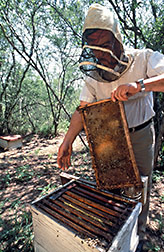
In 1984, working with commercial beekeeper David Cardosa at Allende, Nuevo Leon, Wilson developed a treatment to kill the mites as bees breathed menthol vapors in the hive. Later, Wilson worked with Celina Garza of the Universidad Autonoma de Nuevo Leon on use of formic acid, a synthetic version of a component of bee venom, as a fumigant against the mites.
"In all these various projects, we're looking for ways to more efficiently and economically protect American agriculture from exotic problems, promote export of U.S. products, and meet consumer demand for a wide array of food and fiber products," says deputy undersecretary Horn.
"Mexico is our neighbor. The Mexican people are a significant market for us, and clearly their fate is tied to ours. There are many advantages to this type of scientific teamwork." — By Sandy Miller Hays, ARS.
Robert L. Mangan is at the USDA-ARS Subtropical Agricultural Research Laboratory, 2413 East Highway 83, Bldg. 200, Weslaco, TX 78596; phone (956) 447-6316, fax (956) 447-6345.
John E. George is at the USDA-ARS Livestock Insects Research Laboratory, 2700 Fredericksburg Rd., Kerrville, TX, 78029-9184; phone (830) 792-0303, fax (830) 792-0302.
USDA-ARS Southwest Watershed Research Laboratory, 2000 East Allen Road Tucson, AZ 85719.
"Joint Venture Pays Ag Dividends" was published in the September 1995 issue of Agricultural Research magazine.
A Diet As Good As the Real Thing
The first essential for devising an appropriate artificial diet was knowledge about the chemical composition of immature boll weevils, the preferred diet of the Catolaccus grandis wasp.
Entomologist Guadalupe Rojas and ARS scientists learned that this parasitic wasp applies a venom to its host that changes the host's chemical makeup so it never matures. The venom also liquefies the internal portion of the host, making it easier to consume and digest.
The scientists have now simulated the composition of the liquefied boll weevil with synthetic chemicals. Feeding tests show that C. grandis wasps find the simulation to be acceptable. Using the artificial diet is greatly simplifying the mass-rearing of this biocontrol agent for boll weevils.
A patent application has been filed for the artificial diet and rearing system. A cooperative R&D agreement with Integrated BioControl Systems of Lawrenceburg, Indiana, will speed commercial development.
