
United States Department of Agriculture
AgResearch Magazine


Fatal Cherry Disease Is Treed
|
|
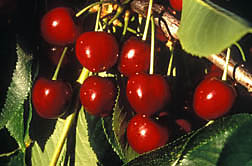
Buckskin disease of sweet cherry trees can't be stopped—that's the bad news. But researchers have developed methods to keep it in check and growers in business.
The disease is so named because cherries are small and turn buckskin color, rather than reddish purple.
Before control methods were developed, tree deaths were averaging between 3 and 5 percent a year throughout the industry. But some growers experienced catastrophic losses—their whole orchards died within 2 or 3 years—while other growers were unaffected.
Buckskin disease was first noted in California in 1931 and was then quickly identified in eastern U.S. orchards, as well as in Washington State. After only 20 years, it had wiped out the cherry industry in two northern California counties, Napa and Sonoma. It remains a potential threat to other counties statewide.
"Buckskin disease, also called X-disease, is caused by a mycoplasma-like microorganism that is carried from infected trees to new victims by leafhoppers," says Jerry K. Uyemoto, an Agricultural Research Service plant pathologist.
Uyemoto, who is in the ARS Crops Pathology and Genetics Research Unit at Davis, California, is a member of a team that has developed several steps that growers can take to keep their orchards in peak production.
Here's what they recommend:
- Monitor insect populations closely with yellow sticky-board traps. Spray only when necessary. For example, in orchards known to be diseased, spray when traps capture one mountain leafhopper, Colladonus montanus, per trap per week; or spray at the first capture of any Flor's leaf-hoppers, Fieberiella florii.
- Promptly cut down infected trees and completely remove tree stumps. But first spray with approved insecticides to kill leafhoppers, so they don't just jump from trees being cut down to nearby healthy ones.
- Monitor ornamental plants such as boxwood and myrtle that are hosts to the leafhoppers.
These controls work. Researchers studied orchards in El Dorado county, east of Sacramento. One grower there, who followed recommendations, confined the disease to an average infestation rate of 3 percent in his orchard during a 6-year period. Another, who ignored the problem, saw more than 60 percent of his orchard infected.
The recommendations are cost-effective, too, according to San Joaquin County farm adviser Joseph A. Grant, who is located in Stockton, California.
He calculates direct loss to his county's growers would run more than $2 million each year. But with insect control and tree removal on about 80 percent of the county's 7,100 acres of cherry trees, that loss is reduced by two-thirds, for an annual benefit of almost $ 1.4 million—even with insect control costs running about $70 per acre.
"If growers want to fill in where dead trees were removed or establish new orchards, they should plant trees that have mahaleb rootstock, which is immune to the buckskin pathogen," says Uyemoto.
These trees should have multiple scion buds grafted high up on the rootstock. Later, if individual branches that develop from the buds become diseased, growers can cut them off without harming the rest of the tree.
In collaboration with colleague Bruce Kirkpatrick at the University of California-Davis, the latest research focuses on developing more sensitive tests to better identify the disease-causing organism. A test called PCR—polymerase chain reaction—is more accurate and may put the finger on additional plants that serve as reservoirs for the organism.
ARS worked in close cooperation with the University of California-Davis and two industry groups, the Cherry Growers' Industry Foundation and the California Cherry Advisory Board. — By Dennis Senft, ARS.
Jerry K. Uyemoto is in the USDA-ARS Crops Pathology and Genetics Research Unit, University of California, 380 Hutchinson Hall, Davis, CA 95616; phone (530) 752-0309, fax (530) 754-7195.
"Fatal Cherry Disease Is Treed" was published in the September 1995 issue of Agricultural Research magazine.
