
United States Department of Agriculture
AgResearch Magazine


Treasures of the National Agricultural Library: Curtis's Botanical Magazine |
|
 Cone flower Rudbeckia purpurea. (K9982-1) |
Hand-painted watercolors of some of the world's most beautiful and interesting flowers grace the pages of a historic British gardening journal called Curtis's Botanical Magazine. ARS' National Agricultural Library in Beltsville, Maryland, holds one of the most complete collections of this fascinating periodical, which has been published continuously since 1787. Its illustrations—detailed, accurate, and delightful—portray plants ranging from Aegyptian water lily to zebra-flowered arum, commonly known as jack-in-the-pulpit. The magazine was the brainchild of William Curtis, a self- taught botanist who wanted avid gardeners in the British Isles to have information more readily available about the impressive array of flowering plants that could flourish in their gardens and greenhouses. In elegant, classic botanical prints, the illustrations in his magazine depict familiar and unusual plants, along with their scientific and common names. Each drawing is accompanied by a narrative about the origin and care of the specimen. The journal's description of cone flower, or Rudbeckia purpurea, captures the style and tone of the earliest issues. Presented as plate number 2 in the first issue of 1787, this pretty perennial is native to the south-central and eastern United States. Readers were told: |
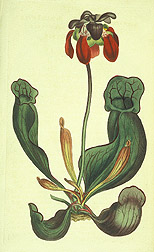 Broad-lipped purple side-saddle flower Sarracenia purpurea. (K9982-5) |
"This species differs from other plants of the genus in the color of its outermost petals, which are long, narrow, purple, and pendulous ... it is a native of ... Carolina and Virginia ... it succeeds very well with us ... but it will always be prudent to shelter two or three plants under a common hot-bed frame in winter to preserve the kind, because in very severe winters those in the open air are sometimes killed. It flowers in July ... the only mode of propagating it is by partitioning the roots." Other flowers featured in the magazine included daisies and daffodils, jonquils and jasmines, roses and ranunculus, and hundreds of others. Some have picturesque names, like broad-lipped purple side-saddle flower, cobweb houseleek, lion's tail phlomis, livid hellebore, melancholy toad-flax, parrot-beaked heliconia, and warty St. John's wort. The library's holdings of the magazine include some 11,000 plates, according to Sara B. Lee of Special Collections. Volumes 1 through 26, published from 1787 to 1807, are posted on the World Wide Web at http://www.nal.usda.gov/curtis. |
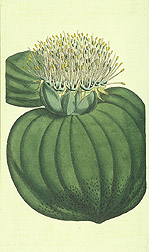 Prickly-leaved massonia Massonia muricata. (K9982-6) |
The detail and accuracy of the drawings, plus the well-mannered descriptions, make this electronic database a useful and pleasing reference. Researchers can use the text to learn more about horticultural trends. Home gardeners can log onto the site to find the perfect accent for a shady path or sunny flower bed. Especially prized are plates of unusual plants, such as crested sida, crimson monarda, hairy wachendorfia, Norfolk-island lagunaea, prickly-leaved massonia, sweet-scented tritonia, and winged-podded sophora. The publication has been issued as The Botanical Magazine, its original title; then, as Curtis's Botanical Magazine, its current name; and, at one time, The Kew Magazine, because so many of its editors were from London's famed Kew Gardens. Still published today, it is thought to be the longest-lived English-language gardening publication. |
 Livid hellebore Helleborus lividus. (K9982-12) |
 Crimson monarda Monarda fistulosa. (K9982-2) |
 Canadian lily Lilium canadense. (K9982-3) |
 Sweet-scented tritonia Tritonia squalida. (K9982-8) |
 Warty St. John's wort Hypericum balearicum. (K9982-4) |
 Wing-podded sophora Sophora tetraptera. (K9982-13) |
 Norfolk-island lagunaea Lagunaea patersonia. (K9982-10) |
 Zebra-flowered arum Arum triphyllum. (K9982-9) |
 Hairy wachendorfia Wachendorfia hirsuta. (K9982-11) |
The magazine gives us a glimpse of past eras, something like Audubon's illustrations of birds and other wildlife. For most of the magazine's history, lavish full-color photography wasn't yet known. So the splendid illustrations were the best means available for professional horticulturists and hobbyist gardeners alike to learn about new plants that were being brought to England from throughout the British Empire and other places around the globe.
A 400-page book, titled Curtis's Botanical Magazine Dedications, 1827—1927: Portraits and Biographical Notes, and published for the Royal Horticultural Society in 1931, ranks as one of the best resources for more information about this distinctive publication.—By Marcia Wood, Agricultural Research Service Information Staff. Sara B. Lee is with the USDA-ARS National Agricultural Library, Special Collections, 10301 Baltimore Ave., Beltsville, MD 20705; phone (301) 504-5876, fax (301) 504-7593. "Treasures of the National Agricultural Library: Curtis's Botanical Magazine" was published in the September 2002 issue of Agricultural Research magazine. |
|
|
|
||

