United States Department of Agriculture
AgResearch Magazine


One Gene Makes the Difference—for Plum Pox Resistance
|
|
|
|
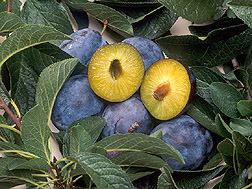
Standing in an ARS orchard are three genetically engineered plum trees, simply dubbed "C5." They look like their female parent—Bluebyrd—a commercial cultivar developed through traditional breeding by ARS horticulturist Ralph Scorza. And their fruit tastes the same.
The difference, says Scorza, is that C5 was given a gene that allows it to resist plum pox virus (PPV) infection. Scorza, who also developed Bluebyrd, says the gene turns off, or "silences," the production of a protein essential for PPV to infect the tree. "It's basically immune to the plum pox virus. We've shown that it is resistant to all major strains of the virus that we've tested," he says. Even if C5 is grafted onto PPV-infected rootstock, virus levels remain so low that aphids apparently can't pick it up and spread it to other trees. And that's critical for maintaining the health of U.S. stone fruit orchards. "You want something that's totally resistant, so that you don't harbor the virus unknowingly," Scorza explains. "Tolerant trees can harbor lots of the virus without any visible symptoms, and then it's easily transmitted by aphids." Scorza says the fruit quality of C5 is good enough for commercial use. What's more, the tree transfers its viral resistance to its seedlings, so breeders could use it to develop new resistant varieties. The tree first proved its resistance under strict quarantine in ARS greenhouse studies, jointly conducted by the ARS team of Scorza, Vern Damsteegt, and Ann Callahan, and APHIS' Laurene Levy. Now, it has completed its fifth year of testing by researchers in three European countries where the virus is well established. ARS technology-transfer specialists can't say when the tree will be available for commercial release because it's breaking new ground. It is the first tree for temperate climates to be given a gene for virus resistance and is subject to strict regulation. Moreover, the pieces of DNA—and the genetic techniques—are all from different sources. And several are patented. Michel Ravelonandro at INRA, the French counterpart of ARS, provided the plum pox resistance gene. Dennis Gonsalves at Cornell University in Ithaca, New York, provided a souped-up vector—anAgrobacterium—for inserting the gene. ARS has filed a patent on C5 to encourage an industry partner to pull all these threads together toward commercialization. Then, U.S. stone fruit growers can breathe a sigh of relief, knowing they have a backup tree to plant. And U.S. consumers may prefer a transformed plum to no plum at all. "In every other way," says Scorza, "C5 acts like a normal plum tree."—By Judy McBride, Agricultural Research Service Information Staff. This research is part of Plant, Microbial, and Insect Genetic Resources, Genomics, and Genetic Improvement, an ARS National Program (#301) described on the World Wide Web at http://www.nps.ars.usda.gov.
|
|
"One Gene Makes the Difference—for Plum Pox Resistance" was published in the September 2001 issue of Agricultural Research magazine. |
|