
United States Department of Agriculture
AgResearch Magazine


Managing Manure Nitrogen To Curb Odors
|
|
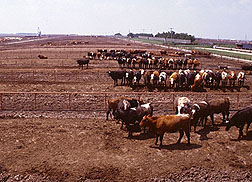
People often think of livestock manure as waste, but scientists believe such animal byproducts should be considered production resources.
They are trying to find new ways to use these resources from cattle feedlots and hog farms in farming operations to address environmental concerns and residential complaints about odors, says Vincent H. Varel. He is an Agricultural Research Service microbiologist at the Roman L. Hruska U.S. Meat Animal Research Center in Clay Center, Nebraska.
Manure from beef cattle feedlots could be valuable for its nitrogen fertilizer, says Varel. But unfortunately, half to three-fourths of that nitrogen never reaches the field.
Most of the loss occurs through a process called hydrolysis. Microbes in animal manure and soil produce the enzyme urease that converts the urea in urine into ammonia that escapes into the air.
This same process happens in urea-based commercial fertilizers. To prevent ammonia loss, fertilizer manufacturers routinely add urease inhibitors--actually, chemical relatives of urea--to block hydrolysis, thus preserving nitrogen until it's taken up by plants.
In laboratory experiments, Varel also blocked this nitrogen loss from manure by adding urease-inhibiting compounds. He mixed either feedlot cattle manure or swine manure with cattle urine into a slurry. Like modern waste-handling systems, the slurry contained naturally occurring urease-producing microbes.
Varel added as little as 10 milligrams (35 millionths of an ounce) of urease-inhibiting cyclohexylphosphoric triamide (CHPT) per liter of manure slurry mixture. In untreated samples, the urease hydrolyzed nearly all the urea within 1 day. But in treated samples, hydrolysis was completely prevented for at least 4 days.
Another urease inhibitor, phenyl phosphorodiamidate (PPDA), produced similar results.
Varel found that adding more urease inhibitor each week provided longer term control. For example, 100 milligrams of PPDA added weekly to cattle waste preserved 70 percent of the urea for 28 days. Adding just 10 milligrams weekly preserved 38 percent.
The researchers are trying to determine why the larger amount of inhibitor didn't preserve even more urea. An understanding may lead to scaled-up farm-size applications. "Our laboratory studies with CHPT and PPDA just started us on the learning curve," Varel says.
He tested a third urease inhibitor, n-(n-butyl) thiophosphoric triamide (NBPT). This compound is currently being used as a nitrogen preservative in no-till cropping systems.
Preliminary experiments showed NBPT works even better in the feedlot than in the laboratory. Under feedlot conditions, Varel explains, NBPT is exposed to air that converts the compound into a more effective urease inhibitor. The researchers spread NBPT over a feedlot surface once each week. As cattle urinate, the chemical binds to urea and blocks ammonia production, thus preserving nitrogen.
Varel says urease inhibitors will reduce ammonia emissions, which contribute to odors. However, other odor-reducing compounds will be needed to more fully control a variety of unpleasant-smelling volatile compounds from manure.
Encapsulating these mixtures in starch or other protective materials could ensure slow release of the active compounds and require fewer applications to cattle feedlots, manure slurry tanks, and covered lagoons used on livestock farms.--By Ben Hardin, Agricultural Research Service Information Staff.
Vincent H. Varel is at the USDA-ARS Roman L. Hruska U.S. Meat Animal Research Center, P.O. Box 166, State Spur 18D, Clay Center, NE 68933; phone (402) 762-4207, fax (402) 762-4209.
"Managing Manure Nitrogen To Curb Odors " was published in the October 1998 issue of Agricultural Research magazine. Click here to see this issue's table of contents.
