
United States Department of Agriculture
AgResearch Magazine


A Guardian Angel for Peach Trees
|
|
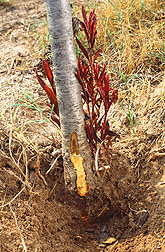
Horticulturist Thomas G. Beckman has found a "guardian angel" for disease-threatened peach trees. Beckman and Clemson University scientists co-developed a new rootstock, called Guardian, that protects trees from peach tree short life (PTSL) disease.
The leading cause of tree death in the southeast region, PTSL costs peach growers about $10 million in damages annually. It is seen as a sudden collapse and death of peach trees in the spring, usually when the tree is between 3 and 7 years old.
U.S. growers produce about 2.6 billion pounds of peaches annually. Now, naturally sweet peaches, packed with flavor, have Beckman's new rootstock to protect them, ensuring their arrival to grocery produce sections and local fruit stands.
"To date, the performance of Guardian rootstock on PTSL sites in the southeastern United States has been exceptional," says Beckman, a scientist with the Agricultural Research Service's Southeastern Fruit and Tree Nut Research Laboratory in Byron, Georgia.
The first commercial-scale trial of Guardian began in 1989. Scientistsplanted trees in South Carolina and Georgia to compare those grown on Lovell and Nemaguard--two commonly used commercial rootstocks--with trees grown on Guardian. Lovell has tolerance to PTSL, and Nemaguard has resistance to root knot nematodes. Guardian has a unique combination of both.
|
|
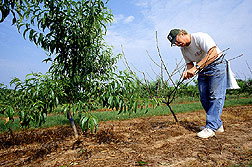
In the trial, completed in 1996, no Guardian rootstock trees were lost to PTSL in South Carolina and only 20 percent were lost in Georgia. Beckman says the trees in South Carolina were grown under best management practices, while the trees in Georgia were planted under a worst-case scenario--no lime, fall rather than spring pruning, and no nematicides.
In comparison plantings, PTSL claimed 97 percent of Lovell rootstock trees in South Carolina and 40 percent in Georgia. For Nemaguard, 95 percent in South Carolina and 80 percent in Georgia succumbed to the disease.
"While we're not sure what causes short life, we do know some things that can help," Beckman says.
Keeping soil pH above 6 to reduce acidity, pruning just before bloom in February or March, and fumigating to control ring nematodes are some of the most important things growers can do.
|
|

"We believe ring nematodes predispose the tree to injury by winter cold and bacterial canker," says Beckman. "Unfortunately, it is not always cost effective for growers to fumigate routinely." The Agricultural Research Service and Clemson have jointly applied for a plant variety protection certificate on Guardian rootstock. They released Guardian to nurseries in 1993.
Demand for Guardian seed initially outstripped supply, because a severe frost in 1996 destroyed the Byron crop and reduced the Clemson crop. The rootstock is available only through licensed nurseries, and demand has been from 1 to 2 million seeds per year for the Southeast alone. Beckman says as of 1997, supplies have been adequate to meet commercial needs. He is confident that establishment of a seed bank as a hedge against future failures will ensure adequate supplies.
Beckman is gauging Guardian's adaptability in other regions. He and cooperators are testing it at 20 sites in North America, including Canada. It will be a few years before he can measure results, but the rootstock's future as a guardian angel is bright.
"Guardian has excellent potential to replace both popular commercial rootstocks in the Southeast," says Beckman.--By Tara Weaver, Agricultural Research Service Information Staff.
Thomas G. Beckman is at the USDA-ARS Southeast Fruit and Tree Nut Research Laboratory, 21 Dunbar Rd., Byron, GA 31008; phone (912) 956-6436, fax (912) 956-2929.
"A Guardian Angel for Peach Trees" was published in the October 1998 issue of Agricultural Research magazine. Click here to see this issue's table of contents.
