
United States Department of Agriculture
AgResearch Magazine


Insect Pollinators Help Preserve Plant Treasures
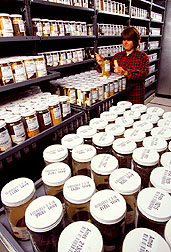
Pumpkins, corn, and certain sunflowers all share something in common at a 120-acre site near Ames, Iowa.
These plants at the ARS North Central Regional Plant Introduction Station must be hand-pollinated by employees who are helping maintain the genetic variability of a treasure trove of seeds and plants gathered from around the world.
Other plants among the 40,000 different populations, or accessions representing over a thousand species are maintained in field cages where bees and flies cross-pollinate them. These plants include melons, cucumbers, carrots, chicory, wild sunflowers, herbaceous ornamentals, and shrubs, as well as species of Brassica and Cuphea.
The north central location, one of four U.S. plant introduction stations, was founded in 1948 as a joint venture among the Agricultural Research Service, Iowa State University, and agricultural experiment stations of the 12 north-central states.
"One of our chief goals is to find ways to keep genetic variability in the plant populations the same as when we first acquire the accessions," says the Iowa station's coordinator, biologist Peter K. Bretting.
|
|

To achieve this, ARS scientists including Craig A. Abel, Richard L. Wilson, and Mark P. Widrlechner combine their expertise in pollination biology, horticulture, genetics, and plant pathology.
Hand pollination was the normal way to maintain the collections until the 1970s, when honey bees were put to use. Since then, plant germplasm collections have grown steadily, increasing the importance of insect pollination and of research to make that process work more efficiently.
Every summer, honey bees from about 700 hives can be seen buzzing through the mustard, zinnias, wild sunflowers, and melons being grown in the tentlike cages. A hive of 4,000 to 6,000 confined bees gets free lunches of corn syrup when they can't be sustained by the relatively few flowers blooming within their cages.
|
|
In most years, too few honey bees are available for the pollination work that must be done in spring. Overwintered hives don't have enough time to build up their numbers before late April pollination time for mustard and other plants of the Brassica family.
Purchasing additional honey bees from suppliers in the southern United States is expensive and runs a risk of importing diseases and mites. So these honey bees are being replaced by solitary horn-faced bees, Osmia cornifrons,which can efficiently pollinate flowers in the cool temperatures of spring.
Since the early 1990s, entomologist Abel has worked on developing rearing procedures for a native Iowa bumblebee, Bombus bimaculatus. These bees are now being put to work in colonies of 30 to 150 in the field cages. Their long tongues allow them to pollinate flowers like snapdragons and certain types of Cuphea that honey bees cannot easily pollinate.
Still, honey bees in some 700 nucleus hives remain the principal pollinating workhorses at the station to help ensure maintenance of the botanical treasure trove. — By Ben Hardin, ARS.
Scientists mentioned in this story are at the USDA-ARS North Central Regional Plant Introduction Station, G212 Agronomy Bldg., Iowa State University, Ames, IA 50011; phone (515) 294-3255
