
United States Department of Agriculture
AgResearch Magazine


Soil Secrets Probed
|
|

Massive, state-of-the-art rhizotrons help solve the mysteries of underground processes.
Thanks to futuristic technology, Agricultural Research Service scientists can now observe plant and soil processes from below ground, as well as above.
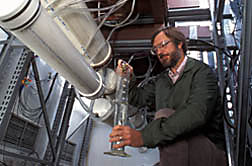
The National Soil Tilth Laboratory (NSTL)—a new, state-of-the-art laboratory in Ames, Iowa—houses three sophisticated, fully instrumented and monitored, controlled-environment chambers called rhizotrons.
"Most rhizotrons are outdoor facilities where roots and shoots of plants growing in soil columns can be observed without disturbing plant growth," says Jerry Hatfield. He is a plant physiologist and director of the Ames laboratory.
Hatfield says the major limitation of most facilities is that the soil is exposed to ambient weather conditions. Thus, root systems being studied are affected by the temperatures of soil surrounding the facility and of nearby access areas or walkways.
"Unlike those rhizotrons, the NSTL facility has a controlled environment with separately controlled chambers for shoots and roots," says Hatfield.
These two-story chambers, the only ones of their kind in the world, can house various-size soil columns in their lower chamber, while the upper part is large enough for plants as tall as corn to grow to maturity. Each chamber is served by an independent computer system that automatically collects all the data generated during an experiment.
"Rhizotrons are ideal facilities for studying the interaction of plant roots with soil, as well as soil processes and soil organisms," says ARS plant physiologist Tom Kaspar. He is beginning a long-term experiment on cover crops—the first of its kind—using the new rhizotrons.
"These chambers will give us unique opportunities to make observations and measurements that would be difficult—if not impossible—in the field," he says. "One of the biggest advantages is that any experiment can be conducted year round, regardless of the changes in the season and weather."
The chambers' controlled environments will make it possible for scientists, under regulated, repeatable environmental conditions, to compare processes that occur in soil samples from different geographical and climatic regions. This unique ability is in keeping with the NSTL's national scope and mission: to understand soil processes and components as they relate to plant productivity and water quality.
"We can simulate just about any growing condition experienced by plants and roots in any soil and environment in the United States," Kaspar says. And we will be able to study how soil and biological processes, like those of earthworms and important soil microbes, respond to changing environmental conditions."
These chambers are capable of answering some age-old mysteries like, does soil temperature influence how deep plant roots will grow?
The lower chamber can house cylinders, of soil from 15 to 20 inches in diameter to monolithic columns 3.3 feet square by 5 feet deep.
For Kaspar's current experiment, the largest, 7,000-pound soil columns are being used. These are actually pieces of Iowa farmland taken from the Deep Loess Research Station near Treynor, Iowa, about 150 miles from Ames.
|
|
The columns have been kept as undisturbed as possible. To collect the soil, steel boxes were pushed into the soil, excavated, and then lifted by cranes onto a truck and transported to the NSTL. There, they were hoisted from the truck and placed in the lower chambers.
The surface of the soil columns is level with the floor of the upper chamber. Once columns are in place, the opening between the upper and lower chamber is sealed and insulated. Except for the surface of the columns, which is the only exposed area shared by both chambers, the upper and lower parts are separated and sealed from each other. The only access to the full depth of the soil column is gained from inside the lower chamber.
In the lower chamber, temperature, water, and drainage can be controlled and monitored. Chemicals and minerals dissolved in water—applied to the surface—can be traced as they move down the column.
Scientists also measure water balance and uptake, as well as the water given off by plants and soils (evapotranspiration) and solute movement. And they measure and monitor root growth at certain depths using a fiber optic scope and horizontally installed transparent tubes (mini-rhizotrons) at various depths. Soil gases can be measured by periodic sampling and analysis using a chromatograph.
The rhizotron's upper half resembles a standard controlled-environment plant chamber. But it is 11-½ feet high, nearly 7-½ feet wide, and about 12-½ feet long. Microprocessors control temperature, moisture, and relative humidity, allowing scientists to program daily, weekly, and seasonal environmental patterns.
"Seasonal changes in light, temperature, and humidity can be simulated to mirror actual growing conditions," says Kaspar.
Taking It Out for a Spin
Last December, Kaspar, along with ARS micrometeorologist John H. Prueger and soil scientist Sally D. Logsdon, started a 2- to 3-year experiment looking at the effects of planting small grains as cover crops after soybeans.
"We wanted to find out how growing oats, a crop that doesn't overwinter, and rye, which does, affects soil moisture and nitrate leaching from soil," Kaspar says.
"Both grains are overseeded into standing soybeans. They are relatively inexpensive, grow well in cool weather, and take up a lot of nitrogen that they store in their leaves, stems, and roots."
The idea is that the small grains will fill the gap between soybean maturity and corn planting. This will make the rotation more like a natural prairie system.
"In nature, some plant is always growing when the weather is warm enough," says Kaspar. "So some plant is always using the nitrogen and water in the soil, which reduces the leaching of nitrate into water supplies."
The researchers planted soybeans in the rhizotron and simulated May 1 temperatures and day length. Since then, the temperature and day length have been changed weekly to match normal conditions for Ames from May onward.
The upper chamber will be set to mimic daily 30-year-normal temperatures.
Enough water will be applied to simulate a wet year, so drainage can be collected from the cover crop treatment. The photoperiod simulated will follow normal summer, fall, and spring patterns. Lower chambers will have temperature settings to mimic changes in soil temperatures observed in the field.
During the summer of 1994, three more large columns were taken from the field. They will be installed in the second chamber so the two chambers can run simultaneously at different crop stages to repeat and confirm the original experiment.
After adjusting temperature to "winter kill" the cover crops, the researchers will grow corn before starting the crop cycle over again.
"We are using the rhizotron for this experiment," says Kaspar, "because it allows us to eliminate the effect of weather—which varies so much from year to year—and concentrate on the effect of the cover crop. -- By Hank Becker, ARS.
Jerry L. Hatfield and Thomas C. Kaspar are at the USDA-ARS National Soil Tilth Laboratory, 2150 Pammel Drive Ames, IA 50011; phone (515) 294-5723, fax (515) 294-8125.
"Soil Secrets Probed" was published in the October 1995 issue of Agricultural Research magazine.
