
United States Department of Agriculture
AgResearch Magazine


From Idea to Supermarket:
|
|
|
|
If you ask Chad Finn whether he has any nicknames, the first one he is likely to say is "plant geek." An even better name may be "fruit geek." Ninety miles south of Portland, Oregon, the ARS geneticist and fruit breeder is surveying a field of new berry seedlings in Corvallis. "I enjoy getting paid to look at fruit in a field with the beautiful mountains in the background," Finn explains. He only wishes it were for more than the 6 weeks a year that he spends full time in the field. Finn works out of the Horticultural Crops Research Laboratory. He is responsible for genetics research and breeding of blackberries, strawberries, blueberries, and raspberries for one of USDA's oldest fruit-breeding programs, dating back to the 1920s. The program's early leaders developed a series of berry cultivars that became the foundation of the small fruits industry in the Pacific Northwest. |
|
|
Finn's job is not for those who like instant results. He gives an example of a blackberry released in 1996 that took 9 years to create, which was "as quick as it could be." That blackberry was designed to be planted in backyard gardens and did not have to be tested to see how well it could be harvested and processed, which can add years to the process. Strawberries take less time to breed, since they grow and fruit more quickly than blackberries, while blueberries usually take a lot longer. Why Does It Take So Long? Plant breeding is a process that has been conducted for hundreds of years, though the science underpinning it was developed in the 20th century. The procedures are practically identical for all the fruits that Finn breeds. A successful cultivar must be appealing to consumers' taste buds, economical to produce commercially, and, ideally, widely adapted to environmental stresses and tolerant of pests. |
|
|
The first step is to make a cross between two parent plants. Finn listens to various groups including growers, processors, and other fruit breeders to decide what his objectives should be. He then chooses parents he thinks are most likely to produce offspring that meet those objectives. For instance, he may want to create a new blackberry cultivar that produces large yields and is thornless—something very important to growers. Finn makes a cross of the two parents with a female and male flower. For the female, he and his staff emasculate the flower (remove the male parts). He then places a bag over the emasculated flowers to keep unwanted pollen out. Finn lets the flowers develop for a few days. Meanwhile, the anthers containing the pollen are dried and then stored in a refrigerator to keep them fresh. |
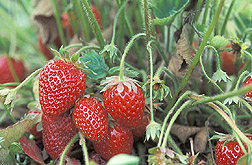 Intense red color and flavor, and suitability for processing are key characteristics of strawberries developed by ARS for the processing market. (K10715-1) |
With a small paintbrush, Finn pollinates the emasculated flowers with the pollen. He does this every few days, and fruit eventually develops in the bag. Ripe fruit is mashed and treated with an enzyme, pectinase, to remove the flesh from the seeds. Seeds of blackberries and raspberries, which have thick, protective outer layers, are soaked in concentrated acid to digest the layers. To mimic winter, all seeds are placed in moistened peat moss and refrigerated for 2 months. The seeds are placed in a greenhouse to germinate, and eventually the seedlings are planted in the field. Each type of fruit takes a different amount of time after planting before Finn gets a representative crop to evaluate. Strawberries can be evaluated 1 year after planting, while blackberries and raspberries take 2 years, and blueberries take 3 to 4. |
 A plump bright berry is great to eat, but a smaller, darker berry is better in foods such as ice cream and bakery goods. (K10713-1) |
"It's the breeder's responsibility to be in the field to make the decision on which plants to select," Finn explains. He says he studies the plants and their fruit to see whether they exhibit the characteristics that are important to growers, processors, and consumers. And maybe most importantly, he tastes the fruit. Only one half to one percent of the fruit Finn planted a few years ago will make it past this point. "I replicate only the ones I have a very good feeling about," Finn says. Since it costs a lot of money in labor and land to grow these selections in a replicated trial, he must be picky about which ones he decides to continue working on. |
 Virologist Robert Martin grafts a strawberry plant to an indicator plant to determine whether any viruses are present. (K10710-1) |
The few he does like are repeatedly evaluated to make sure they meet the criteria needed for commercial success. He pays careful attention to yield data; the fruit may taste delicious and look great, but growers need to be able to grow plentiful yields. During the evaluation period, ARS virologist Robert Martin tests the selections for viruses. If any are detected, Martin uses heat therapy to eliminate them. "Having virus-free stock for the commercial nurseries is critical as it allows the growers to start with the healthiest planting stock," Finn says. At this point, Finn identifies a few advanced selections—the best of the best. He may continue growing these on ARS-owned fields, or he may get some outside help. For additional field trials, Finn often turns to nurseries, such as Fall Creek Farm and Nursery of Lowell, Oregon. |
 Close-up of pollen application to female flower parts of a blackberry plant. (K10712-4) |
The nurseries grow advanced selections on their land to see how they grow in a different environment. This information helps Finn evaluate which prospective cultivars are best. Nurseries benefit too. "We get a firsthand idea of the varieties that show promise," says David Brazelton, president of Fall Creek. University cooperators also help in the evaluation. The breeding program has been working with the Department of Horticulture at Oregon State University, in Corvallis, for more than 80 years. A cooperative agreement with the department has allowed the two groups to work collaboratively to develop new cultivars. Finn also works with breeders from Washington State University, Agriculture and Agri-Food Canada, and other universities and companies located throughout the United States and Canada to see just how well the berries will grow in different climates. |
 Technician Mary Peterson emasculates (removes male flower parts from) blackberry buds during a plant breeding procedure. (K10712-1) |
Some researchers evaluate Finn's selections for other reasons. Brian Yorgey of the Department of Food Science and Technology at Oregon State University looks at the fruits' chemical properties as well as quality after they have been processed as whole frozen berries, puree, or juice. He says that most of the berries grown in Oregon are used by processors, so he makes sure that Finn's selections are suited to the processing industry. Hard Work Finally Pays Off After years of testing, Finn released several new berry cultivars to the public. The industry has given him high praise for five thornless blackberries soon to be released. But in all likelihood, Finn says, in 10 years just one of the cultivars will be popular, two will be okay, and two will no longer be available. To breed the five new cultivars, he started with 40 selections that were evaluated in 1999. Two years later he tested only 25 of those 40. When the industry evaluated them, they eliminated another two-thirds. The remaining one-third were processed, and a blind taste test was done with researchers and industry personnel to identify the best ones. |
 During a plant breeding procedure, technician Mary Peterson applies pollen from a desired male blackberry parent to the female flower parts of another blackberry plant. (K10712-2) |
Two strawberry cultivars, Pinnacle and Tillamook, were released this winter, and three raspberry cultivars (Chinook, Coho, and Lewis) were released during the last few years. Finn also plans to release more blackberries in the near future. But before they are released, cultivars must be named. It's not as easy as it may seem to come up with a great name, Finn says. Many of his names are based on themes. Two strawberry cultivars that ripen around July 4 are called Independence and Firecracker. His blackberries usually have names associated with the Northwest, and raspberries are named after types of salmon. The thornless blackberries are ready for release, but he is still struggling to find names for them. For now, they have selection numbers such as ORUS 1431-1, which indicates the cross number (1431) and that it was the first selection (-1) from that cross. |
 Technician Mary Peterson covers flower stalks following a pollination procedure. The purpose of the covers is to prevent cross pollination by bees, insects, or wind. (K10712-3) |
Meeting Market Demands Why do we need so many cultivars of one fruit? To meet the demands of various markets. For example, consumers want fresh strawberries year-round, so growers need cultivars that ripen throughout the year and can be shipped long distances. Pick-your-own-fruit farms need cultivars that have excellent quality when freshly picked and that are adapted to local climates and problems. Other cultivars are needed for processed foods such as ice cream, cookies, and yogurt, where the fruit's color and taste must be intense and consistent. Different cultivars take into account the environment, harvesting periods, and consumer tastes. Other ARS research facilities that focus on berry breeding include the Fruit Laboratory in Beltsville, Maryland; the blueberry programs in Chatsworth, New Jersey, and Poplarville, Mississippi; and the grape program in Fresno, California.—By David Elstein, Agricultural Research Service Information Staff. |
 To evaluate whether these berries are suitable for the food industry, Oregon State University food scientist Brian Yorgey (left) and Chad Finn study berry quality following freezing and thawing. (K10707-1) |
This research is part of Plant, Microbial, and Insect Genetic Resources, Genomics, and Genetic Improvement, an ARS National Program (#301) described on the World Wide Web at www.nps.ars.usda.gov. Chad E. Finn is with the USDA-ARS Horticultural Crops Research Laboratory, 3420 N.W. Orchard Ave., Corvallis, OR 97330-5098; phone (541) 738-4037, fax (541) 738-4025. "From Idea to Supermarket: The Process of Berry Breeding" was published in the October 2003 issue of Agricultural Research magazine.
|


