
United States Department of Agriculture
AgResearch Magazine


Draining the Land Without
|
|
 ARS soil scientist Brandon Grigg handles a water sample from a Louisiana bayou to measure fertilizer nutrients transported from agricultural production areas. Grigg's research on soil drainage represents just one part of ARS' commitment to keeping agricultural chemicals out of the nation's waterways. (K10017-1) |
Deep in Mississippi Delta country, where Spanish moss grows on live oaks and crawfish and alligators thrive, ARS scientists are keeping their eyes on the ground. Specifically, they're looking at how it drains. The results of their studies could affect farming practices throughout the humid regions of the United States and may also help reduce the size of the so-called dead zone in the Gulf of Mexico. This far-reaching experiment is an offshoot of a more region-specific soil-drainage study that began 7 years ago. Because field crops, like potted plants, languish when they're over-watered, proper drainage is an important aspect of successful farming. Nearly a third of the farmers in the Midwest rely on underground, or subsurface, drainage to keep their plants healthy. Perforated pipes are placed at a specified depth and grade below the surface of the soil. After a heavy rain, excess water in the crop's root zone enters the pipe through the perforations and flows away from the field to a ditch, stream, or other outlet. The soil stays moist but doesn't get waterlogged, allowing plants to grow faster and bigger. Although the benefits of subsurface drainage have been well documented, most farmers in the Lower Mississippi River Valley still rely on surface drainage, which removes only standing water on top of the soil. |
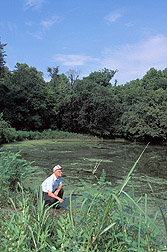 Agricultural engineer Jim Fouss observes an algal bloom on Alligator Bayou, near Baton Rouge, Louisiana. These blooms, a particular problem during hot summer months, can be caused by high concentrations of fertilizer nutrients from agricultural drainage waters. (K10015-1) |
Surprising Findings Below the Surface A few years ago, scientists with ARS' Soil and Water Research Unit (SWRU) in Baton Rouge, Louisiana, decided to compare the two drainage approaches and determine which is the better management practice for the region. "We hypothesized that installing subsurface drainage on farms in the Lower Mississippi River Valley would reduce pollution and improve the productivity of the land," says agricultural engineer Jim Fouss, SWRU's research leader. "The drains would act like sump pumps and help get rainwater into the soil, reducing fertilizer and pesticide runoff to ditches and streams." Fouss and soil scientist Brandon Grigg tested this hypothesis by examining data they collected from 16 research plots at Louisiana State University's Ben Hur Research Farm over the course of 6 years, beginning in 1995. They grew corn on the 0.2-hectare (about one-half acre) plots and followed recommended tillage, fertilization, and pesticide application practices. In 12 of the plots, they installed drainpipes 4 feet below the soil surface, a common drainage depth. The other four plots remained drainpipe-free, and all plots were graded to provide surface drainage. What the scientists discovered surprised them. Underground drainage did not significantly reduce the amount of water that ran off the surface of the soil at any time during the study. During years with normal rainfall, it did not significantly affect corn yield or the amount of soluble nutrients lost from the field in surface runoff, either. |
 Deep-chiseling fine-textured soils after harvest can increase rainfall infiltration and decrease surface runoff and nutrient loss. Here, Keith Whitehead, farm manager at Louisiana State University's Central Agricultural Experiment Station, deep-chisels a field in the high-rainfall region. (K10019-1) |
During drought conditions, however—which existed in the test area from 1998 through 2000—underground drainage increased the total amount of nitrate lost from the soil threefold. Much of this nitrate loss took place late in the year, after the corn had been harvested. The Soil Factor The alluvial soil profile of the Mississippi Delta region is quite different from soils typical of the humid Midwest. "In most areas," says Grigg, "porous soil forms the surface layer, and less permeable soil lies underneath. But in the Lower Mississippi River Valley, the top 8 inches of earth is very fine, made up of river sediment." This fine soil sits on top and acts like a barrier, slowing down water infiltration. The barrier effect explains why subsurface drainage did not reduce the amount of surface runoff and why Grigg's and Fouss's results were the opposite of what they expected. "An earlier study on subsurface drainage had been done in this region," says Fouss. "The researcher found that the fields with subsurface drainage had less surface runoff and nitrogen loss, something our experiment didn't support. What we didn't take into account—and what the other researcher hadn't emphasized—was that he had deep-chiseled the soil before planting." |
 At the Ben Hur Water Quality Site at LSU Central Agricultural Station in Baton Rouge, Louisiana, Jim Fouss and soil scientist Brandon Grigg collect runoff water samples for nutrient analysis back at the laboratory. (K10022-1) |
To deep-chisel a field, a farmer attaches a short, angled shank to a tractor tool-bar and pulls it down the rows, breaking up just the top layer of soil. Deep-chiseling used to be a common practice in the region, but farmers have moved away from it because they didn't see any economic benefits and because minimum-tillage production has been widely adopted during the past decade. The absence of deep-chiseling may explain why subsurface drainage didn't reduce surface runoff. But it doesn't account for why the plots with subsurface drainage lost so much nitrate during the drought. Grigg explains the phenomenon. "Between 1998 and 2000, the soil was so dry that when it did occasionally rain, the water that didn't run off the surface passed right through the dry and cracked soil, picking up soluble nitrate and carrying it into the drainpipes." In these plots, nitrate was washed out in concentrations of up to 200 parts per million—10 times greater than the level expected. |
 Technician Katherine Davis analyzes drainage water samples for fertilizer- nutrient content with an ion chromatograph. (K10023-1) |
Reducing the Dead Zone Nitrate-nitrogen is a major contributor to the hypoxic zone in the Gulf of Mexico. It is washed from fields to drainage ditches to streams, which feed into rivers and, ultimately, the Gulf of Mexico. Just as it helps crops grow on land, the nutrient also helps algae grow in water. Unfortunately, when the algae start to die and decompose, the oxygen in the water is depleted, creating an area that can't support most marine life. When Fouss and Grigg looked at the data from their 1995-2001 study and saw how much nitrate was being leached from the soil, they realized just how important it is to manage drainage systems carefully. They began designing a new experiment, focusing on how to reduce the amount of nitrate lost through subsurface systems. The scope of their work expanded from the Lower Mississippi River Valley to the entire humid region of the United States. Fouss and Grigg understood that although subsurface drainage may not be necessary in the Lower Mississippi River Valley, it is an essential tool for many farmers in other areas of the country. Without it, huge tracts of farmland would have widely fluctuating water tables and would not be nearly as productive. With their new study, they hope to collect data that can be used to improve the design of future drainage systems or retrofit existing ones, especially in the Midwest where much of the Gulf of Mexico's nitrate-nitrogen problem originates. |
|
|
They are including elements in their experiment proposed by Wayne Skaggs, a distinguished professor at North Carolina State University and 2002 president of the American Society of Agricultural Engineers (ASAE). During a presentation at the 1999 ASAE annual meeting, Skaggs proposed that nitrogen losses from drained agricultural lands could be substantially reduced by using shallow drains, narrowly spaced, instead of deeper, more widely spaced drains. He based this proposal on the results of a computer modeling study in which drainage discharge and nitrate losses from drains at various depths were simulated. In the model, shallower drainage raised the average level of the water table, lowering soil nitrogen content by promoting denitrification. This reduces the potential for nitrogen loss in drainage water. "Agricultural profits are reduced somewhat with the shallow drains because you have to put more pipe in," says Skaggs. But the cost of removing nitrogen from drainage water may make the installation of shallow drains the more profitable choice for farmers in the future. This is an important consideration, since state and federal agencies are increasingly regulating the total maximum daily load of nitrate that farms may release into the environment. Farmers must also consider the Farm Security and Rural Investment Act of 2002. Once it is implemented, USDA will be able to provide cost sharing to farmers who follow certain land-management practices that improve water quality. Accordingly, the cost of installing environmentally friendly drainage could be further reduced. Currently, Skaggs is running two experiments with subsurface drainage at depths ranging from 30 to 60 inches. In the coming year, Fouss and Grigg will run an experiment with three types of drainage: surface drainage only, shallow-installed drainage, and deep-installed drainage retrofitted with water-control structures. This third type, called controlled drainage, allows the grower to set the drainage outlet at any level between the ground surface and the drainpipe. For example, with controlled drainage set at 25 inches, the drainpipe could be 47 inches deep, but no water would drain from it until the water table climbed to a depth shallower than 25 inches. Fouss and Grigg plan on deep-chiseling all three treatment sites so their soils behave more like those in other humid agricultural regions. They will also monitor a fourth treatment area that will have controlled drainage but will not be deep-chiseled before planting. They will use this as a control to further evaluate how deep-chisel plowing affects surface runoff and nutrient movement in the Lower Mississippi River Valley. Dale Bucks, head of ARS' national program for Water Quality and Water Management, says that during this new experiment the scientists "should expect to see a substantial reduction in nitrate losses from deep-chiseled plots with controlled drainage. Skaggs and other researchers in North Carolina and Ohio have shown a 30- to 40-percent reduction in nitrate losses from subsurface drainage systems with controlled outlets. But since controlled drainage isn't appropriate for many sloping or rolling lands, it'll be interesting to see whether shallow drainage can match these results in field trials." The Sooner, the Better Although this would be an important topic of study at any time, Fouss and Grigg have an added incentive to test different drainage options. Fouss explains: "Subsurface drainage is normally assumed to have a life span of about 40 years, and much of what's currently in place in the Midwest was installed in the 1950s and 1960s. Pretty soon, a lot of farmers are going to need to replace what they have with something that's both agriculturally and environmentally sound. This study and others like it will help them decide what that approach should be." During their research, Fouss and Grigg will cooperate with Skaggs, as well as with researchers at ARS' Soil and Water Quality Research Unit (SWQRU) in Ames, Iowa, and at the Soil Drainage Research Unit (SDRU) in Columbus, Ohio. Skaggs is looking forward to the results. "We have a great deal of information about how subsurface drainage affects agricultural productivity," he says. "Now we need to consider environmental factors. The more data we can gather, the better." Norm Fausey, SDRU's research leader, agrees. Fausey is currently studying how different levels of controlled drainage affect the amount of nutrients lost from the soil. He says that the research Fouss and Grigg have planned in Baton Rouge will be important to the entire humid region. "They're doing direct comparisons of shallow and controlled drainage and their effect on nutrient loss. We have very little data on this issue, and it affects farmers all the way up the Mississippi and east to Maine and Florida." Like Fouss and Grigg, Dan Jaynes, SWQRU's research leader, is studying ways to manipulate subsurface drainage to reduce nitrate losses. "Of course," he says, "we will continue to study and advocate specific management practices that reduce the amount of nitrate lost from the soil, such as soybean/corn crop rotation and efficient fertilizer application. But these practices alone will not solve the problem. Subsurface drainage is the primary source of nitrate runoff in the Midwest. We must find ways to either keep the nitrogen in the field or denitrify the water before it drains into streams and rivers." Bucks says, "One of our best chances for reducing nitrate pollution in our streams, rivers, and the Gulf is by improving our surface and subsurface drainage systems. We must invest in this research." Current experiments will take at least 3 more years.—By Amy Spillman, Agricultural Research Service Information Staff. This research is part of Water Quality and Management, an ARS National Program (#201) described on the World Wide Web at http://www.nps.ars.usda.gov. Jim Fouss and Brandon Grigg are in the USDA-ARS Soil and Water Research Unit, 4115 Gourrier Ave., Baton Rouge, LA 70808-4499; phone (225) 578-0743 [Fouss], (225) 578-0746 [Grigg], fax (225) 757-7728. |
|
"Draining the Land Without Polluting the Waters" was published in the October 2002 issue of Agricultural Research magazine. |

