
United States Department of Agriculture
AgResearch Magazine


A Storybook Future for Lesquerella?
|
|

Like Cinderella, a hardy native plant called lesquerella may soon fit into the glass slipper of success. Agricultural Research Service scientists who are studying this wild, yellow-flowered member of the mustard family want to turn lesquerella into the "Princess of New Crops."
In Phoenix, Arizona, ARS researchers are breeding new and improved lesquerella plants to meet the needs of growers and processors. They're also using techniques of modern biotechnology to explore the plant's genetic makeup.
This work should simplify breeding of faster growing, higher yielding lesquerella plants—not only for the arid Southwest, but for other regions of the country as well. And at Peoria, Illinois, ARS investigators are finding new uses and markets for every part of the plant: oil, gum, and meal.
Known to scientists as Lesquerella fendleri, the plant is native to Arizona, New Mexico, Colorado, Utah, Texas, and Mexico.
Lesquerella's "Cinderella story" began several decades ago, when ARS chemists at Peoria were the first to show that oil from its seeds could become a new, domestic alternative to castor oil—today imported from India, Brazil, The Netherlands, the United Kingdom, and Indonesia.
Robert Kleiman (retired) and Kenneth D. Carlson (deceased) identified three compounds, known as hydroxy fatty acids, in lesquerella seed oil. All three acids—lesquerolic, densipolic, and auricolic—are similar to ricinoleic acid, the main fatty acid in castor oil. Castor oil is required in high-quality lubricants for racing cars and heavy equipment. It is also used in coatings, plastics, paints, lipstick, shampoo, and other products.
|
|
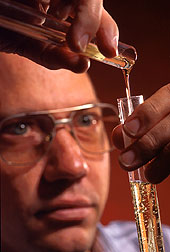
Peoria research showed that lesquerella oil could be superior to castor oil for some uses. But the red-to-brown color of lesquerella oil has been one of the key obstacles to its commercialization. For many end products—particularly cosmetics—the pigment has to be removed, adding to processing costs.
To sidestep that problem, plant geneticists David A. Dierig and Terry A. Coffelt at ARS' U.S. Water Conservation Laboratory in Phoenix, Arizona, developed lesquerella that yields yellow-coated seeds with significantly less of the troublesome pigments. The scientists made seeds available to other plant breeders for the first time in 1997.
Says Dierig, "This is only the second time that lesquerella breeding material has been released to the public. The first release, also from our lab, was made 3 years ago when we offered seed of lesquerellas that had 2 percent more oil than others that we tested." Now Dierig is readying a new lesquerella with even higher oil content, as well as plants with a high hydroxy fatty acid content and increased salt tolerance. In lab and greenhouse experiments, the Phoenix scientists have also succeeded in producing healthy offspring from species of other lesquerella parents that, until now, apparently had not been successfully paired with L. fendleri. This pioneering work opens the door to producing unique hybrids that boast the best characteristics of each parent.
Biotech tactics should also hasten breeding of superb lesquerellas for the future. Phoenix experiments led by Benjamin Kaufman, who is now with Centre Analytical Laboratories in Pennsylvania, targeted lesquerella genes that confer a prized trait: male sterility. This trait ensures that only top-quality plants—those specially selected by breeders—can produce the viable pollen needed to yield outstanding offspring. Kaufman pinpointed several genes, known as markers, that may indicate the presence of the valuable male-sterility genes.
Lots of New Product Potential
ARS scientists with the National Center for Agricultural Utilization Research in Peoria have shown industry what can be made from the plant.
"We know of no other crop that is valued for both its oil and its gum," says Thomas F. Abbott, leader of the New Crops Research Unit in Peoria. Abbott and other Peoria researchers hold a patent on lesquerella gum and the methods for preparing it. ARS chemical engineer Ronald A. Holser and chemist Abbott are exploring new uses for the gums.
|
|
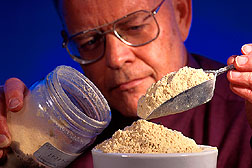
Xanthan gum, another product of Peoria research, is widely used as a thickener in products ranging from salad oil to ice cream. "We don't know yet," says Holser, "how a similar product made with lesquerella gum would perform."
In preliminary tests, however, adding small amounts of lesquerella gums to cornstarch, then forcing these ingredients through a nozzle in a process known as jet-cooking, yielded a compound that was different than either the gum or the cornstarch alone.
"Lesquerella gum," notes Abbott, "might also add texture to processed frozen foods." Holser and Abbott tested the gum's performance by freezing and thawing samples more than a half-dozen times. Says Abbott, "These tests showed that the gum can withstand freeze-thaw cycling without breaking down."
"The gum," Holser adds, "also has potential as a thickener in industrial products such as paints and drilling fluids."
Holser has investigated the costs of extracting the gums from either whole-seed meal, defatted whole-seed meal, or defatted hulls. "The most efficient way to recover the gums," says Holser, "appears to be from the whole-seed meal. This route requires the least amount of additional processing and equipment."
"The lesquerella meal that's left over after the gums have been removed has 30 to 35 percent protein, so it could be used as a protein supplement in livestock rations," says Abbott.
"Initially, however, we expect that the meal will be used—with the gum still in it—as a binder or a gluelike compound needed for products such as feed pellets. Lesquerella meal may be ideal for this market."—By Marcia Wood and Linda McGraw, Agricultural Research Service Information Staff.
This research is part of New Uses, Quality, and Marketability of Plant and Animal Products, an ARS national program (#306) described on the World Wide Web at http://www.nps.ars. usda.gov/programs/cppvs.htm.
David A. Dierig and Terry A. Coffelt are with the USDA-ARS U.S. Water Conservation Laboratory, 4331 E. Broadway, Phoenix, AZ 85040; phone (602) 379-4356, fax (602) 379-4355.
Thomas P. Abbott and Ronald A. Holser are in the USDA-ARS New Crops Research Unit, National Center for Agricultural Utilization Research, 1815 N. University St., Peoria, IL 61604; phone (309) 681-6533, fax (309) 681-6524.
"A Storybook Future for Lesquerella?" was published in the November 1999 issue of Agricultural Research magazine.
