
United States Department of Agriculture
AgResearch Magazine


Irradiation Helps Keep Meat Safe
|
|

The naked eye can't see them, but millions can exist on the head of a pin. They can make you very sick, and some can even be lethal.
These are the microbial agents that cause foodborne diseases.
Economists with USDA's Economic Research Service estimate that costs associated with foodborne illnesses ranged from $6 billion to $9 billion in 1993. This included medical and lost productivity costs.
But at the Eastern Regional Research Center (ERRC) in Philadelphia, ARS scientists are battling these disturbing statistics with hard work and hard science. Researchers in the ERRC's Food Safely and Microbial Food Safety Units are using irradiation and natural flavoring agents to kill Escherichia coli and other microbial food pathogens.
"It used to be that we just kept food at the appropriate hot or cold temperature to keep it safe. However, we now know that some harmful organisms can thrive in cold and in heat," explains Donald W. Thayer.
In charge of the Food Safety Unit, ARS microbiologist Thayer has built a career on ensuring the safety of fresh and frozen meat.
With ERRC chemists Jay B. Fox, Jr., and Leon Lakritz, Thayer has shown that ionizing radiation in the form of gamma rays can reduce—and in some cases eliminate—many foodborne pathogens, to extend the shelf life of meats.
The appearance of E. coli O157:H7 in the Northwest in 1993 brought Thayer's work to the forefront. That outbreak killed four people and sickened about 250 others who had eaten undercooked beef.
Earlier research by Thayer's group provided, in part, the basis for obtaining approval from USDA's Food Safety and Inspection Service and the U.S. Food and Drug Administration (FDA) to use irradiation to kill pathogens in poultry.
"We treated beef with the same level of radiation authorized for poultry and found that it eliminated 99.90 percent of E. coli O157:H7 in frozen meat and 99.99 percent in fresh meat," Thayer says.
The approved treatment for poultry is a minimum of 1.5 kiloGrays (kGy). The amount of energy absorbed as radiation beams pass through food in processing is measured in units called Grays. It takes 1,000 Grays to make 1 kiloGray.
E. coil O157:H7 is a deadly new strain of a bacterium commonly found in nature, particularly in the intestinal tract. This pathogen, which is sometimes present in undercooked and raw beef—especially hamburger—can cause bloody diarrhea, kidney failure, and death. It can also be found in undercooked and raw lamb, pork, and poultry. E. coli O157:H7 releases a toxin that enters the kidneys and intestines, shutting down body functions.
There is no way to tell visually if beef, or any other meat, is infected with E. coli, Thayer says. And because the bacterium is so common, contamination can occur through handling or processing, even under the best of conditions.
Thayer mixed lean ground beef with 100,000 cells of E. coli per gram of meat and irradiated the samples with dosages up to 3.0 kGy, the maximum allowed. He then stored them at 95° F overnight.
At this temperature, the E. coli should have multiplied. None survived—not even those treated at 1.5 kGy. Tests also showed that 90 percent of this pathogen was killed in fresh beef irradiated with 0.27 kGy at 41° F and in frozen beef using 0.42 kGy at 23° F.
|
|
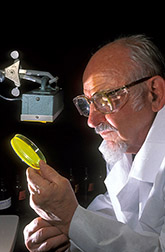
"Our research has shown that irradiation eliminates this pathogen without leaving any residue or affecting the taste or quality of the meat," Thayer says.
"But an important point to remember is that irradiation doesn't preclude the need for other safe practices like proper processing, refrigeration, handling, and cooking."
What Happens Nutritionally?
One concern that is raised about irradiation, Thayer says, is its effect on critical nutrients. Colleagues Fox and Lakritz have some answers to this question.
Fox tested the effects of gamma radiation doses up to 6.65 kGy on thiamin (vitamin B1), niacin, and riboflavin (B2) content of chicken breasts and on thiamin, niacin, pyridoxine (B6), and cobalamin (B12) content of pork chops. Significant losses were apparent only in thiamin, with the rate of loss in chicken only about half that in pork.
These losses were not deemed nutritionally significant because "we don't eat meal primarily for its vitamin content" Lakritz says, "and cooking can cause greater vitamin loss than irradiation.
"Vitamins B1 and E are very sensitive to radiation and may be detected at very low levels," he adds. "They are therefore good indicators of effects of radiation."
According to Thayer, "Since it looks and smells the same, in most cases, one can't tell the difference between meat that has been irradiated and meat that hasn't. Maybe a trained taste panelist could detect a slight taste difference, but that could also be a positive, rather than a negative, difference."
In the March 8, 1995, Federal Register, FDA reported that "radiation-sterilized meats will be at least as nutritious as those sterilized by conventional means."
Because federal law treats the irradiation process as a food additive, irradiation falls under FDA jurisdiction.
Based in part on Thayer's research, FDA approved use of irradiation to control Salmonella and other foodborne bacteria in raw chicken, turkey, and other poultry in May 1990. And partly as a result of Thayer's work with E. coli, a petition to FDA for approval to use irradiation to control contaminants on red meat was made by Isomedix, Inc., of Whippany, New Jersey.
Irradiated poultry is now available in several grocery stores in Miami and Chicago and is also being supplied by a large food-service chain to hospitals and nursing homes.
Health and safety authorities in 37 countries have approved irradiation of 40 different foods—spices, grains, deboned chicken meat, fruits, and vegetables. Commercial food irradiation is being done in 24 countries.
Changes in Foods Are Similar to Cooking
Another concern often voiced about irradiated food is that new compounds could be formed within the products as a result of the irradiation process.
"Again, I'll use the example of cooking, canning, or other commercial food processing. It is common knowledge that these processes also cause chemical changes in food. The changes that occur in irradiated meat are no different," Thayer explains.
The only difference, he says, is that in irradiated food, these changes are called "radiolytic products," because they result from radiation.
Referring to foods irradiated for the space program, FDA states in the March 8 Federal Register that the total amount of radiolytic products or changes produced in meats during the irradiation process is too small to be of any toxicological—or human health—significance.
In repeated tests of 40 generations of 2,000 mice that were fed diets of food irradiated at 50 kGy, no adverse effect was found. Past human feeding trials in China, where up to 71 percent of participants' diets consisted of irradiated food for 15 weeks, showed the food to be well received and to cause no ill effects.
"The United States has been doing research on food irradiation since the early part of the century," says Thayer, "though the majority has been completed since World War II." Astronauts have used irradiated food for many years.
"We're confident," he says, "that irradiation can drastically reduce the number of deaths and illnesses caused by foodborne pathogens."
|
|
Other Routes Toward Microbial Suppression
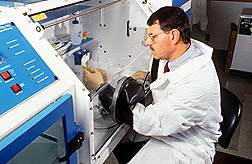
In addition to irradiation, Thayer's group is also working to develop an electronic probe that could be used at the packinghouse to detect the presence of E. coli bacteria and other pathogens as well.
"This is a fairly simple, small device that a meat inspector could use to determine within 20 minutes whether or not E. coli or other harmful organisms were present," explains chemist Jeffrey D. Brewster.
Microbiologists Arthur Miller and Bobby Bowles in the ERRC Microbial Food Safety Research Unit have taken a different approach to fighting foodborne pathogens.
Under Miller's leadership, Bowles tested the effusiveness of natural flavoring agents against E. coli, Clostridium botulinum, and Staphylococcus aureus—all bacteria that may be of concern in processed poultry and red meat products.
"We found that purified extracts of vanilla, cinnamon, almond, and pepper that contain compounds like benzaldehyde, which is also found in peaches, inhibited the growth of these bacteria," Miller says. An application has been filed to patent these compounds as antimicrobial agents.
The two scientists also tested extracts from asparagus, carrots, radishes, shallots, and turnips—and mixtures of these extracts—against several food pathogens.
"We got the best results with benzaldehyde, the simplest aromatic compound tested," Miller says. "These compounds, in combination with heat, slow down or stop the growth of bacterial cells."
Used as antimicrobial sprays or dips, the natural compounds could reduce the thermal processing requirement in processing plants or packinghouses.
"Poultry, pork, and beef processing plants could use these compounds to increase the microbiological safety and shelf life of their products," says Miller.
Canned foods must now be cooked at temperatures high enough to kill bacterial spores, giving them a mushy consistency. These new compounds could lessen the amount of time processed foods would need to be cooked, thereby increasing their quality.
Miller says that the problem of foodborne pathogens has been magnified by the proliferation of prepared refrigerated foods that require minimum home cooking.
The packaging conditions, minimal thermal treatments, and extended shelf life of such products raise more concerns about contamination by pathogenic bacteria. These product features increase the importance of finding new ways to ensure food safety and make the research on natural protective compounds even more significant.
— By Doris Stanley, ARS.
Jeffrey D Brewster is in the USDA-ARS Microbial Biophysics and Residue Chemistry Research Unit, Eastern Regional Research Center, 600 East Mermaid Lane, Philadelphia, PA 19038-8598; phone (215) 233-6447, fax (215) 233-6581.
"Irradiation Helps Keep Meat Safe" was published in the November 1995 issue of Agricultural Research magazine.
