
United States Department of Agriculture
AgResearch Magazine


A Curator Minds His Peas
|
|
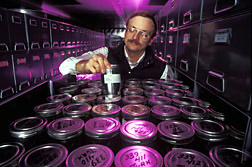
There are nearly 3,000 different kinds in the national collection.
Charles J. Simon was a typical, teenage boy—cars were his life. When he graduated from high school in Sturgeon Bay, Wisconsin, he planned a career teaching auto mechanics.
That is, until he look a summer job working with the Agricultural Research Service. Now, 18 years later, Simon is the curator of the ARS national pea collection in Pullman, Washington.
Simon has big plans for these legumes. He's separating out, or isolating, the genetic material of the almost 3,000 different kinds of peas in his care. He'll use the isolated DNA to identify whether there have been any undesirable genetic changes in the pea collection, speed up the selection of new varieties, and encourage additional research on peas.
"Lots of people are isolating DNA. Our approach is unique because it involves an entire germplasm collection. And we're the first to formally distribute the DNA through an established system normally used for seeds," Simon says.
The pea collection is part of ARS' National Plant Germplasm System. Germplasm is living tissue that can be grown into a plant; for peas, this means seeds. The system saves and distributes germplasm to researchers and plant breeders.
Simon receives peas from all over the world to add to the collection. Each entry is given an accession number for identification. An accession may have only one type of pea, such as a specific cultivar, so each individual in the accession is genetically similar.
A different accession may be very diverse and contain several sizes and colors of peas.
As curator, Simon's goal is to make sure that each accession retains its generic diversity.
This diversity is important, because one type of pea may grow better than another in cold climates, resist different diseases, or have a more appealing color.
"My job is like that of a museum curator. If I'm showing the Mona Lisa, it's my job to maintain the painting as it is, not to add a mustache. We want to make sure we don't put any mustaches on our accessions," he says.
But Simon says the pea collection may have lost some of its diversity because many of the peas were once infected with pea seedborne mosaic virus. "In the process of eliminating the virus, we may have inadvertently discarded some unique genetic material in some of the accessions."
Simon will use the isolated DNA to find out.
Using a process called randomly amplified polymorphic DNA (RAPD), Simon can gel something similar to genetic fingerprints for each plant. [For more on genetic fingerprinting, see "DNA Sequencing Is New Tool for Insect Detectives," Agricultural Research, Feb. 1995, pp.12-18.]
After growing the seeds into plants, he'll compare fingerprints of the virus-free plants with plants grown from backup samples of the original group of seeds.
|
|
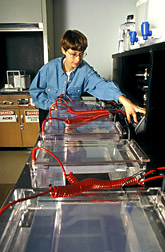
"If we find that some fingerprints were lost, we can redo the virus eradication with special attention to keeping the lost plants," he says.
The DNA could also help plant breeders develop new pea varieties.
Traditionally, breeders select varieties by crossing two plants with desired characteristics—say, one with a large pea size and one with a deep-green color—until they get progeny incorporating both.
Some traits are easy to select this way. Others, like disease resistance, could benefit from using the isolated DNA.
"We might have five peas that resist a certain disease but aren't valuable as cultivars for other reasons. If a breeder wants that disease resistance, we can compare the RAPD fingerprints of the five peas to look for similarities," says Simon.
"From that, we can develop a molecular marker for that disease resistance and then look for that marker in the rest of the collection. Peas with the marker might also resist the disease. Then breeders can pick the best resistant pea type to develop into a new variety."
"Disease-resistance characteristics are difficult to select inside the greenhouse," says David Webster, project leader for peas and dry beans, who is with Asgrow Seed Company in Twin Falls, Idaho. "Markers would be very valuable."
Especially useful, says Webster, is a special group of peas now at Pullman, called the Marx Genetic Stocks Collection.
Gerald A. Marx, a Cornell University scientist who died in 1988, left to ARS a collection of 80,000 packets of seeds. He had labeled each packet according to hundreds of different genetic characteristics, such as flower color, pea size, and leaf shape.
"He was this country's—and perhaps the world's—best pea geneticist," says Simon, who had a neighboring office at Cornell during his graduate studies.
Simon plans to isolate and make available the DNA from the Marx collection as well.
"When I look at DNA, I'm looking right at the genes. When Marx looked at the plants, he was looking at how the genes were manifested. These are two different and complementary ways to look at pea diversity.
"As curator," says Simon, "I want to see people use the collection. Genetics researchers may decide to study peas rather than other plants because the DNA is already available in a convenient form."
Simon says his switch from grease monkey to gene banker was not as strange as it might sound.
He needed a job to fill the summer between high school and college. His older brother Philipp W. Simon was already studying genetics at the University of Wisconsin. Phil suggested he talk to Robert E. Hanneman, Jr., who was project leader of the ARS potato germplasm collection then called IR-1 and now known as NSRP-6, in Sturgeon Bay. The elder Simon had spent his summers during college working with IR-1's potatoes. He later joined ARS and now leads the Vegetable Crops Research Unit in Madison [see p. 13].
"One of my first assignments was to help a couple of graduate students with their genetics research. We'd go out and eat pizza, and I'd listen to them talk about how genes worked in potatoes. They were excited," the younger Simon says.
"I like car engines because there's an elegance in how everything works together towards a purpose. Listening to engines, I realized that plants also have that elegance," he says.
After a semester, he changed his college major from industrial education to biology. He worked at Sturgeon Bay during the summers and at Hanneman's laboratory in Madison during the school year.
Simon went on to get graduate degrees in molecular biology. Then a postdoctoral position in Pullman—working with chickpeas—brought him back to ARS in 1989. He was hired as curator for the pea collection in 1993, shortly after the collection was moved from Geneva, New York, to Pullman.
"Sometimes we change people's lives as well as affect science," says Hanneman. "I was tickled to see Charles take a role in the ARS germplasm system."
And Simon hopes he can interest other students in a scientific career.
"I feel really lucky to have met people excited about science. Had that not happened to me, I'd be off on another career somewhere."
— By Kathryn Barry Stelljes, ARS.
Charles J. Simon is at the USDA-ARS Plant Genetic Resources Unit, 630 West North Street, Geneva, NY 14456; phone (315) 787-2244, fax (315) 787-2339.
USDA-ARS Western Regional Plant Introduction Station, Washington State University, Pullman, WA 99164; phone (509) 335-3683, fax (509) 335-6654.
"A Curator Minds His Peas" was published in the November 1995 issue of Agricultural Research magazine.
