United States Department of Agriculture
AgResearch Magazine


New Fungal Strain Spells Trouble for Caterpillar Pests
|
||
|
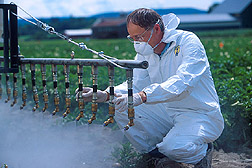
The future of environmentally friendly crop insecticides could be brightened by the discovery of a more effective fungus from which to make mycoinsecticides. Mycoinsecticides are fungal sprays that work on insect pests from the inside out. Fungal spores attach to an insect's cuticle, germinate, and then penetrate its body. Spores from dead insects can survive to infect later pest generations.
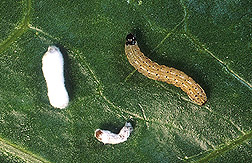
A new strain of theBeauveria bassiana fungus known as BB-1200 appears to be even more effective in curbing lepidopteran—or caterpillar—pests than its close relative, the commercially available GHA strain. In laboratory bioassays, BB-1200 consistently exhibited virulence equal to or greater than the GHA strain against all lepidopteran pests tested, including fall armyworm, beet armyworm, black cutworm, corn borer, and cabbage looper—pests that are not highly susceptible to the GHA strain, according to ARS ecologist Stephen P. Wraight. "These lepidopteran defoliators are among the most destructive insect pests of important crops like corn and cabbage and other vegetables. Each year, they cause billions of dollars in losses," says ARS entomologist John D. Vandenberg. |
|
|
Cooperation Leads to Success
While the GHA strain ofB. bassiana is effective against some lepidopteran pests—including diamondback moth—in the field, vegetable crop damage typically results from the feeding activities of several caterpillar pest species. Manufacturers of conventional pesticides, however, are often reluctant to research new controls for these pests because their hosts are considered to be minor crops and therefore offer limited market potential. It was through a cooperative research and development agreement between ARS and Mycotech Corporation of Butte, Montana, that spores ofBeauveria strain GHA came to be incorporated in two commercial biocontrol products: Mycotrol and BotaniGard. These products grew out of joint efforts to exploit aBeauveria strain first discovered by Vandenberg over two decades ago. Now with ARS at the U.S. Plant, Soil, and Nutrition Laboratory at Ithaca, New York, Vandenberg collected the GHA strain while he was a graduate student at Oregon State University—Corvallis in 1977. Originally isolated from a chrysomelid beetle, the GHA strain was tested extensively against grasshoppers and whiteflies before its commercial development and patenting by Mycotech. |
|
|
The commercial products Mycotrol and BotaniGard are registered for use in the United States, Mexico, and other countries for biological control of grasshoppers, whiteflies, aphids, thrips, and diamondback moths. They can be used on many important agricultural crops, such as cabbage, broccoli, cucumbers, and greenhouse ornamentals.
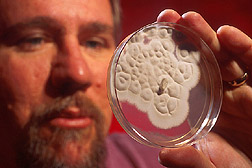
"The fungus used in the Mycotrol and BotaniGard products could be said to originate here at Ithaca," says Wraight. That's because Mycotech scientists discovered the commercial pest-control potential of the GHA strain after screening many other strains selected from the ARS Collection of Entomopathogenic Fungal Cultures (ARSEF) in Ithaca. The GHA strain originated from Vandenberg's culture, originally deposited as ARSEF-201. Curated by ARS microbiologist Richard A. Humber, the Ithaca collection includes about 6,200 cultures of fungi. Specimens are stored at very low temperatures in liquid nitrogen, and many have undiscovered insect biocontrol properties, Humber says. The Search for a Better Fungus "After the discovery of ARSEF-201, the search intensified for a more highly virulent, broad-spectrum mycoinsecticide effective against a large group of lepidopteran pests," says Wraight. Since the registration of Mycotrol in 1995, its use in the United States has been largely limited to greenhouse production. Larger markets have been slow to develop, but vegetable production is one area in which demand for mycoinsecticides is strong. That's partly because of recent passage of the Food Quality Protection Act, which regulates insecticide use on certain food crops. During 1998 and early 1999, ARS scientists at Ithaca tested about 50 strains ofB. bassiana and several ofPaecilomyces fumosoroseus—selected from the extensive culture collections of ARS and Mycotech—against the diamondback moth, fall armyworm, European corn borer, and corn earworm. They also tested promising strains against the beet armyworm, black cutworm, cabbage looper, and imported cabbageworm. "Many of these strains came from the ARSEF collection, which is a veritable treasure trove of untapped potential biocontrol fungi," says Wraight. "But we found no single strain with acceptable mass-production characteristics that was also highly virulent against more than three pest species." Better Than the Rest Then, in June 1999, Wraight and Vandenberg, who head up the ARS fungal-screening program at Ithaca, discovered the high virulence and exceptionally broad lepidopteran host range of the BB-1200 strain. "Mycotech had received this new isolate—originally taken from a diamondback moth—from a collaborator and passed it on to the ARS fungal-screening program for routine study as part of our long-standing cooperative agreement," says Wraight. Laboratory testing of the BB-1200 strain is continuing at Ithaca, to further characterize its host range and virulence and to determine its potential for use as a biological control agent in the United States, says Wraight. Field and greenhouse experiments are planned that will compare effectiveness of exposing moths either to direct sprays of fungal spores or to spores sprayed on plant foliage. Meanwhile, researchers at Mycotech are investigating industrial-scale mass production and shelf life of the new fungal strain. Other Mycotech collaborators are assessing its efficacy against thrips, whiteflies, and other major insect pests. Mycotech has applied to the appropriate regulatory agencies to request permits for limited field testing in the United States. Preliminary field evaluations against armyworms and diamondback moths are under way in Mexico and Guatemala. Results of these studies will determine whether further commercial development is warranted. The Ithaca lab's role in future development efforts will focus both on field testing of new BB-1200 formulations and on laboratory studies to discover reasons for BB-1200's high level of potency against lepidopteran pests. If successful, this collaboration could lead to registration, production, and use of one or more new mycoinsecticides to control lepidopteran pests and better protect the nation's vegetable crops.—By Hank Becker, Agricultural Research Service Information Staff. This research is part of Plant, Microbial, and Insect Genetic Resources, Genomics, and Genetic Improvement, an ARS National Program (# 301) described on the World Wide Web at http://www.nps.ars.usda.gov. Stephen P. Wraight, John D. Vandenberg, and Richard A. Humber are with the USDA-ARS U.S. Plant, Soil, and Nutrition Laboratory, Tower Rd., Ithaca, NY 14853; phone (607) 255-2458, fax (607) 255-1132. |
|
|
"New Fungal Strain Spells Trouble for Caterpillar Pests" was published in the November 2000 issue of Agricultural Research magazine. |
||