
United States Department of Agriculture
AgResearch Magazine


Allergic to Rubber?
|
|
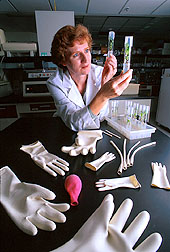
Scientists Probe Potential of Guayule Latex
Rubber from a native southwestern shrub called guayule (pronounced why-YOU-lee) may become a new source of high-quality, hypoallergenic latex for medical, industrial, and home products.
Scientists with the Agricultural Research Service at Albany, California, were the first to discover that the milky latex from this hardy plant is free of allergens that can cause severe reactions, such as anaphylactic shock or even death.
"An estimated 20 million Americans," says plant physiologist Katrina Cornish, "are allergic to the latex in gloves, catheters, condoms, or other products made from the most widely used source, the Brazilian rubber tree."
Cornish, with ARS at Albany, and agency colleagues in Phoenix, Arizona, explore new ways to make production of guayule latex practical, efficient, and profitable. The ARS experiments—some in cooperation with universities in California, Arizona, New Mexico, Texas, and Utah—address conventional breeding and genetic engineering of the plant, as well as its planting, cultivation, and harvesting. Other studies investigate techniques for extracting, storing, and processing the latex.
Composed of rubber particles in a water-based suspension, latex is a higher value product than solid rubber. This fact, plus the urgent need for hypoallergenic alternatives to conventional latex, has made guayule's latex—as opposed to its solid rubber—the focus of the ARS research.
Until this decade, most studies of guayule, Parthenium argentatum, dealt primarily with its rubber, which hasn't been produced commercially in this country since 1929.
Today's guayule plants are superior to those of the past, thanks to plant breeding by ARS and university scientists in Arizona. In 1997, these researchers offered growers seed from guayule plants selected for fast growth and high latex content.
ARS geneticists Terry A. Coffelt and David A. Dierig, who are at the U.S. Water Conservation Laboratory in Phoenix, are continuing the quest for even better guayule. They are screening thousands of candidate plants in greenhouses and outdoor plots. Their experiments also help breeders pinpoint whether environment or genetics is the dominant factor affecting growth rates and latex yields.
Biotech experiments by Cornish focus on genetically engineering guayule plants to boost their latex levels. "Guayule lines that we've tested," says Cornish, "contain up to 10 percent latex. Even a small increase in that latex level could mean a significant increase in potential profits for growers and processors."
Cornish, along with Christopher J.D. Mau and Mary H. Chapman at the Western Regional Research Center in Albany, and former Albany researcher Javier Castillón, developed a faster, easier way to move new genes into guayule tissue in the lab.
Their procedure, patterned after one used by scientists elsewhere with other plant species, relies on bathing pieces of leaves in a solution containing a reworked form of a microbe, Agrobacterium tumefaciens. The modified bacterium has the experimental genes inside and can slip them into guayule cells. The leaf pieces are nurtured to form shoots and, later, roots.
The team is apparently the first to use this approach successfully with guayule.
Says Mau, "With this technique, we get more genetically engineered guayule plants than with an earlier, more cumbersome procedure. That other approach required piercing plants with a very thin needle to make an entryway for the microbe."
Castillón and Cornish also produced a new, simplified procedure for successfully raising identical copiesor clonesof promising plants, using shoots snipped from the parent plant. They cultivate shoots in small containers filled with a nutrient-rich liquid and plugs—small, stubby rolls of a papery material that look something like miniature, tightly compressed rolls of paper towels. Later, they move the developing plantlet, with new roots anchoring it to the plug, directly into greenhouse pots.
This procedure, not yet reported by any other guayule researchers, causes little if any damage to guayule's young, fragile roots. An earlier technique was riskier: A plantlet had to be pried from a test tube and nutrient gel pulled from its roots before it could be transplanted to pots.
Plantlets raised with the Albany technique form roots as readily as those grown with the earlier procedure. And they adjust to the greenhouse in a few days instead of several weeks. Used successfully at Albany for more than 3 years, the new procedure has been adopted by a lab in South Africa. It is expected to be in use in a guayule display planned for next year at Disney's Epcot Center in Florida.
Estimating What You've Got
|
|
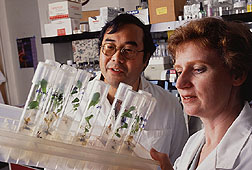
ARS scientists Francis S. Nakayama and Stephen H. Vinyard in Phoenix collaborated with Cornish, Chapman, and statistician Linda C. Whitehand at Albany to develop a simple, reliable procedure for estimating latex levels in guayule samples.
The basic approach requires cutting branches into half-inch-long pieces, grinding them for precise periods in a blender, and filtering the resulting liquid, or homogenate. The liquid is spun in a device called a microcentrifuge to separate the creamy latex from the rest of the slurry. Then the latex is coagulated, dried, and measured.
"We estimate," says Nakayama, "that we're extracting at least 90 percent of the latex in each specimen without having to use harsh solvents."
The researchers anticipate that it won't be practical for latex producers to always process guayule shrubs immediately after harvest. Earlier studies already showed that guayule rubber levels decrease in storage, but the Albany and Phoenix scientists were the first to track changes in latex levels from both stored shrubs and stored homogenate.
Medium-size branches—those about one-fourth- to one-half-inch in diameter—consistently had more extractable latex than smaller or larger branches tested throughout a 5-week period. Stored branches retained all of their latex for 2 weeks. But homogenates didn't begin to lose latex until the beginning of the fifth week, "meaning that homogenate is the best option for processors who need to store the harvest for more than 2 weeks," says Cornish.
"Up until that time," says Nakayama, "it is probably cheaper to store the crop as whole shrubs, provided they are not allowed to dry out. Further studies will give us more details about the cost advantages of the two storage options."—By Marcia Wood, Agricultural Research Service Information Staff.
This research is part of New Uses, Quality, and Marketability of Plant Products, an ARS National Program described on the World Wide Web at http://www.nps.ars.usda.gov/programs/cppvs.htm.
Katrina Cornish is in the USDA-ARS Crop Improvement and Utilization Research Unit, Western Regional Research Center, 800 Buchanan St., Albany, CA 94710; phone (510) 559-5950, fax (510) 559-5777.
Francis S. Nakayama is in the USDA-ARS Environmental and Plant Dynamics Research Unit, U.S. Water Conservation Laboratory, 4331 E. Broadway Rd., Phoenix, AZ 85040; phone (602) 379-4356, ext. 255, fax (602) 379-4355.
"Allergic to Rubber?" was published in the May 1999 issue of Agricultural Research magazine.
