
United States Department of Agriculture
AgResearch Magazine


Microwaves Zap Grain Pests
|
|
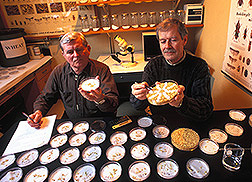
More than anything, Steven L. Halverson, a self-employed consulting engineer, would like to see the economy perk up in his hometown of Clinton (pop. 1,850) in south central Wisconsin. For now, he's doing his homework so that he can design and, in future years, manufacture a microwave applicator for killing insects in stored grain.
If successful, Halverson could eventually employ as many as 40 people to manufacture his specially designed applicators.
In the meantime, entomologists Wendell E. Burkholder and Rudy Plarre, who are in the ARS Stored Product Insects Research Unit at the University of Wisconsin in Madison, are helping Halverson gather basic research data needed to establish optimum frequencies and temperatures for microwaving grain weevils.
"This research could lead to an alternative to chemicals now used to control insect pests in stored grain and stored-grain products," says Burkholder.
Not only have insects developed resistance to chemicals, but the U.S. Environmental Protection Agency is banning a commonly used fumigant, methyl bromide, in 2001.
"We are demonstrating that high-power microwaves can efficiently and economically kill insects in stored grain," says Burkholder.
In preliminary studies done 2 years ago, Burkholder and Halverson eliminated 94 percent of maize weevils, Sitophilus zeamais, in samples of soft white wheat at a temperature of about 122° F. At 145° F, 100 percent of the insects were killed.
The weevils live as larvae inside grain kernels before they hatch into adults. Maize weevils infest wheat, barley, oats, and corn.
Halverson envisions that the practical application of this research technology will result in equipment that will apply microwave energy to the grain as it flows continuously from bucket elevators and into storage facilities.
"Insects contain more moisture than grain does. Microwave energy applied to the grain as it falls into storage kills the insects without cooking the grain or significantly reducing germination. It takes about 6 seconds for grain to flow through the applicator. The higher the energy level applied, the shorter the exposure time and length of the applicator," says Halverson.
With information gathered from the latest experiments done at the Oak Ridge National Laboratory in Oak Ridge, Tennessee, Halverson will begin designing the applicators. He is in the process of filing for a patent on his design.
Higher microwaving frequencies and power mean less time will be needed to kill insects, and that parlays into reduced energy costs. At today's energy prices, we can expect the cost of microwaving—including capital equipment, operating, and fixed costs—to be comparable to that of chemical treatment.
Halverson and colleagues plan to report these findings at the American Society of Agricultural Engineers international meeting in July 1996, to be held in Phoenix, Arizona.
Clinton is the home of the DeLong Company, Inc., grain storers and processors, which may be one of the first users of this technology. — By Linda Cooke, ARS.
"Microwaves Zap Grain Pests" was published in the May 1996 issue of Agricultural Research magazine.
