
United States Department of Agriculture
AgResearch Magazine


|
|
Reinventing Systematics
When it comes to savoring mushrooms, ants have a 23-million-year jump on humans.
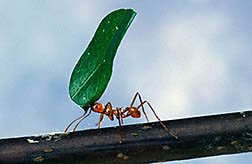
ARS scientists recently discovered that about 200 species of a fungus-farming ant group called attines have long cultivated a fungus related to the parasol mushroom prized by connoisseurs. Attines include the destructive leaf-cutter ants of Central America.
The fungus can do what the insects cannot: break down indigestible leaf pieces harvested by the leaf-cutting ants and turn them into absorbable nutrients. In turn, the ants provide the fungi with vegetable matter on which to grow, protect them from competing organisms, and propagate them by cloning, which allows the fungi to reproduce without sex.
"We found parallel patterns of genetic development between many ant species and their favorite fungi—evidence that the two have been coevolving for millions of years," says ARS mycologist Steve Rehner, a fungus expert.
He made the discovery with ARS mycologist Ignacio H. Chapela and scientists at Cornell University in Ithaca, New York.
Their fungus research answered a century-old mystery for mycologists. In relying on the ants for reproduction, the fungus had stopped making spores and, instead, had come to depend on the ants to propagate it. So it was impossible to determine the species or relationships of the ant-farmed fungus through traditional taxonomic means—analysis of its fruiting body—the mushroom cap where the spores are produced.
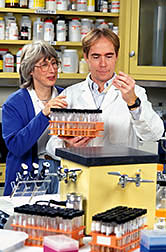
Instead, Rehner and Chapela took genetic samples from fungi isolated from the nests of 19 species of attine ants. Then they compared those genes with the DNA of free-living-fungi not tended by the ants.
|
|
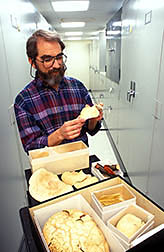
To identify the fungal species, they relied on specimens that Chapela had collected. These are now part of the 1 million specimens in the U.S. National Fungus Collections at ARS' Beltsville (Maryland) Agricultural Research Center.
200-Year-Old System Still Useful
Morphological characteristics, which rely on observable form and structure, have served systematists as the primary basis for classifying agriculturally important organisms for more than 200 years. "These will continue to provide the majority of systematic information, since they are easily and inexpensively obtained," says ARS mycologist Amy Rossman, who is in charge of the Systematic Botany and Mycology Laboratory.
But according to Rossman, "two new computer-based tools—DNA fingerprinting and expert systems—are now revolutionizing how systematists classify organisms, including our ability to accurately identify, catalog and characterize them."
DNA sequencing uses molecular characteristics to develop "fingerprints'" for genetic material found in all living organisms. This new technology can differentiate between organisms based on their genes, rather than their morphology. (See "DNA Sequencing Is New Tool for Insect Detectives," Agricultural Research, Feb. 1995, pp.12-18.)
"For the first time, this powerful tool makes it possible to distinguish between so-called cryptic species that appear identical," says Douglass R. Miller, who works in the ARS Systematic Entomology Laboratory in Beltsville, "DNA fingerprinting can prove if two visually similar species are related, different, or new."
Rehner adds, "Until now, precisely identifying fungal species and defining relationships have been difficult because many fungi look alike. Neither DNA fingerprinting nor modern phylogenetic analysis, as a means for determining the pattern of evolutionary history and common ancestry among species, existed until about 10 years ago."
Tracking Trichinosis Carriers
|
|
The practical benefits of precise classification can be seen in the case of Trichinella spiralis, the round-worm that causes trichinosis. The disease was discovered in 1835 and for almost 150 years was believed to be caused by one species.
Says Ralph Lichtenfels, "Because we couldn't distinguish between parasites of this genus, field studies on the transmission patterns of wild strains and their impact on food safety were hindered." Lichtenfels heads the ARS Biosystematics and National Parasite Collection Unit at Beltsville.
Trichinella spiralis is a parasitic nematode with a complex life cycle. Because it can infect nearly all meat-eating animals, it poses a public health risk worldwide.
Despite a very low estimated trichinellosis infection rate in pigs—and even though thorough cooking or freezing makes pork safe to eat—consumer confidence in pork products suffers and swine producers lose sales. In 1985, the National Pork Producers Council estimated that being able to assure consumers of trichina-free pork would boost domestic demand by 2 percent and exports by 33 percent—gains worth about $450 million yearly to pork producers.
"Although most control strategies can effectively prevent transmission within hog farms, concern persists over the risk posed by infections from wild animals—especially by roundworm species not killed by freezing," Lichtenfels says.
He and ARS scientists Darwin Murrell and Dante S. Zarlenga, working with two Italian parasitologists, used DNA fingerprinting and other biochemical and statistical technologies to compare 300 Trichinella samples taken from various animals from around the world. They discovered that instead of one, there are at least five species in the genus Trichinella that appear virtually identical.
This basic systematic research confirmed biological and epidemiological evidence developed by Murrell and his cooperators that Trichinellain domestic pigs is a species that infects wildlife coming in contact with pig farms, causing the wildlife to become reservoirs for reinfection of swine.
However, several other species and genetic types of the parasite that are commonly present in wildlife have a very low infectivity for pigs; thus, natural infections are extremely rare.
Expert Systems
The other breakthrough technology for systematists is expert systems. Rossman says electronic technology now provides a means of synthesizing and making available to users vast quantities of detailed information that exists on agriculturally important organisms.
To be developed as an expert system, information must not only be converted to an electronic format and made available to all users, but must also be reevaluated for accuracy.
According to Miller, "At present, our knowledge of the systematics of less conspicuous organisms—such as fungi, insects, nematodes, and bacteria—is grossly limited. It's so limited, we often don't have even the most elemental systematic understanding of their existence—no inventory, checklist, or way of identifying them."
For example, because of a lack of systematic information, there is confusion between the pathogenic organism that causes dogwood anthracnose in the United States and a similar fungus isolated from dogwood trees. The real pathogen was unknown to science until about 10 years after it started to devastate U.S. dogwoods.
|
|
After a careful study of both organisms, the pathogenic dogwood fungus was described and classified as a new species in 1991 by ARS mycologist Scott Redlin.
Rossman thinks that DNA fingerprinting may yield clues about the fungus' distribution and the means of its introduction into the United States—information that cannot be obtained through conventional morphological studies.
"However, before we can apply modern technology to answer these questions, we need fundamental systematic knowledge about the organism," she adds.
"And to facilitate breeding new dogwood trees resistant to this fungus, rapid identification tools are needed."
The elusiveness of this fungus is not unique.
"Mycologists estimate there are at least 1.5 million species of fungi," says Rossman. "Of these, only 150,000 species—about 10 percent—have been discovered and named.
And the situation is similar for insects and parasites. Many of these organisms are important to agriculture but remain undescribed or relatively unknown."
In 1993, Plant Protection and Quarantine officers with USDA's Animal and Plant Health Inspection Service (APHIS) intercepted about 37,000 non-native or quarantine-significant insects on commodities entering the United States. "And," reports the agency's national identification branch chief, Rebecca Bech, "over 500,000 quarantine-significant diseases and 8 quarantine-significant nematodes were intercepted on incoming materials."
|
|
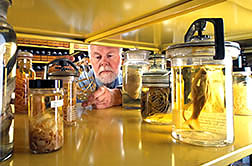
Accurately identifying fungi and insects is essential but difficult. Between 25 and 50 percent of the specimens submitted to the ARS systematic laboratories cannot be accurately identified at the species level. Many belong to large genera that have never been systematically described and classified. So identifying them at the species level is nearly impossible.
One reason for accurately identifying these organisms is to prevent the introduction of exotic diseases and pests. Some disastrous accidents have occurred in the past, such as the introduction of Dutch elm disease into North America and the release of Japanese beetles, as well as the importation of dogwood anthracnose, oak wilt, chestnut blight, and scleroderris canker that attacks pine trees.
"If we had had available more knowledge of the causal organisms of these diseases—their identity, range of hosts, and geographic distribution—perhaps those inadvertent introductions could have been avoided," says Rossman.
A Separate Kingdom
Since the third century B.C., when Aristotle attempted to order life forms from simplest to most complex into a "great chain of being," fungi have been lumped in with plants.
|
|
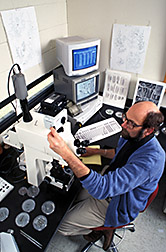
Occurring everywhere and on all living matter, fungi have coevolved with and flourished inside diverse hosts.
Though they've been recognized for more than 20 years as a separate kingdom thought to be closely related to plants, DNA sequencing now places them closer to animals.
"The implication of the revelation that mushrooms are more closely related to humans than to orchids is that biologists will start looking more closely at characteristics that fungi and animals share—like biochemical pathways," says Rossman.
The fact that fungi are related to animals makes it difficult to treat fungal infections in humans, livestock, and domestic animals. Fungi are becoming more and more common as human pathogens. But antibiotics capable of destroying them are also likely to harm human patients.
Recently, Rehner and colleague ARS mycologist Gary Samuels have been studying the relationships of an important beneficial fungus. Previously misclassified as Gliocladium virens, this species is used as a biocontrol agent against several root pathogens, including those that cause damping-off diseases. These diseases rot seeds, seedlings, and cuttings in cotton, beans, carrots, and other crops at a cost of more than $1 billion yearly.
"DNA sequencing has shown that the genus Gliocladium is an unnatural group," says Samuels. "What was called Gliocladium virens is actually a species of Trichoderma. All members of the genus Gliocladium do not share a recent common ancestor. So putting the organisms together using morphology, as has been done in the past, has proven incorrect."
This discovery gives scientists looking for more effective biocontrol agents a clue about where to look.
"Because Trichoderma virens is not known to reproduce sexually, traditional breeding techniques can't be used to develop stable strains that might be even more effective in controlling damping off diseases," says Samuels. "But we now see that T. virens is related to species with a sexual cycle that can he manipulated for genetic improvement."
He thinks DNA sequencing will reveal those links.
"What's significant for mycologists is that after nearly 200 years of having a separate classification for fungi known to reproduce sexually versus those that reproduce asexually, we can now use molecular characters to unity the classification of both types of organisms," says Rehner.
"In so doing," he adds, "we can learn more about the evolutionary relationships in our classifications and better understand the roles of sexual and asexual reproduction in the evolution of fungi—especially those of economic interest that are either beneficial or pathogenic to plants and insects." — By Hank Becker, ARS.
Amy Rossman and Gary Samuels are at the USDA-ARS Systematic Botany and Mycology Laboratory, 10300 Baltimore Ave., Beltsville, MD 20705; phone (301) (301) 504-5364.
Douglass R Miller is at the USDA-ARS Systematic Entomology Laboratory, 10300 Baltimore Ave., Beltsville, MD 20705; phone (301) 504-5895, fax (301) 504-6482.
J. Ralph Lichtenfels is in the USDA-ARS Biosystematic and National Parasite Collection Unit, 10300 Baltimore Ave., Beltsville, MD 20705; phone (301) 504-8444.
On Chalcid Corner
|
|
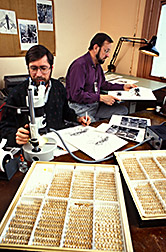
Parasitic wasps are the single most important group of organisms currently used for biological control. Nearly half of all biocontrol successes are attributed to them, says ARS entomologist Eric E. Grissell, who is quartered at the National Museum of Natural History in Washington, D.C.
Practically every insect pest has a wasp enemy that can be used to control it. At just about every stage in an insect's life cycle, one or more species of wasps will parasitize it.
"Beneficial wasps," entomologist Michael E. Schauff says, "are tremendously important as natural enemies of insect pests like the Colorado potato beetle and the Mexican bean beetle—two of the most devastating pests of potatoes, tomatoes, beans and eggplants."
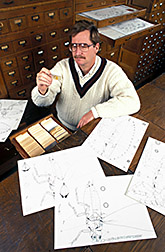
For the last 4 years, Schauff and Grissell have been working with an international group of taxonomists on a pictorial key of a superfamily of beneficial parasitic wasps, the Chalcidoidea. With several hundred pages, the key will have over 1,500 illustrations of more than 700 genera.
"This is the first time so much information about a wasp superfamily has been compiled. It includes over 2,500 species of Nearctic Chalcidoidea wasps that belong to 20 different families. Each genus has illustrations showing peculiar characteristics, including male and female, winged and wingless, and exceptional forms," Schauff says.
The illustrated key is also the basis for a new interactive expert system called Chalcid Corner.
The system incorporates graphics, sound, visual effects, and other features to help users identify members of this important group of beneficial insects.
"What is needed to increase the use of wasps as an alternative to chemical controls are some basic, easy-to-use guides to help identify adult wasps and summarize pest species that wasps will attack," he says.
Chalcid Comer should fill that need because it is geared to nonexpert audiences—like farmers, home gardeners, and others not knowledgeable about insect taxonomy.
The program allows users to choose from a list of alternative questions about chalcids, then proceed through a series of screens to help identify a wasp. Users can confirm tentative identifications, look at biological and taxonomic information on a particular family, or review the superfamily as a whole.
Schauff says one version of the system is now available, free, by sending a high-density 3-½-inch disk to the address below. He is working on an updated, interactive version of the key that will make identification even easier.
Available electronically on the Internet by the end of 1995, the updated version of Chalcid Corner will have a voice component that warns users to "be careful," if they are making an error in their search. — By Hank Becker, ARS.
Where Identifications Are Made
Five reference collections are curated by more than 30 Agricultural Research Service systematists at Beltsville, Maryland. These specialists discover, name, describe, and classify biota consisting of plants, insects and mites, nematodes, other parasites, and fungi.
During 1994, experts in the Beltsville systematic collections processed about 85,000 specimens, categorized roughly as follows:
- Systematic Botany and Mycology Laboratory (two collections) identified about 350 seed samples and 2,500 specimens of fungi;
- Systematic Entomology Laboratory identified about 80,000 insect and mite specimens;
- Biosystematics and National Parasite Collection Unit added about 1,000 new samples of parasites;
- USDA Nematology Laboratory examined more than 300 samples of nematodes. Each nematode sample included several different genera and species of both plant-parasitic and soil nematodes.
" Reinventing Systematics" was published in the May 1995 issue of Agricultural Research magazine.
