United States Department of Agriculture
AgResearch Magazine


Make Hayst, Not Waste |
|
|
|
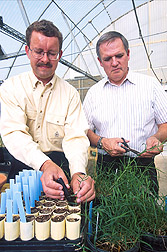
Hayfields and pastures in the southeastern United States are often fertilized with animal waste such as poultry litter and swine effluent. Farmers apply these wastes because they're effective, low-cost fertilizers. But a buildup of nutrients—including nitrogen, phosphorus, potassium, copper, and zinc—can occur because the waste is sometimes applied in amounts greater than needed. When these nutrients accumulate in soils, they can cause environmental problems. For example, phosphorus and some forms of nitrogen move rapidly through the soil and can contaminate ground and surface waters. ARS plant geneticists Dennis E. Rowe and Gary A. Pederson, along with colleagues in ARS' Waste Management and Forage Research Unit, Mississippi State, Mississippi, have been looking for ways to maximize the uptake of nutrients by forage plants grown for hay. Focusing on annual ryegrass, red clover, and Bermuda grass, they've found that over half of all the animal waste nutrients taken up by forage plants concentrates in their stems or runners. |
|
|
"Since most phosphorus in forages is located in stems and runners, managing upright forages such as annual ryegrass to maximize stem production should also maximize removal of this nutrient from the soil," says Pederson. "Selection of the proper species also helps to maximize nutrient removal, since forages differ in their concentration and uptake of major nutrients and metals," he adds. About 25 percent of all phosphorus in a harvest is contained in the leaves. Forages are typically managed in several ways. They may be used in rotational or continuous grazing systems, for making hay to use as feed during winter or times of drought, or for processing into silage. Managing the forage for hay production not only removes excess nutrients from the soil, but also provides the farmer with another source of income when the hay is sold. While making forage into silage also removes nutrients from the soil, the product is more difficult than hay to transport. The application of animal waste to farm fields varies from region to region. "Production of poultry and cattle on the same farm works well since the animal waste from poultry can serve as fertilizer for pastures grazed by cows and calves," says Pederson. "As poultry production increased in the Southeast, numbers of beef cattle also increased," he adds. Farmers in the Midwest apply animal waste to row crops, such as corn. The scientists found that the species of forage influences the levels of nutrient concentration and retention. The amount of nutrients also increases as the plant ages. "The older the plant, the greater the amount of nutrients it contains, until it peaks at full maturity," says Pederson. "This age-induced increase in nutrient content is due to an increase in total dry matter." However, frequent cuttings of immature plants maximizes nutrient removal because fast-growing plants remove more nutrients than slower growing, mature plants do. These findings suggest that managing forage plants for growth and maturity and then harvesting them as hay for selling off-farm would maximize nutrient removal and lessen the impact of excess nutrients on the environment.—By Jesús García, Agricultural Research Service Information Staff. This research is part of Rangeland, Pasture, and Forages (#205), and Manure and Byproduct Utilization (#206), two ARS National Programs described on the World Wide Web at http://www.nps.ars.usda.gov. Gary A. Pederson is in the USDA-ARS Waste Management and Forage Research Unit, 810 Highway 12E, Mississippi State, MS 39762; phone (662) 320-7464, fax (662) 320-7544. |
|
"Make Hayst, Not Waste" was published in the May 2001 issue of Agricultural Research magazine. |