
United States Department of Agriculture
AgResearch Magazine


Seeking New Controls for Costly Nematodes
|
|

Even though farmers have a 4-year reprieve on the Jan. 1, 2001, phaseout date for methyl bromide, researchers at the ARS Nematology Laboratory in Beltsville, Maryland, are searching for replacements to control microscopic worms called plant-parasitic nematodes.
Thousands of species of these worms infect nearly every agronomic and horticultural plant important to agriculture. In the United States, these pests cause estimated annual economic losses of $9 billion from decreased food, fiber, and ornamental production. Although used to protect more than 100 crops from nematodes and a variety of other pests and pathogens, methyl bromide will be prohibited as of January 1, 2005.
"According to the U.S. Environmental Protection Agency, 35 percent of the world's methyl bromide production is used by U.S. agriculture," says ARS zoologist David J. Chitwood. "Eighty-seven percent of this is used for preplant soil fumigation to kill soilborne fungi, as well as nematodes."
"At the present time, only a small array of chemicals—which are frequently inadequate, unsuitable, or too costly for some crops or soils—are available to control these pests," he says. "When methyl bromide goes, there will only be two broad-spectrum fumigant nematicides left, and one of them is in danger of being restricted."
Chitwood says there's an urgent need to develop environmentally safe, target-specific ways of controlling soybean cyst and root-knot nematodes, two of the worst soil-dwelling pests. The first attacks soybeans; the second feeds on strawberries, most vegetables, and just about all other agricultural crops. These pests feed on the living roots of plants, weakening and sometimes killing their host.
Chitwood's lab is the only ARS research group devoted exclusively to studying nematodes. It's a hub for finding state-of-the-art control techniques. Several of the labs' research projects have produced some promising results in the ongoing battle to keep these pests in check.
An Elegant Genetic Approach
One project involves what are called free-living nematodes. These cousins of plant parasites are important in nutrient recycling within soils.
"Several scientists at the lab are studying one free-living species—Caenorhabditis elegans. It can be used as a model organism to explore the biochemistry of its two destructive cousins, the soybean cyst and root-knot nematodes," Chitwood says.
|
|
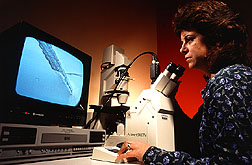
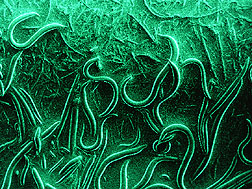
For example, the C. elegans genome sequencing project has just yielded the genetic pattern of that organism—the complete structure of the genetic material, or DNA, that makes it unique. This is the first multicellular animal for which such valuable information is available.
This project, he says, will give ARS plant pathologists and molecular biologists a very powerful way to speed up the identification of genes that control plant-parasitic nematode growth, development, and sex determination.
"Since the ability to sense and respond appropriately to environmental cues is critical for all nematodes," says ARS molecular biologist Andrea M. Skantar, "it is likely that plant-parasitic ones use a mechanism similar to that of free-living relatives to adapt to changes in their environment and know when to mature and reproduce."
To that end, Skantar and colleagues are studying one of the most critical junctures in the life cycle of many plant-parasitic nematodes—the pre-infective larval stage. At this vulnerable stage, she explains, the parasite's development is on hold until it finds a suitable plant host in which to mature and reproduce.
Skantar hopes to exploit this vulnerability, either by preventing maturity altogether or by tricking the worm into developing prematurely outside the host plant—where it would likely starve to death.
"Plant-parasitic worm larvae share a number of traits with their free-living C. elegans relatives," she says. During the arrested state, the worms don't feed; their outer shell, or cuticle, becomes stress-resistant; their bodies adapt for energy storage verses energy production; and they live longer.
Going a Little Daffy
"In C. elegans, these changes are mediated by molecules called the daf genes. Environmental cues and insulin-like signals all pass through this daf sensory processing pathway that enables these nematodes to couple their food uptake with development and lifespan," says Skantar.
She used a process called PCR amplification to find daf genes in soybean cyst and root-knot nematode DNA.
In PCR, or polymerase chain reaction, a heat-stable enzyme uses molecules called primers as 'bait' to isolate and make copies of a target gene from the organism's DNA.
Skantar is developing procedures to micro-inject nematodes with normal or altered copies of these cloned genes. By examining the effects of this injection on nematode development, she hopes to understand how parasitic nematodes differ from free-living ones.
"A thorough molecular understanding of how a nematode responds to environmental stimuli by altering its development will uncover novel targets for controlling nematodes," she says.
Skantar believes the daf genes may be used to permanently disrupt these pests' development so they remain as nonfeeding larvae for an entire crop-growing season. After that, they would perish.
Searching for other new management schemes for nematodes, ARS plant pathologist Susan L.F. Meyer and ARS chemist James Nitao are looking at various beneficial fungi and at pheromones—male and female sex attractants.
Meyer and colleagues collected 250 fungi from soybean-growing areas of China, where soybeans were first cultivated, to look for natural biological controls. She and Nitao screened most of these fungi in the lab to see if they inhibit egg hatch in plant parasitic nematodes.
|
|
"Fifteen of the fungi isolated from soybean cyst nematode eggs produce compounds that reduced egg hatch of either soybean cyst nematodes or root-knot nematodes by at least 80 percent," says Meyer, "and one isolate reduced hatch of both nematodes. Compounds from three of these isolates also caused the root-knot nematode larvae that did hatch to stop moving."
Nitao has analyzed these secretions and is isolating the compounds that inhibit hatching. Next, he will test these compounds in the greenhouse to determine their commercial control potential.
In another approach, Chitwood and other ARS scientists are trying to develop new control methods for parasitic nematodes by studying their biochemistry and that of their host plants.
Chitwood is an expert on the biochemistry of the steroids and fats, or lipids, of nematodes. Steroids are important components of nematode membranes and biochemical precursors of their hormones. Lipids are used as food reserves and as communication molecules between and within their cells. Chitwood is working on methods of disrupting the nematode's life cycle by interfering with its steroid and fat biochemistry.
One of the most unusual tactics for attacking nematodes is that of ARS cytologist William P. Wergin. He wants to kill the nematodes using dry ice, which is solid carbon dioxide that has a temperature below -78.5oC. A nonpolluting material, the dry ice can be applied to the soil before planting to lower soil temperature enough to either kill nematodes or reduce their infection and reproduction on plants.
"Results indicate that this treatment reduced by several hundredfold the number of nematode eggs that could be found on mature plant roots," says Wergin. "Although further studies are needed to optimize and economize this procedure, the dry ice treatment may provide some farmers with an environmentally safe and effective means to control certain types of these plant parasites."—By Hank Becker, Agricultural Research Service Information Staff.
This research is part of Methyl Bromide Alternatives, an ARS National Program described on the World Wide Web at http://www.nps.ars.usda.gov/programs/cppvs.htm.
Scientists mentioned in this story can be reached at the USDA-ARS Nematology Laboratory, Bldg. 011A, 10300 Baltimore Ave, Beltsville, MD 20705-2350; phone (301) 504-5660, fax (301) 504-5589, e-mail:
dchitwoo@asrr.arsusda.gov
wwergin@ggpl.arsusda.gov
smeyer@asrr.arsusda.gov
jnitao@asrr.arsusda.gov
askantar@asrr.arsusda.gov
"Seeking New Controls for Costly Nematodes" was published in the March 1999 issue of Agricultural Research magazine.
