
United States Department of Agriculture
AgResearch Magazine


UNMASKED: A Karnal Bunt Fungus Look-Alike
|
|

Sometimes distinguishing the real thing from an impostor takes a lot of expertise and know-how. This is especially true with microscopic organisms such as Tilletia indica, a fungus that causes the disease called Karnal bunt in wheat.
But Agricultural Research Service fungus-identifying experts have made this difficult task look easy.
Working with state and federal researchers, they've developed a technique to unmask a ryegrass fungus that was mistakenly identified as a possible form of Karnal bunt. In so doing, they've helped solve a serious problem affecting U.S. farmers and disrupting international trade. Southeastern wheat growers should now face less risk of a regulatory action on their wheat crop due to Karnal bunt.
In 1996 and 1997, much of the $5-billion-a-year U.S. wheat export market was threatened by the discovery of the real Karnal bunt in Arizona and a small part of California.
"About one-third of the foreign countries that might buy wheat from the United States will not buy Karnal-bunt-infected wheat," says Mary E. Palm, a mycologist with USDA's Animal and Plant Health Inspection Service (APHIS). Palm's job as a federal quarantine official is to identify suspicious or unknown fungi intercepted at ports of entry into the United States. Because of the possibility that the disease was widespread, the export of all U.S. wheat was threatened, she says.
|
|
"Karnal bunt is a disease that is quarantined around the world—meaning many countries that don't have the fungus won't buy wheat from countries where it is found. So keeping the disease out of American wheat has been a top priority," she adds.
In making plant quarantine decisions, it is essential that fungi be identified accurately. This not only keeps out nonindigenous pathogenic fungi, but also allows the entry of food and fibers infected by fungi that are already present in the United States and, thus, are not a plant quarantine concern.
"Throughout the U.S. national Karnal bunt survey during the summer of 1996, T. indica-like fungal spores, or teliospores, were found in wheat seed washes of grain from the southeastern United States," Palm says. "Although available tests indicated these samples tested positive for Karnal bunt, we found no bunted—that is, blackened and foul-smelling—wheat seeds, which would indicate the presence of the disease, in any of the samples from which these teliospores were found."
Palm explains, "Sometimes, ryegrass seed infected with a fungus gets harvested along with the wheat. Initially, available tests have incorrectly identified this fungus as Karnal bunt. As a result, in 1996 and early 1997, restrictions were placed on the movement of suspect wheat from Alabama, Georgia, Florida, and Tennessee."
Working with Palm at the ARS Systematic Botany and Mycology Laboratory in Beltsville, Maryland, mycologist Lisa A. Castlebury set about to solve the mystery of the bunt fungus.
Even though wheat seed wash samples were testing positive for the Karnal bunt fungus using the then-available molecular test, Castlebury and Palm were detecting structural, or morphological, differences. Because no bunted wheat kernels were found in the southeastern United States, they suspected the presence of an impostor masking as the destructive fungus.
|
|
"At present, about 1,200 species of bunts are known worldwide," says Castlebury, whose specialty is bunt and smut fungi. "They occur worldwide and infect about 4,000 plant species in more than 75 flowering plant families. They cause millions of dollars in losses to both food crops and ornamental plants."
Castlebury used the basic tools of systematics to study the unknown and unnamed ryegrass fungus. After close examination of the bunt fungi family, she determined the Tilletia species was an unnamed fungus new to science.
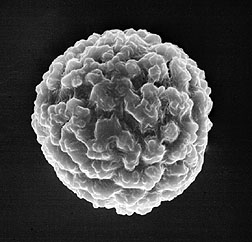
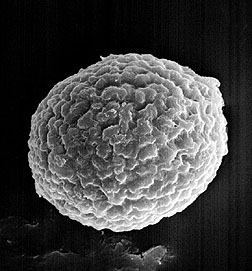
Castlebury analyzed and characterized the teliospores of both dried and fresh specimens. After noting their shape, size, surface characteristics, and color, she found that light and scanning electron microscopy could be used to further examine and compare the two fungi. With these techniques, she determined that visual characteristics can be used to tell the two fungi apart.
"Mature T. indica teliospores on wheat appear dark red-brown, often opaque, with fine spines that densely cover the outer spore coat. The teliospores on ryegrass range in color from pale yellow or golden to dark brown, with thicker, more widely spaced spines covering the outer coat," says Castlebury.
She validated her technique by rigorously comparing previously observed differences in spore ornamentation in samples from known host plants.
The technique quickly showed that 100 percent of each of the 70 wheat samples collected from southeastern farms in 1996 were contaminated with the look-alike fungus—not Karnal bunt.
"As a result, in March 1997, restrictions on the movement of the suspect wheat were lifted from the counties where the suspect samples originated," says Palm, who used Castlebury's test.
Palm and other federal plant quarantine officials now use the technique as a first cut, to decide if possible quarantine actions are needed. "If the test results indicate a sample might be Karnal bunt, officials go back and look for bunted wheat seeds," says Palm.
Castlebury and plant pathologist Lori M. Carris at Washington State University in Pullman have described the new species and named it Tilletia walkeri. Their paper will be published in Mycologia—the official journal of mycologists worldwide.
|
|

Carris is also working on several greenhouse experiments at Pullman to see if the ryegrass fungus is able to infect other grass hosts under artificial conditions.
"We may find, as with other Tilletia species, that it could infect species other than ryegrass in the greenhouse," says Carris, "But in nature, these fungi are generally host specific."
Castlebury and Carris also worked with APHIS mycologist Robert J. Meyer and APHIS plant pathologist Laurene Levy at the USDA National Plant Germplasm Quarantine Center in Beltsville.
They have developed a new molecular test that will be the definitive one for official use to tell the two fungi apart. It uses a standard restriction enzyme analysis to distinguish between the two.
"Our test uses a set of PCR [polymerase chain reaction] primers to amplify specific genes from the mycelium or fungal tissue of the suspect fungi. We have a restriction enzyme that cuts the amplified ryegrass fungus gene, but not the Karnal bunt fungus gene, into two pieces," says Levy.
"We've tested it using nine other Tilletia species on grasses."
Two other labs that routinely perform molecular tests—at Frederick, Maryland, and Pullman, Washington—have validated the accuracy of Levy's PCR test.—By Hank Becker, Agricultural Research Service Information Staff.
This research is part of Plant Diseases, an ARS National Program described on the World Wide Web at http://www.nps.ars. usda.gov/programs/cppvs.htm.
Lisa A. Castlebury and Mary E. Palm are at the USDA-ARS Systematic Botany and Mycology Laboratory, Bldg. 011A, 10300 Baltimore Ave., Beltsville, MD 20705; phone (301) 504-5364 or (301) 504-5327, fax (301) 504-5810.
An interactive system for identifying teliospores of species of Tilletia that occur in the United States is now available through the Systematic Botany and Mycology Laboratory's web site. Go to http://nt.ars-grin.gov."UNMASKED: A Karnal Bunt Fungus Look-Alike" was published in the March 1999 issue of Agricultural Research magazine.
