United States Department of Agriculture
AgResearch Magazine


Investigating Minor Nutrients of Major Importance
|
|
|
|
American favorites like chocolate bars and some kinds of beer are—perhaps surprisingly—rich in an essential nutrient, copper. So, too, are the foods that Mom may have told you to eat, like liver and other organ meats; peas, beans, and other legumes; and whole-grain breads or other grain products.
Even though copper has been known for a century to play a key role in our health, much more remains to be discovered about this vital mineral. Investigations led by Judith R. Turnlund at the ARS Western Human Nutrition Research Center in Davis, California, are helping to fill in missing pieces of this puzzle. Her studies are revealing new clues about what our bodies do with the copper that we get from everyday foods. |
|
|
"We already know that we need copper for strong bones, a well-functioning nervous system, and a healthy heart," says Turnlund. "But we'd like to know more, like where exactly does it go after we eat? How fast does it get there? How much do we store? How much do we lose?" To help answer these questions, Turnlund's group uses rare, trackable forms of copper, called stable isotopes, to follow copper's fate in the body. Turnlund pioneered the use of isotopes to study essential minerals in humans. The information that her team uncovers can be used—along with findings from labs elsewhere—in setting the national nutrition guidelines, or recommended dietary intakes, which help ensure that Americans of all ages get enough copper to stay healthy. The recommended intakes for some nutrients show up in the familiar lists printed on regular products, like a box of breakfast cereal, can of fruit, or bottle of vitamin/mineral tablets. Among Turnlund's other research targets are molybdenum and magnesium. Molybdenum is an essential component of three enzymes needed to chemically process—or metabolize—certain amino acids that we get from protein. Magnesium, like copper, is important for our bones, nervous system, and heart. |
|
|
Turnlund's work with these trace elements, plus zinc and iron, has made her an international authority on mineral nutrition. Her copper studies include unique investigations in which she has scrutinized the effects of very low and very high intakes to find out what's safe for us—and what likely isn't.
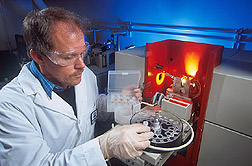
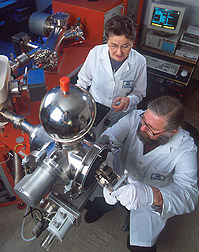
"In our tests of healthy young men," she reports, "we found that 0.38 milligrams of copper a day is too low." Levels of a copper-containing enzyme called lysyl oxidase—needed in the skin, bones, and heart—decreased in most of the volunteers during the low-copper regimen. What's more, a trio of other indicators of copper nutrition—serum copper, ceruloplasmin, and superoxide dismutase—also declined. Turnlund and collaborators in the United Sates and abroad are currently analyzing the data from their recent high-copper study. "We want to know," she says, "what might happen to people who take two or three vitamin/mineral supplements a day, meaning that they'd be getting several extra milligrams of copper. We think it's important to establish whether that amount—if taken over a long period of time—is too high." Model Mimics Copper's Cycle Discoveries from each of the copper experiments help Turnlund refine a major product of her research—a handy, computer-driven model for filling in gaps about how our bodies use copper. Says Turnlund, "We started with a very sophisticated, highly versatile modeling program that scientists at the National Institutes of Health and the University of Washington in Seattle developed for simulating many different kinds of biochemical processes. We use the program in desktop computers to process—with mathematical equations—our data as well as data from other nutrition studies of animals and humans. "The result, in our case, is a best estimate of how copper makes its way through the body. For example, the model predicts how copper might move from our digestive tract to the plasma in our blood, then to our liver—where it is incorporated into enzymes—and, later, to the cells of other tissues and out of our systems. "Each of these points along the pathway," she notes, "is called a compartment. Some, like plasma or urine, can be easily sampled to get a better idea of how much copper goes into each and for how long, and how much remains." But what about compartments like the liver, where following copper's progress would be difficult unless one sampled a little chunk of liver from time to time? "For those compartments," explains Turnlund, "we start with animal data. The mathematical equations can help us extrapolate it to match—to the greatest extent possible—what may happen in humans. "Our model," she says, "is only a prediction, or estimate, of course. But it allows us to apply the computer's enormous speed and power to crunch mountains of data into possible scenarios. Looking at the scenarios helps reveal new possibilities. And it can help us decide what needs to be studied next." Turnlund's copper model, first published in 1994, was based on studies of healthy volunteers. It was the first-ever computerized model of how copper is metabolized in healthy people. The model has provided new support for what some scientists had suspected earlier, namely that copper most likely progresses though our bodies primarily in one-way paths, with little recycling. Notes Turnlund, "That's unlike molybdenum, zinc, or a number of other nutrients that tend to move back and forth from one compartment to another." Monitoring Molybdenum and Magnesium In their studies of molybdenum, Turnlund and coinvestigators have produced another computerized model similar to the copper one. Data for the model came from studies in which Turnlund's team fed volunteers various amounts of molybdenum, "ranging from as low as we could get to as high as might be conceivable," she says. "We found that it's unlikely that healthy people would develop a molybdenum deficiency at any of these levels," she reports. "We estimated that the minimum requirement for adults is about 25 micrograms a day. People usually eat considerably more than that in a day's worth of ordinary meals." The investigation was the first to provide an estimated minimum level for molybdenum in healthy volunteers. Seeds, such as those from sunflower or pumpkin; legumes like peas, beans, and peanuts; and grain-based products, such as breakfast cereals or whole-grain breads, are often good sources of molybdenum. The level varies, however, according to the quantity of molybdenum in the soil where the crop was grown. In her magnesium research, Turnlund is now tackling the daunting task of determining an easy, reliable way to measure how much of this mineral we absorb from our food. Good sources of magnesium include green, leafy vegetables; whole grains; and nuts. In this venture, she's collaborating with the producers of Perrier, a premium bottled water. "Perrier researchers," says Turnlund, "want to know if bottled water is a good source of magnesium. To find out, they need a good way to measure magnesium absorption. We need that for our research, too. So we're working together to find a test that is fast, easy, accurate, reliable, reproducible, and, of course, affordable." So far, they've found that a urine test appears to be as accurate as fecal analyses—and is faster and easier. For the urine test, researchers provide volunteers with a food or beverage that's spiked with a traceable form of magnesium. They also inject a tiny quantity of the tracer magnesium into the volunteers' blood, then collect urine specimens about 2 days later. To determine the amount of tracer magnesium in the sample, the researchers use a high-tech instrument known as an inductively coupled plasma mass spectrometer. From this they can calculate how much magnesium each volunteer absorbed and used. Turnlund's team will also use data from the magnesium study—hundreds of specimens in all—to create a new model of how our bodies cycle this important mineral.—By Marcia Wood, Agricultural Research Service Information Staff. This research is part of Human Nutrition, an ARS National Program (#107) described on the World Wide Web at http://www.nps.ars.usda.gov. Judith R. Turnlund is with the USDA-ARS Western Human Nutrition Research Center, One Shields Ave., Davis, CA 95616; phone (530) 752-5249, fax (530) 752-5271. |
|
"Investigating Minor Nutrients of Major Importance" was published in the March 2001 issue of Agricultural Research magazine. |
|