United States Department of Agriculture
AgResearch Magazine


New Clues About Carotenes Revealed
|
|
|
|
The rich yellow of a mango or deep orange of a carrot are the work of nutrients called carotenes. Our bodies can convert some carotenes—namely, alpha-carotene, beta-carotene, and beta-cryptoxanthin—into vitamin A, a nutrient essential for proper growth and reproduction as well as for good eyesight. What's more, new evidence further supports the value of carotenes as antioxidants that may reduce our risk of cancer, stroke, arteriosclerosis, and cataracts.
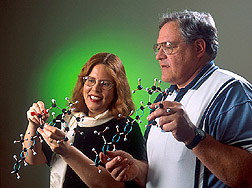
Dozens of familiar, brightly colored, yellow, orange, or dark-green vegetables and fruits provide carotenes. Perhaps most studied to date is beta-carotene. Scientists have long suspected that individuals differ in their ability to absorb beta-carotene and convert it to vitamin A. Early beta-carotene studies with humans gave researchers a glimpse of this variability. But a series of investigations over the past 5 years, led by ARS chemist Betty J. Burri, offers new, more detailed proof of this diversity. These findings are important for people who are cutting back on the amount of meat and dairy products they eat. "Meat, eggs, cheese, and whole milk are rich in vitamin A," says Burri, "so people who eat little if any of these foods need to be sure they are getting an adequate supply of this nutrient from other sources." Burri is with the ARS Western Human Nutrition Research Center in Davis, California. She did the work with Terry J. Neidlinger, also at the center; Andrew J. Clifford, Stephen R. Dueker, Sabrina J. Hickenbottom, and Yumei Lin of the University of California, Davis, Department of Nutrition; and Jin-Young K. Park, formerly with ARS and now with the Food and Drug Administration. Special Compounds Used As Trackers The researchers studied 45 male and female volunteers, aged 18 to 42. For some of the studies, volunteers were fed supplements containing special forms of vitamin A and of beta-carotene. These forms can be traced, or detected, because they weigh more than naturally occurring vitamin A and beta-carotene. The sophisticated laboratory instruments that the researchers used—a gas-chromatograph mass spectrometer and a high-performance liquid chromatograph—can differentiate the tracer compounds from the naturally occurring forms. Research done elsewhere has tracked the fate of one or another of the compounds in human volunteers. But the California studies were apparently the first to evaluate uptake and use of both tracer beta-carotene and tracer vitamin A concurrently. That gave Burri's team what is probably the best-ever look at the interaction of these nutrients in healthy humans. Surprising Variability "We found new extremes in the amount of time it takes for beta-carotene to be absorbed and converted—and in the amount that is converted," Burri reports. "But most unexpected was the statistically significant difference in beta-carotene uptake and conversion by physically similar volunteers, including one pair who were so alike that they could well have been twins. "Both were females of nearly identical age, height, and weight. They had a similar amount of body fat and about the same amount of vitamin A in their blood at the start of the study. Their uptake of our tracer vitamin A was similar. That isn't unusual, because we already know that most well-fed people absorb vitamin A in nearly the same way. But the first volunteer used about 30 percent of the tracer beta-carotene within only 12 hours of taking it. Of that amount, she converted about 30 percent to vitamin A. "The second volunteer took up only about 15 percent of the tracer beta-carotene and took about 3 days to do it. Then, she converted only about 8 percent to vitamin A. "Essentially," Burri summarized, "the first volunteer used up about twice as much beta-carotene and converted it to about 8 times more vitamin A. We hadn't expected individuals who were so similar in so many key variables to be so different in their processing of beta-carotene." With the exception of a volunteer who was very low in vitamin A at the outset of one of the studies, most volunteers handled vitamin A similarly, as had been shown in previous research in the United States and abroad. But about half of all Burri's volunteers—male and female—didn't take up much beta-carotene at all. Uptake amounts ranged from undetectable to about 50 percent. About half of the volunteers didn't form much vitamin A from the beta-carotene they did absorb. Basic Chemistry Doesn't Apply Notes Burri, "None of our volunteers metabolized 100 percent of the beta-carotene, but that's what we expected to happen. Even though beta-carotene—of all the carotenoids—is the easiest for us to convert into vitamin A, we don't do it as efficiently as the basic chemistry of beta-carotene might suggest. "Beta-carotene is a large molecule. Its chemical structure looks like two molecules of vitamin A joined end to end but facing opposite directions. It would seem—on paper, at least—that one molecule of beta-carotene should, logically, yield two molecules of vitamin A. But the body isn't a perfect chemical factory. We don't form two molecules of vitamin A for every one molecule of beta-carotene that we consume." Burri says the findings may help explain why giving beta-carotene supplements to people who are deficient in vitamin A may not be sufficient to prevent the blindness and death that lack of vitamin A causes today in Southeast Asia, sub-Saharan Africa, or South America, for instance. The procedure that her team used for tracking vitamin A and beta-carotene simultaneously could be adapted to screen individuals in these regions for their ability to process beta-carotene. That could save vision and lives by identifying—earlier on—those who likely won't respond to beta-carotene supplementation. Vitamin A deficiency isn't prevalent in the United States. Nevertheless, the procedure could be used here to help healthcare professionals identify individuals at risk of developing a shortage of this nutrient. An example: people who don't process fats efficiently. Fats, like those in whole milk, help our bodies absorb and digest vitamin A. Genes Likely Control Beta-Carotene Processing "The variation in the way our bodies respond to beta-carotene is likely gene-based," Burri points out. "Some genes that govern our use of this compound have already been identified, and more will likely be pinpointed as a result of the human genome project. That might lead to new strategies for fighting vitamin A deficiency. And it may reveal useful clues about how other genes control processing of other compounds and nutrients. "Ideally," adds Burri, "it may also help us produce customized dietary guidelines that take into account an individual's ability to convert carotenes from fruits and vegetables into vitamin A." Burri and co-researchers published their findings in the American Journal of Clinical Nutrition and in Mathematical Modeling in Experimental Nutrition.—By Marcia Wood, Agricultural Research Service Information Staff. This research is part of Human Nutrition, an ARS National Program (#107) described on the World Wide Web at http://www.nps.ars.usda.gov. Betty J. Burri is with the USDA-ARS Western Human Nutrition Research Center, One Shields Ave., Davis, CA 95616; phone and fax (530) 752-4748. |
|
"New Clues About Carotenes Revealed" was published in the March 2001 issue of Agricultural Research magazine. |
|