
United States Department of Agriculture
AgResearch Magazine


Helping Raisins Make the Grade
|
|
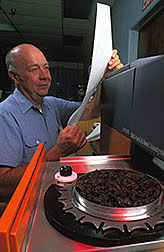
Oatmeal cookies, bread pudding, cinnamon rolls—plump, juicy raisins add a sweet touch to these and other favorite desserts. To ensure consumers always get the best fruit, Agricultural Research Service scientists are developing new tools to evaluate raisin quality.
Most U.S. raisin grapes are grown and dried near Fresno, California. Between 300,000 and 400,000 tons of raisins are produced annually, with a farm value around $400 million.
Inspectors with USDA's Agricultural Marketing Service (AMS) grade each 1,000-pound bin of raisins as it enters the processing plant.
Raisins are graded A, B, C, or substandard based on visual characteristics like plumpness, maturity, color, and wrinkle depth. To be sold for food, at least 70 percent of the raisins in a sample must be graded "B or Better," with less than 5 percent substandard. Raisins that do not meet these requirements may be used to make raisin concentrate or to fortify animal feed.
AMS also uses a mechanical sorter to grade raisins based on weight. With it, lighter, lower quality raisins float on an air current into one chamber, while the heavier raisins fall into another
"External characteristics like depth of wrinkles reflect the composition or amount of sugars in the raisins. We're trying to develop a rapid method that directly measures the composition and correlates well with the visual grading system," says Charles C. Huxsoll, an agricultural engineer at the ARS Western Regional Research Center in Albany, California.
Huxsoll believes near infrared reflectance (NIR) or transmittance spectroscopy may be the best method. Near infrared is a form of electromagnetic radiation, like light and X rays. Infrared light cannot be seen by the naked eye.
When an object like a raisin is exposed to near infrared—or any type of light—it absorbs some of the energy and either reflects it or lets the rest through. The energy that passes through or reflects from the raisins can be measured, producing a spectrum. The NIR technology was originally developed by ARS agricultural engineer Karl H. Norris (now retired) about 30 years ago.
"Although all raisins project a similar spectrum, there are minor differences for low- and high-quality raisins," Huxsoll says. A computer correlates the differences in the spectra with the quality of the raisins.
Because the NIR analysis produces an objective, numerical representation of the quality, Huxsoll says it should help improve the reliability and reproducibility of the grade assignments. Once calibrated, the machine can measure many different characteristics simultaneously, like acidity, water content, and sugar content.
"It could also allow more specific grades, like AA, for specialty purposes," he says.
Inspectors with AMS agree.
"Our current methods work well, but the industry wants a more encompassing and accurate analysis," says Yoshiki (Junior) Kagawa, officer in charge of AMS' processed products field office in Fresno.
Now Huxsoll and Kagawa are testing the system's ability to evaluate samples of unknown quality. They will compare the NIR rating to the assessment of visual graders and adjust the calibration as necessary.
"We expect to soon pass the technology to AMS completely," Huxsoll says. "They're doing much of the hands-on work already."
Kagawa hopes to have the system online in 3 years. — By Kathryn Barry Stelljes, ARS.
USDA-ARS Processed Foods Research Unit, Western Regional Research Center, 800 Buchanan St., Albany, CA 94710.
"Helping Raisins Make the Grade" was published in the June 1996 issue of Agricultural Research magazine.
