
United States Department of Agriculture
AgResearch Magazine


Hiking Human Zinc Absorption
|
|
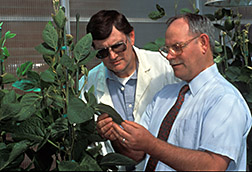
Boosting plants' internal levels of an amino acid called methionine could increase the availability of dietary zinc in those plants.
This would be a valuable benefit in developing countries where meat, the most common source of dietary zinc, may be scarce.
"When animals or people don't have enough zinc in their diet, problems such as depressed growth of the young, slower wound healing, and birthing difficulties have been observed," notes Agricultural Research Service animal physiologist William A. House. He is at the U.S. Plant, Soil, and Nutrition Laboratory at Ithaca, New York.
"Zinc is a major constituent of many enzymes, so many of the body's metabolic processes depend on zinc," he says.
The Recommended Dietary Allowance of zinc for adults is 12 to 15 milligrams. Although most non-vegetarian Americans gel the bulk of their dietary zinc from meat, about 13 percent comes from cereal grains.
Zinc levels in a plant can be boosted by adding zinc to the soil it grows in. And the added presence of methionine makes it possible for humans and animals to use more of the plant's zinc, though it does not alter its zinc content.
In experiments at the Ithaca lab, House and ARS plant physiologist Ross M. Welch fed rats a diet laced with traceable zinc. Some of the rats also ate either extra methionine, extra lysine—another amino acid—or a combination of the two.
The rats that received the supplemental lysine were able to absorb 69 percent of the zinc, about the same as the 64 percent absorbed by rats with no supplemental amino acids.
But the rats that ate supplemental methionine absorbed 82 percent of the zinc, and those treated to lysine plus methionine absorbed 89 percent. In a second experiment, rats were able to absorb about 20 percent more dietary zinc when also fed supplemental methionine or cysteine, a third amino acid.
"This tells us that if you're marginally deficient in methionine in your diet, you probably have impaired zinc absorption," House points out. But he warns that simply loading up on methionine isn't the entire answer to meeting dietary zinc needs.
The Ithaca studies revealed an oddity: Rats absorbed less zinc from corn that had grown multiple layers of special cells where minerals are normally stored, compared with rats eating corn with the typical number of those cells.
"One difference was that the normal corn contained less of a particular form of phosphorus called phytate," explains House. "It's thought that zinc forms an insoluble compound with phytate in the intestinal tract and can't be absorbed because of that."
To further confuse the issue, fiber--the same fiber encouraged in virtually every diet—also ties up zinc. By binding it, much as resins in water softeners bind calcium and magnesium, fiber reduces availability of zinc for absorption, House adds.
"Zinc deficiency is a bigger problem in developing countries than in the United States," he notes.
"In some areas, people might depend heavily on foods grown right in the neighborhood. If their soil is low in zinc, that increases their likelihood of a deficiency. Plants with increased levels of methionine might increase the availability of the zinc that's in those plants." — By Sandy Miller Hays, ARS.
Ross M. Welch is at the USDA-ARS U.S. Plant, Soil and Nutrition Research Unit, Tower Road, Ithaca, NY 14853; phone (607) 255-2454.
"Hiking Human Zinc Absorption" was published in the June 1995 issue of Agricultural Research magazine.
