
United States Department of Agriculture
AgResearch Magazine


Monitoring Methane
|
|
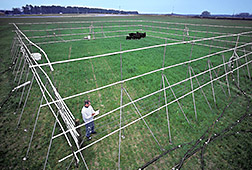
This is the first noninvasive outdoor measurement of methane emissions from cattle.
It's relatively easy to measure emissions of greenhouse gases from the exhaust pipe of a car or the smokestack of a factory.
But how about methane from rice paddies, landfills, termite mounds, livestock waste, or cows' breath? And what of airborne carbon dioxide or nitrous oxide from soil?
Lowry A. Harper, an ARS agricultural microclimatologist, and ARS soil chemist Ronald R. Sharpe—both at the Southern Piedmont Conservation Research Center in Watkinsville, Georgia—measure the gases with an array of outdoor sampling tubes.
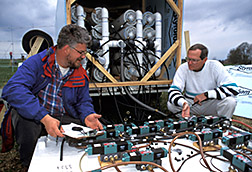
These connect to a laser spectrometer for trace gas analysis made in a nearby trailer. The spectrometer is one of about 10 such instruments being used in the world.
The first of these outdoor measurements came far from Georgia—near Canberra, Australia. There Harper and scientists from Australia's Commonwealth Scientific and Industrial Research Organization were able to sample methane emissions from grazing cattle.
Harper is currently repeating the Australian experiment at Watkinsville, Georgia, with four Angus beef cows and four calves in a fenced pasture. He and colleagues will do the same experiment at College Station, Texas, with four crossbred beef cows and calves.
|
|
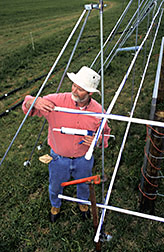
In these experiments, a perforated "sniffing" tube is placed along each side of a fence enclosing four cows in a 24- by 24-meter pasture.
"The fence is 3 ½ meters high, which our experience shows is the appropriate height to sample the gases emitted in this size pasture," Harper says.
Hoses draw air continuously into the trailer, where the laser spectrometer measures the methane content of air entering and leaving the pasture area, allowing calculation of the amount emitted by the cows.
"This and the Australian tests are the first noninvasive outdoor tests of methane production by cattle," Harper says. "Prior tests were done in indoor chambers or outdoors with sampling devices attached above the cattle's nostrils."
From the outdoor test in Australia, Harper and colleague Tom Denmead found that a cow grazing can emit more than 350 liters of methane per day. "That more than estimates from tests of confined animals," he says.
The Australian studies showed that cows fed grain rather than pasture grass emitted about 100 liters per day, about half as much as previous tests indicated.
Scientists found a 3-hour cycle of peaks and dips in methane production, with the greatest emissions at dawn and dusk, presumably when the cows eat the most grass. The cycle continues throughout the night as cattle awaken during the night for food. Cows and other cud-chewers, such as sheep and goats, release methane almost solely through belching, says Harper.
"The methane comes from fermentation in the cow's rumen, the first of four stomachs—and the one nearest the cow's mouth. The longer food stays in this rumen, the more methane is produced. Oats and other grains are more digestible than grass or hay, so they spend a briefer time in the rumen."
|
|
Harper says these studies show that "current climate change models used for predicting animal methane emissions do not account properly for the large effects of feed quality on methane production.
"So we can hope that total methane emissions from cattle throughout the world can be significantly reduced through diet. This could be accomplished either by feeding cattle grain in a feedlot or planting more digestible pasture grasses."
According to the indoor estimates of the Intergovernmental Panel on Climate Change, cud-chewing animals account for about a sixth of the world's total emissions of methane. Cattle account for about three-quarters of those emissions.
Notes Harper, "Each molecule of methane has about 20 times the global warming potential of a carbon dioxide molecule—partly because it lasts longer in the atmosphere, and partly because of the way it reacts with sunlight."
Increasing atmospheric concentrations of methane are believed to be responsible for about a quarter of the predicted global warming associated with the so-called greenhouse effect.
Grazing beef cattle are the biggest contributors, since they make up about half the 100 million or so head of cattle in this country. The rest are about evenly split between dairy and beef cattle on feedlots.
Harper is also working with Sharpe to adapt the equipment to measure methane emissions from landfills and nitrous oxide from farm fields.
"Nitrous oxide is produced as microbes eat nutrients in the soil. This gas gradually filters upward through soil pores and cracks until it is released into the air," Harper says. "We'd also like to measure carbon dioxide released as the soil is plowed or tilled.
"If this equipment works, we could provide more appropriate information to help make climate change models more accurate at predicting the emissions of several greenhouse gases," he says. "We could also find ways to reduce the emissions."
While this equipment should work on small animal waste lagoons, Harper and Sharpe have developed a different system to measure methane, carbon dioxide, and ammonia emissions from large dairy and swine waste lagoons on private farms.
Harper explains that lagoons are large, shallow pits, from 0.25 to 5 hectares in size, where all water used in dairy or swine barns is stored. They look like lakes, except for the color of some of them and for the continuous methane bubbling. "Sometimes, huge bubbles bring large mats of organic matter from the bottom mud up to the surface," Harper says.
Most of the wastewater comes from hosing down the barns to flush out manure. As an environmental measure, farmers store the liquid manure in the lagoon and apply the wastewater to their farmland as needed for fertilizer.
Harper and his colleagues mounted the equipment on a metal barge 2 meters wide by 6 meters long, and floated the barge on pontoons out to the middle of the lagoon. They let legs attached to the barge sink down for support. Then they let air out of the pontoons until the barge sank a couple of inches below the water's surface, thus keeping the barge's frame from interfering with the wind.
Monitoring devices project from 20 centimeters to 270 centimeters above the surface of the water. These instruments collect gases from the air and pump them through tubes back to a trailer on the lagoon's banks. There the gases are sampled and analyzed by one of the two laser spectrometers used by Lowry and Sharpe.
Lowry hopes the devices on the barge will not only help modelers better evaluate the gases emitted from animal waste lagoons, but also establish whether there's enough methane emitted to make it worthwhile for a farmer to use the methane as fuel for an electrical generator. — By Don Comis, ARS.
Lowry A. Harper and Ronald R. Sharpe are at the USDA-ARS J. Phil Campbell, Senior, Natural Resource Conservation Center, 1420 Experiment Station Road, Watkinsville, GA, 30677; phone (706) 769-5631, fax (706) 769-8962.
"Monitoring Methane" was published in the June 1995 issue of Agricultural Research magazine.
