
United States Department of Agriculture
AgResearch Magazine


St. Croix Sheep Produce More Spring Lamb
|
|
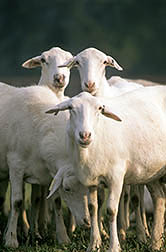
Ah, spring! Flowers blooming, young lambs frolicking in the lush green grass ... and missed opportunities for profits by sheep producers.
That's because in the normal course of events, sheep breed in September and October and lamb in February and March—much too late for the lambs to reach market weight of about 110 pounds by Easter, the prime sales time for lamb.
Now, from the island of St. Croix, comes a solution: sheep that aren't so picky about when they breed.
"St. Croix lambs can be ready when market opportunities come knocking," says ARS animal scientist Michael A. Brown.
"St. Croix sheep are not seasonal in terms of breeding in the Virgin Islands, and they're heat-tolerant. So we've been looking at them as a type that might be useful to small family farmers in the South," he says.
"If you can breed them outside the usual sheep-breeding season, this means you could produce three lambs per ewe in 24 months, versus the usual two. That's a 33-percent increase in productivity."
In a 3-year project begun in 1989, Brown and coworker Wesley G. Jackson divided St. Croix ewes into 6 groups of about 20 ewes each. Each year of the project, the scientists bred a group of ewes every 2 months and compared subsequent lambing rates.
"The only time when lambing rates went down was among ewes bred in springtime," notes Brown. "At all the other times, the resultant lambing rate was very acceptable."
Lambing percentages ranged from the high 80's for animals bred in October through January and the low 70's for animals bred in June through September to the mid-30's for animals bred in April and May.
St. Croix sheep offer other advantages to the small-scale farmer, says Brown. Earlier ARS studies at Beltsville, Maryland, have shown the breed is more resistant than other sheep to nematode parasites. These stomach worms cost U.S. sheep farmers an estimated $45 million annually.
In the Beltsville tests, untreated St. Croix sheep had 99.9 percent fewer worms in their fourth stomach and passed 99.5 percent fewer parasite eggs in their feces than did untreated Dorset sheep on the same pasture.
Another peculiarity of the St. Croix breed might seem a disadvantage at first, but it is actually a benefit for the midsouth producer: These sheep don't grow wool. Instead, St. Croix sheep are covered with hair that naturally comes out in clumps during the year.
The hair is unusable, but it doesn't have to he sheared off—an expense for Southern sheep farmers. Their nearest wool market may he a long and costly distance from their farms, making it difficult if not impossible to recoup the shearing costs.
Also, sheep that don't produce wool are less likely to carry over the associated lanolin taste into their meat, Brown adds.
"The South has major potential for sheep production, but parasites, wool production, heat tolerance, and predators are big obstacles that have to be overcome," he says.
"The St. Croix have shown resistance to parasites, they don't have wool, and they're very tolerant of the heat. These animals could be used in a sheep crossbreeding program as a good alternative livestock operation for the midsouth producer with smaller available acreage and less resources to invest than a cattle operation requires." — By Sandy Miller Hays, ARS.
Michael Brown is at the USDA-ARS Grazinglands Research Laboratory, 7207 W. Cheyenne Street, El Reno OK 73036; phone: (405) 262-5291.
"St. Croix Sheep Produce More Spring Lamb" was published in the June 1995 issue of Agricultural Research magazine.
