
United States Department of Agriculture
AgResearch Magazine


The Next Bioherbicide?
|
|
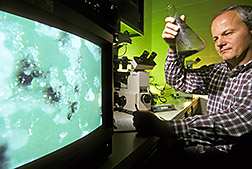
Fungus can be reproduced in liquid culture and dried for easy application.
A fungus that attacks hemp sesbania may lead to more economical nonchemical weed killers.
"Colletotrichum truncatum is looking better and better as a species that could he grown in liquid fermentation cultures and made into a user-friendly dried product, much as dried bakers' yeast is processed." says Mark Jackson. He is a microbiologist at the National Center for Agricultural Utilization Research in Peoria, Illinois.
Jackson is part of a multidisciplinary team of scientists and technicians who are refining techniques to produce a persistent life form of C. truncatum that could he mixed into soil to infect weed roots when moisture becomes available. The studies have advanced to field testing.
So far, only three fungi—from among more than 100 known weed-damaging microorganisms—have been officially registered in North America for use as biocontrol agents.
One of the three, Phytophthora palmivora, controlled strangler vine in Florida citrus groves so well it's no longer marketed—a victim of its own success. Of the two C. gloeosporiodides strains approved as biocontrols, one is used against northern jointvetch in Arkansas rice fields, while the other is effective against round-leaved mallow in several crops in Canada.
"More bioherbicides will merit commercial interest and farmers' acceptance when we find low-cost methods for making products that remain viable in storage and work well consistently under variable field conditions," says Jackson.
In 6 years of field tests at Stoneville, Mississippi, C. truncatum in its spore form has shown promise against hemp sesbania, a bane of cotton, soybeans, and other crops in the South.
The tests were conducted by ARS plant pathologist C. Douglas Boyette, who discovered and patented the microbe.
But two problems persist, one is that, so far, no technology exists for drying these spores for months-long storage. The other problem is uncertainty of the weather: Enough dew or other moisture must be present on leaves for the fungus to infect the weed.
So the scientists wondered if these problems with spore application could he avoided by using the microsclerotia form—dormant clumped threads—of the microbe, instead.
Plant pathologist David Schisler and Jackson conducted a laboratory growth-chamber study to find out, applying the dry microsclerotia to the soil to infect weed roots.
"Our results were very encouraging," Schisler says.
More than 95 percent of hemp sesbania seedlings died as they sprouted in pots containing some 150 microsclerotia per cubic centimeter of soil.
Schisler is now trying to learn how microsclerotia, or the spores they produce, can infect roots.
Microsclerotia resist such conditions as high temperatures and extreme drying that would kill fungi in other forms. More than 80 percent of the dried microsclerotia remained alive after 8 months in storage, and more than half survived over a year.
By producing microsclerotia in a liquid rather than solid medium, the researchers were better able to control aeration, temperature, and acidity of the fermentations and to adjust nutrient balances to produce high yields of the propagules at a low cost.
As field tests proceed, the researchers plan to fine-tune the medium. The result: microsclerotia that are most fit to infect weeds. -- By Ben Hardin, ARS,
Mark A. Jackson, and David A. Schisler are in the USDA-ARS Crop Bioprotection Research Unit, National Center for Agricultural Utilization Research, 1815 N. University St., Peoria, IL 61604: phone (309) 681-6596.
C. Douglas Boyette is at the USDA-ARS Southern Weed Science Laboratory, 141 Experiment Station Road, Stoneville MS 38776-0350; phone (662) 686-5272 , fax (662) 686-5422.
"The Next Bioherbicide?" was published in the June 1995 issue of Agricultural Research magazine.
