
United States Department of Agriculture
AgResearch Magazine


|
|
Treating the Bees' Wheeze
Natural products show promise for controlling tracheal and Varroa mites.
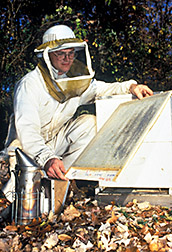
Virginia beekeepers Dennis and Neva Whetzel started noticing several years ago that their "golden angels" were losing their will to fly.
The honey-producing angels emerged from their hives and walked around outside.
They weren't acting like the busy bees whose pollinating activities add an estimated $15 billion to the value of U.S. food crops each year. And the work they do pollinating hay and seed crops for livestock consumption makes possible meat and dairy industries worth another $35 billion. All in all, honey bees contribute to about one-third of the total value of the U.S. food supply.
Small wonder that in her travels, a typical honey bee wears out her wings after 20 days—and 500 miles—of foraging for nectar and pollen.
But the Whetzels' bees, like many others across the country, have been slowed by tracheal and Varroa mites. Tracheal mites work their way into a bee's breathing tubes, making it hard for the bee to breathe—much less to fly.
Nor is it easy for her to fly when the blood-sucking Varroa mite has sapped her strength. In 1992, 2 years after the tracheal mites appeared, the Whetzels found that Varroa mites had weakened and killed many of their bees. These mites have become an increasing problem across the country since the mid-1980's.
To combat Varroa, the Whetzels and other beekeepers put strips containing fluvalinate, a synthetic pyrethroid, inside their colonies. But at $3 to $6 per hive, the strips are an added expense in a profit-slim business. Another limitation: the strips can only be used when bees aren't collecting nectar and pollen, to ensure that fluvalinate residues don't wind up in honey. And there are reports from Europe that Varroa mites have become resistant to fluvalinate—meaning its long-term effectiveness could be limited.
Beekeepers use menthol against tracheal mites. But that, too, adds to costs and is labor intensive.
Mites are the biggest threat to domestic honey bees, killing thousands of colonies each year. The Whetzels and other beekeepers who are struggling with the mites are looking for a less expensive, safer mite medicine to give their bees. Now, U.S. Department of Agriculture scientist Nick Calderone may be able to fill that prescription.
Calderone, an entomologist with USDA's Agricultural Research Service, is testing natural plant extracts that, in lab studies, killed both types of mites without harming honey bees. Also, the extracts were effective against Varroa in small-scale field tests.
Based at the agency's Bee Research lab in Beltsville, Maryland, Calderone is conducting large-scale field studies in four states to see how well the extracts fare at commercial apiaries.
Tests are under way at Whetzel's Golden Angels Apiary near Harrisonburg, Virginia; Haven Keller's apiary in Mercersburg, Pennsylvania; in Texas in cooperation with ARS entomologist William Wilson at Weslaco; and in Minnesota in cooperation with entomologist Maria Spivak at the University of Minnesota.
USDA's Sustainable Agriculture Research and Education Program helped fund the research.
Against Varroa, Calderone used a blend of natural plant oils—primarily thymol and eucalyptus oil. The oils are derived from herbs and other plants and kill fungi, bacteria, and other organisms, as well as mites.
And "a major advantage of these plant oils is that they have low mammalian toxicity," Calderone says.
Calderone and ARS technician Rick Turcotte mixed the plant extracts and soaked them into a green, foam brick that florists use for flower arrangements. Then they put the absorptive bricks into hives for several weeks in late fall, after bees had finished making honey. The mixture killed 98 percent of Varroa mites and was as effective as the fluvalinate strips.
For tracheal mites, the researchers mixed oils from peanuts, sunflowers, rapeseed, or soybeans in sugar patties and placed them in 71 colonies at the Pennsylvania apiary. After 3 months, they removed bees, dissected them, and counted tracheal mites in the bees' breathing tubes.
The result: only 1.5 to 2.5 percent of the bees were infected, compared to nearly 10 percent of those in untreated colonies.
Calderone says he still has to perfect a way to apply the compounds with as little labor as possible and would have to gain regulatory approval from the Environmental Protection Agency to use the compounds to control honey bee mites. Ideally, he hopes to find a mixture of compounds that would kill both mites.
"We still have a way to go before we have a commercial product, but we're encouraged," Calderone says. "These compounds exhibit a significant potential for controlling mites and may also be effective against some honey bee diseases." -- By Sean Adams, ARS.
USDA-ARS Bee Research Laboratory, Bldg. 476, Rm.100 BARC-East, 10300 Baltimore Blvd., Beltsville MD 20705; phone (301) 504-8637.
"Treating the Bees' Wheeze" was published in the June 1995 issue of Agricultural Research magazine.
