
United States Department of Agriculture
AgResearch Magazine


Science Update
With Age, Fat Creeps Up As Body "Idles" More Slowly
Older men, compared to younger counterparts, burn fewer calories after overeating, ARS researchers have discovered. The finding helps explain why body fat creeps up in older men—and why taking a walk after dinner gets smarter as life goes on. Normally, when a person overeats, the body seeks to restore a balance. So, as a car that idles faster burns more gas, the body burns more excess calories by turning up the RPM's of its resting metabolic rate. This rate is the energy spent to keep the resting body functioning. The researchers fed two small groups of men an extra 1,000 calories a day for 3 weeks. One group was in their 60's and 70's; the other, in their 20's. Because of a milder speedup in metabolism, the older men hung on to an estimated 87 extra calories daily, on average, that was stored as fat. This seems trivial, but it adds up: 2.2 pounds a year, or 22 pounds per decade.
Susan Roberts is at the USDA-ARS Jean Mayer USDA Human Nutrition Research Center on Aging at Tufts, Boston, Massachusetts, phone (617) 556-3238.
Genes of Tobacco Cousin May Be Biotech Pest-Fighters
Wild tobacco possesses a natural defense that tomatoes, cotton, and other crops might be able to use. With the right genes from Nicotiana gossei, crop plants might make the same chemicals this wild plant manufactures to kill silverleaf whiteflies and other leaf-feeding pests. N. gossei, an Australian cousin of commercial tobacco, turns out several of the chemicals, including sucrose esters. The esters have killed whiteflies, aphids, spider mites, pear psyllas, and tobacco hornworms in ARS lab and field tests. Scientists now seek to identify and isolate the genes responsible.
USDA-ARS Western Cotton Research Laboratory, Phoenix, Arizona, phone (602) 437-0121.
|
|
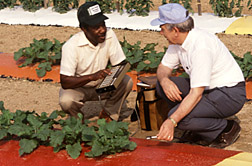
Red Mulch for Hotter Yields
Sonoco Products, Inc., of Hartsville, South Carolina, and ARS scientists are testing colored plastic mulches as yield-boosters for tomatoes and other crops. Sonoco earlier produced a red plastic mulch based on an ARS formula. The mulch is sold by Ken-Bar, Inc., of Reading, Massachusetts. ARS scientists found out why red mulch stimulates plant growth more than black mulch. Light waves reflected by the red make the plant respond as if it’s being crowded. It puts more energy into above-ground growth, including fruit. Under a cooperative research and development agreement (CRADA), scientists are testing red plastic mulch on tomatoes, strawberries, peppers, and other crops in Colorado, Kentucky, Maryland, Pennsylvania, and South Carolina.
USDA-ARS Soil, Water, and Plant Research Center, Florence, South Carolina, phone (843) 669-5203
Enzyme Blocker May Help Tame Whipworms
The swine whipworm, Trichuris suis, makes an enzyme that could be its own undoing. This parasite is sometimes fatal to pigs. But ARS research indicates that the enzyme, a thiol protease, plays a role in the worm's ability to digest and absorb nutrients. Blocking the enzyme's action with a chemical could be a way to improve control. The worms form lesions in the intestinal lining of a pig, which lets bacteria invade underlying tissues. With commercially available worming medicines, control over the worms is sometimes incomplete. Infected pigs suffer weight loss, anemia, and diarrhea.
Dolores E. Hill, USDA-ARS Animal Parasitic Diseases Laboratory, phone (301) 504-8770.
Cups and Plates Made From Wheat
Biodegradable containers made with wheat starch are being developed by ARS scientists and Tenneco Packaging, Inc., of Canandaigua, New York. Under a CRADA, scientists will investigate methods for processing the starch. Then, equipment now used to make food and beverage containers from plastic might produce starch-derived substitutes. This could create a new market for wheat starch.
Gregory M. Glenn, USDA-ARS Bioproduct Chemistry and Engineering Research Unit, Western Regional Research Center, Albany, California, phone (510) 559-5677.
"Science Update" was published in the July 1996 issue of Agricultural Research magazine.
