
United States Department of Agriculture
AgResearch Magazine


Geneplay Combats Cucumber Mosaic Virus
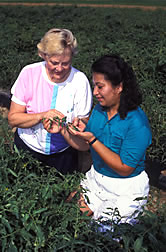 Chemist Marie Tousignant (left) and plant pathologist Thanda Wai check nontransgenic control plants in the field for signs of infection, such as small, malformed leaves. (K7116-8) |
Like a neighborhood bully, cucumber mosaic virus (CMV) has long victimized tomatoes and other vegetables lacking the resistant muscle to challenge it. Now, biotechnology is evening the odds.
At Agricultural Research Service labs in Beltsville, Maryland, and abroad, scientists are bioengineering tomato plants with a virus-fighting component—a genetic snippet known as a viral satellite.
In plants, its sole duty is to poach a crucial enzyme from an invading virus so it is less able to multiply and cause disease, says chemist Marie E. Tousignant. She's at the ARS Plant Science Institute's Molecular Plant Pathology Laboratory.
The viral satellite responsible for this enzyme thievery is S-CARNA 5—short for CMV-associated RNA number 5 from CMV strain S. It depends solely on its viral host to survive and is harmless to humans, animals, and insects.
In nature, S-CARNA 5 occurs as a single strand of genetic material called ribonucleic acid, or RNA. But the Beltsville scientists took nature a step further: They inserted a DNA, or deoxyribonucleic acid, version of the satellite into tomato cells. Then they grew the cells into seed-bearing plants that later passed the new trait on to their offspring.
Recent field tests of the satellite-tomato combo have been encouraging, Tousignant says. "Right now, we're looking for a vigorous plant that will point the way to how this technology can eventually be used in marketable tomatoes."
Having bioengineered tomatoes with high yield, good quality, and CMV resistance would profit growers and consumers, as well as the seed companies that developed them as commercial lines.
Tousignant's colleagues on the project are plant geneticist John R. Stommel of ARS' Vegetable Laboratory in Beltsville and retired ARS chemist Jacobus M. Kaper, who discovered S-CARNA 5 in 1976.
CMV's Notorious Reputation
Worldwide, cucumber mosaic virus attacks nearly 800 different plant species. Its vegetable hit-list includes tomatoes, celery, cucumbers, lettuce, melons, spinach, sweet peppers, hot peppers and squash.
In the United States, CMV mainly attacks the latter three, although in northern Alabama, it has struck that state's top tomato-growing region. Outbreaks in processing tomatoes have also been reported recently in California's San Joaquin Valley.
"Presently, growers' main defense against the virus is to spray insecticides to kill aphids that transmit it," says Tousignant. "But this doesn't always work."
Farmers also try to deter CMV-carrying aphids with other measures—reflective mulch repellants, crop rotation, and staggered seeding dates—also, with mixed success.
Waging Molecular Warfare
The Beltsville team seeks to combat CMV on a molecular front. Their approach targets its assault on plant cells.
This begins when a hungry aphid passes the virus into plant tissues as it feeds on the nutrient-rich sap flowing through the plant's veins.
Once inside, the tiny marauder infiltrates the cells and sheds its protective protein coat. The virus then releases a set of genetic instructions to get the cell to make an enzyme called RNA-specific replicase, which it needs in order to multiply and spread. Its numbers thus bolstered, the virus manifests its conquest by making the plant grow narrow, stringy leaves, stunted stems, and little or no edible fruit.
These cellular breaches, however, meet with little success in the viral satellite-protected plants.
As soon as CMV forces the plant's cells into making the crucial enzyme, the bioengineered S-CARNA 5 moves in. It filches for its own reproduction the enzyme made for the virus. Fortunately, the satellite easily outcompetes it rival—despite being one-twenty-fifth its size. However, such competition also keeps the satellite's own numbers in check. This is because it can reproduce itself only as long as there is enough virus present to compel the plant's production of enzymes.
Readings From the Field
So what's the outcome of this cellular strife, and what's its toll on plants? When challenged with the virus in 1994 field tests, the bioengineered plants not only sustained growth, vigor, and height, they also produced 50 percent more fruit than their ordinary counterparts.
And in a second round of outdoor tests in 1995, Tousignant reports, they produced 65 to 75 percent more fruit than the infected control plants. "The satellite gene doesn't harm the noninfected, bioengineered control plants, nor their fruit," she notes.
Tousignant did the study with Stommel and plant pathologist Thanda Wai, who was formerly with the lab and is now with the U.S. Patent and Trademark Office. They grew three bioengineered lines of commercial tomatoes—and their ordinary counterparts—at the Beltsville center.
Tousignant says fruit yield, weight, and other comparisons will help ascertain the bioengineered line's competitiveness with current market varieties.
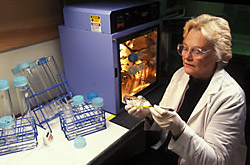 To detect the presence of CARNA 5 in field samples, chemist Marie Tousignant prepares a membrane for nonradioactive dot-blot hybridization. More than 1,000 samples were tested in this manner. (K7142-18) |
Market Bound?
All signs are that the biotech tomatoes look, smell, and taste like other fresh-picked tomatoes. As commercial cultivars, they would most benefit growers in regions plagued with high incidence of CMV, the ARS researchers say.
They also acknowledge the virus' sporadic nature in domestic crops may discourage commercial development of the biotech lines in the United States. For private plant breeders, the investment necessary to produce commercial cultivars and overcome regulatory hurdles to market them may outweigh the risk CMV currently poses to crops.
"Cucumber mosaic virus has to occur on a large enough scale that people will look for more sophisticated technologies to combat it," Kaper observes. In the meantime, more conventional agronomic methods of controlling the virus may appeal to American growers.
"Once you become convinced your long-term threat is there," Kaper says, "then you can start thinking about bioengineered tomato plants."
Bob Heisey of Asgrow Seed Company in San Juan Bautista, California, expresses a similar view on introducing a virus-resistant crop variety—especially one via biotechnology. He says, "We have to get a better feel for whether the disease is a one-shot deal or a long-term thing."
But CMV is not so easily predicted. Alabama's Blount and St. Clair Counties are hapless proof that it can become more than a one-shot deal. Over the past 4 years, epidemics have clobbered the region's 2,000-plus acres of fresh-market tomatoes, says Dan Porch, an Auburn University extension agent in Oneonta.
"We have been known as the most important tomato-producing region in Alabama," says Porch of the 45-year-old industry there. Cucumber mosaic virus's unwelcome debut in 1992 has jeopardized that standing. Also as a result of cucumber mosaic virus, he says, "We've lost several major growers—they've thrown in the towel."
And in the West, plant pathologists suspect CMV and two other virus species as culprits behind white, "mummified" tomato fruit in fields of the San Joaquin Valley, about 3 hours southeast of Sacramento, California.
Abroad, CMV is among the leading viral crop pests in Italy, Spain, Egypt, Japan, and China. There, plant scientists have sought Kaper's expertise in devising viral satellite inoculants for seedlings. They've also pursued satellite-engineered crop plants, he says.
At least one government-run firm in China distributes satellite inoculants to protect seedlings of tomato, pepper, cucurbits and tobacco. Chinese farmers now grow the vaccinated plants on more than 25,000 acres of cropland. All are protected with another satellite, 1-CARNA 5, which Kaper and Beltsville colleagues discovered in the late 1970"s and later supplied to their Asian collaborators.
And for 2 years, Nippon Delmonte Corp., of Tokyo, has successfully marketed satellite-inoculated tomato seedlings in Japan.
Last August, the company dedicated its new transgenic greenhouse. It is gearing up to market a fresh-market tomato variety engineered with a satellite indigenous to Japan.
"Through successes in East Asia, we have seen this technology become reality," says Kaper.
But he shares other scientists' concern that a CMV epidemic may happen here and U.S. growers may not be prepared to deal with it with our own technology or resistant seed. -- By Jan Suszkiw, ARS.
John R. Stommel is at the USDA ARS Vegetable Laboratory, Beltsville, MD 20705-2350; phone (301) 504-5583.
USDA-ARS Molecular Plant Pathology Laboratory, 10300 Baltimore Ave., Beltsville, MD 20705-2350; phone (301)-504-5745.
"Geneplay Combats Cucumber Mosaic Virus" was published in the July 1996 issue of Agricultural Research magazine.
