United States Department of Agriculture
AgResearch Magazine


Two Stilt Bug Species Discovered |
|
|
|
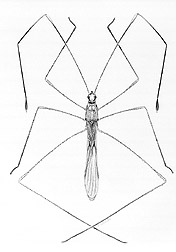
A diverse group of insects known as stilt bugs are both friend and foe to our agricultural crops. And two new ones have just been discovered. Worldwide, stilt bugs are a relatively small group of unusual hemipterans, or true bugs, in the family Berytidae. They possess long, slender legs, leathery front wings, and membranous hind wings. Most notably, their legs and antennae are often longer than their bodies. Stilt bugs range in size from only about 2 millimeters, such as the species Hoplinus scutellaris, to the 16-millimeter Plyapomus longus. While some members of the Berytidae family are beneficial and prey on crop pests such as aphids, mites, cotton budworm, and tomato hornworm, others are serious pests of tomato, cotton, and cacao. Recently, Agricultural Research Service entomologist Thomas J. Henry studied two species of the genus Yemmatropis, including previously known Y. dispar. Reported only in China, Nepal, and Thailand, this species has now been found in Malaysia and Vietnam. Henry has also described a species new to science from Vietnam—Y. erectus. He found this predatory stilt bug at the Bernice Bishop Museum in Honolulu, Hawaii, among specimens that had been collected by scientists during a faunal survey of Southeast Asia. Another new species recognized by Henry, H. paulai, like most stilt bugs, is poorly known. The genus Hoplinus is found from the western United States and Canada south to Argentina and southern Brazil and Chile, but H. paulai is known only from the state of Minas Gerais, Brazil. While many stilt bugs are phytophagous, meaning they eat plants, others are predaceous, meaning they feed on other, usually smaller insects. Some of these insect-eating bugs are recognized as important predators in agricultural ecosystems. But despite the small size of this insect family and the abundance of some of its members, the habits and hosts of most species remain something of a mystery. Henry says recognition of these stilt bugs will assist quarantine and regulatory agencies in halting potentially important foreign species from entering the United States.—By Jennifer Arnold, formerly with ARS. This research is part of Crop Protection and Quarantine, an ARS National Program (#304) described on the World Wide Web at http://www.nps.ars.usda.gov. Thomas J. Henry is with the USDA-ARS Systematic Entomology Laboratory, c/o National Museum of Natural History, 10th St. & Constitution Ave., S.W., Washington, DC 20560; phone (202) 382-1780, fax (202) 786-9422. |
|
"Two Stilt Bug Species Discovered" was published in the July 2002 issue of Agricultural Research magazine. |