United States Department of Agriculture
AgResearch Magazine


Coping With Swine ManureState-of-the-art technology cleans up wastewater from large-scale animal production. |
|
|
|
Scientists at the ARS Coastal Plains Soil, Water, and Plant Research Center in Florence, South Carolina, are tackling one of the nation's greatest environmental problems: the cleanup and disposal of manure from swine-production wastewater. "Large-scale swine production is increasing in the United States at a very rapid rate," says ARS soil scientist Patrick G. Hunt, who leads the Florence lab. "In North Carolina alone, hog production increased from 2.6 million in 1990 to over 9 million in 1997." Pork production is a major enterprise that has monumental waste-treatment challenges. "These problems are related to flushing waste from high-density confinement facilities into anaerobic lagoons and then applying the wastewater to cropland," says Hunt. "Besides nitrogen, swine manure contains phosphorus and other chemicals that can fertilize plants. But it becomes an environmental concern when more nitrogen is applied than crops or forage can assimilate," he says. |
|
|
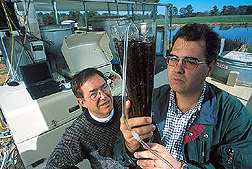
According to ARS soil scientist Matias B. Vanotti at the Florence lab, "As the practice of confined-animal production grows, we desperately need effective and affordable alternatives for managing the nutrient byproducts of these large-scale operations." Vanotti, working with Hunt and a team of ARS colleagues, has devised a quick, effective, and relatively inexpensive new technology for removing the ammonia form of nitrogen from large-scale swine-production facilities. "We adapted Japanese state-of-the-art technology for treating municipal wastewater," he says. "It uses large populations of bacteria entrapped in polymer gel pellets to break the ammonia down into nitrite, then nitrate." This process is known as nitrification. Then, in a process called denitrification, the nitrate is converted to nitrogen, an odorless gas that is the main component of air. |
|
|
Vanotti's team is first to apply the Japanese pellet technology to disposal of high-ammonia wastewater from large-scale U.S. animal production facilities. "Our preliminary research indicated that nitrifying bacteria protected in pellets could nitrify animal lagoon wastewater at rates comparable to those used in Japan to clean up municipal wastewater systems," says Vanotti.
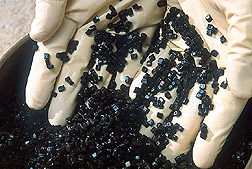
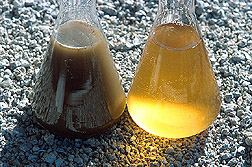
The pellets—an eighth- to a quarter-inch wide—are typically made of polyethylene glycol and polyvinyl alcohol. These polymers are liquefied and mixed with Nitrosomonas and Nitrobacter bacterial sludge and then solidified by cold or chemical treatment. The pellets allow ammonia, oxygen, and carbon dioxide to pass through and nourish the bacteria. "The pellets provide an ideal environment, because the organisms are immobilized inside, yet able to perform optimally," says Vanotti. Nitrification/denitrification of animal wastewater is difficult because it contains high amounts of ammonia that hinder the nitrifying bacteria, says Vanotti. The key to success is to let the bacteria adjust, or acclimate, to the high-ammonia environment. The scientists found that the nitrifying microorganisms can perform optimally after 2 months of acclimation. "Acclimation requires exposing the pellets to 10 to 20 times the ammonia found in municipal wastewater," says Vanotti. "Once acclimated, they should be able to treat high-strength wastewater effectively for 10 years or more." How the Pellet System Works First, swine manure wastewater is stored in a lagoon to settle the solids. Then the liquid is pumped into a tank, or reactor, equipped with an aeration system, which provides the oxygen-rich environment necessary for nitrification to occur. A wire screen retains the pellets, which take up 7 to 15 percent of the tank's volume. The subsequent conversion of nitrate into nitrogen gas—denitrification—occurs under reduced-oxygen conditions. In small-scale tests, the ARS researchers found that the pellets removed 97 to 100 percent of the ammonia in wastewater. "The nitrification rates are three times those achieved in the United States using conventional activated-sludge treatment systems," says Vanotti. "The new technology is quicker and cheaper, too." After the small-scale tests, the researchers spent 2 years developing and perfecting a field-scale pilot test in Kenansville, North Carolina. "For our first pilot-site reactor, we used wastewater from a 2,600-pig nursery, which uses a flushing system to recycle liquid from a single-stage lagoon. The average liquid volume of the lagoon was 144,730 cubic feet. The lagoon liquid typically contained 365 parts per million nitrogen—mostly as ammonia," Hunt says. The team evaluated the pilot unit throughout 1998 and 1999. During the second year, nitrification rates were greater than 90 percent, with treatment lasting a total of 12 hours. The ammonia was converted entirely into nitrate-nitrogen forms without any being lost to volatilization. That ammonia reduction also cut down foul odors considerably. The team developed a second pilot reactor in an innovative system where the lagoon is omitted. The solids and liquid are separated with polyacrylamide (PAM) treatment, followed by nitrification/denitrification with the pellet technology. PAM is a water-soluble polymer that clumps the fine, suspended particles typical of swine manure into larger particles, or flocs. This enhances the separation efficiency of screens and filters. During 2000, the team evaluated the second pilot system in cooperation with North Carolina State University at its Waste Management Center at Lake Wheeler Farm in Raleigh. "Solids separation with PAM reduces 98 percent of the oxygen demand, which allows economical aeration treatment of the liquid-flushed manure," says Vanotti. "By capturing the suspended particles, we also remove most of the volatile and oxygen-demanding organic compounds from the liquid stream. "Instead of breaking down organic compounds, the oxygen in the aeration treatment is used efficiently to convert ammonia. Combined with the pellet technology, this system lowers nitrogen concentration from 675 parts per million to fewer than 25. The purified and deodorized effluent can be recycled to clean the hog houses or used for crop irrigation." A full-scale demonstration of such a system has been planned at a 4,360-pig farm in North Carolina's Duplin County, says Vanotti. The system will separate solids and liquids, make a soil-free growth medium from the solids, remove the nitrogen and phosphorus from the wastewater, and recycle and reuse the cleaned water.—By Hank Becker, formerly of ARS. This research is part of Manure and Byproduct Utilization, an ARS National Program (#206) described on the World Wide Web at http://www.nps.ars.usda.gov. Patrick G. Hunt and Matias B. Vanotti are at the USDA-ARS Coastal Plains Soil, Water, and Plant Research Center, 2611 W. Lucas St., Florence, SC 29501-1241; phone (843) 669-5203, ext. 101/108, fax (843) 669-6970. |
|
"Coping With Swine Manure" was published in the July 2001 issue of Agricultural Research magazine. |