
United States Department of Agriculture
AgResearch Magazine


Low-Cost Way To Pave Feedlots
|
|

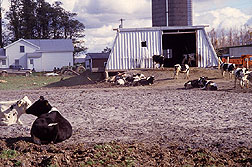
Thanks in part to studies by Agricultural Research Service and industry scientists, this powdery byproduct of burning coal to generate electricity is now helping dairy farmers mud-proof their barnyard feedlots. That's where heavy winter or spring rains quickly turn soils to knee-deep mud, bogging down hefty cows, subjecting them to disease, and sapping them of energy to produce milk.
But research has shown that by paving feedlot areas with a hydrated form of flyash, farmers can build a solid foundation to give their cows a leg up on mud. Not only is flyash cheaper than paving with concrete--$6 per square yard versus $75--it poses little danger to the environment.
That's the verdict from pilot studies conducted by ARS soil scientist William L. Stout in cooperation with professional geologist Thomas L. Nickeson of Wellsboro, Pennsylvania, and two commercial partners--Gerry Thompson of Air Products and Chemicals (AP&C), an Allentown, Pennsylvania, company; and Paul Cunningham of Black Rivers Co-Gen Partners, a Fort Drum, New York, power plant.
One study, conducted in 1995-96 on an experimental dairy farm north of Harrisburg, Pennsylvania--and funded by the U.S. Department of Energy--examined the environmental impact of spreading 33 tons of flyash onto a 900-square-foot feedlot. Researchers applied a form of flyash gleaned from a coal-burning process called fluidized-bed combustion that is employed by the electric utility industry.
|
|
Using instruments called suction lysimeters, the team monitored the concentrations of various elements and heavy metals seeping into groundwater from the flyash pads. Later, they compared the data with that collected from an unpaved feedlot, says Stout, who is at ARS' Pasture Systems and Watershed Management Research Laboratory in University Park, Pennsylvania.
Though lab analysis revealed minute traces of elements like calcium and nickel, a heavy metal, "we weren't able to detect anything at unacceptable levels," says Stout, referring to threshold levels for safe drinking water set by the U.S. Environmental Protection Agency.
Based on results from the Harrisburg study and other earlier ARS projects, the New York Department of Environmental Conservation subsequently approved farmer use of flyash as a safe barnyard paving resource. Follow-up studies conducted by Nickeson and collaborators at AP&C and three other companies also expedited approval in parts of El Niño-soaked California.
Mike Huggins, of the San Joaquin County Environmental Heath Division, said five dairy operations in his jurisdiction have paved their lots with a local plant's flyash to protect their cattle from high water and muddy conditions that promote disease.
"Right now, we have the University of California-Davis Medical Veterinary School looking at flyash from an animal health standpoint," says Huggins. Evidence collected from the farms thus far points to a sharp drop in cases of hairy footwort, a viral hoof infection, and mastitis, a bacterial udder disease.
For Nickeson, using flyash to pave feedlots is a win-win situation for both the electric utility industry and dairy producers. By selling the flyash, power plants save money on waste disposal; by using it, farmers safeguard their cattle's welfare and ensure peak milk production and growth during the rainy season.
Paving also helps direct manure towards waste utilization systems, says Stout. That helps reduce the potential for nitrogen and phosphorus to contaminate groundwater.--By Jan Suszkiw, Agricultural Research Service Information Staff.
William L. Stout is at the USDA-ARS Pasture Systems and Watershed Management Research Laboratory, Curtin Rd., University Park, PA 16802-3702; phone (814) 863-0947, fax (814) 863-0935.
"Low-Cost Way To Pave Feedlots" was published in the January 1999 issue of Agricultural Research magazine.
