
United States Department of Agriculture
AgResearch Magazine


Better Diets for Delta Residents
|
|
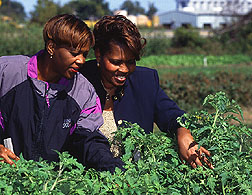
A new nutrition program that combines science with public outreach could help poor families in the lower Mississippi Delta region live healthier lives. Called the Delta Nutrition Intervention Research Initiative (Delta NIRI), it brings public outreach to the Agricultural Research Service's longstanding nutrition research program.
Like scientists at ARS' six nutrition research centers, Delta NIRI researchers will do laboratory work--often using human volunteers--and will publish their work in scientific journals. But their papers may also focus on innovative programs to help Delta families overcome poor nutrition and other problems associated with poverty.
Why this special initiative for the Delta?
Because families in that region often experience low-birth-weight newborns and high infant mortality. Mothers lack prenatal care, which also contributes to the problem. Cardiovascular disease and diabetes cases are above national averages. And though the poverty rate for the United States is at 13 percent, in the Delta, it's 27 percent.
The Delta areas of Mississippi, Louisiana, and Arkansas are home to more than 5.3 million people. They're areas of low crime, with Catholic, Baptist, and Methodist churches serving as key sources of services and information. About 34 percent of the population is African American, with those citizens shouldering the biggest burden of the area's poverty.
Delta NIRI, which started officially in 1995, has an FY 1999 budget of $3.1 million. Its members include research and educational partners throughout Mississippi, Louisiana, and Arkansas, including three historically black 1890 land-grant universities. Many members say the Delta NIRI project benefits from the diversity of members--and institutions--involved.
In addition to ARS, they are the Arkansas Children's Hospital Research Institute in Little Rock; Pennington Biomedical Research Center in Baton Rouge, Louisiana; University of Arkansas at Pine Bluff; and Southern University and A&M College in Baton Rouge. It also includes Alcorn State University in Lorman, Mississippi, and the University of Southern Mississippi at Hattiesburg.
Setting Correctives in Motion
Delta NIRI works like this. Say, for example, a food scientist finds low iron levels in students attending a Delta school. After publishing these findings, the scientist might want to work with a nutritionist to create an iron-rich school snack program. It would then be the community's job to keep it running.
"We have 36 counties or parishes in Louisiana, Mississippi, and Arkansas we are studying. We don't tell people what they need; we listen," says program executive director Margaret L. Bogle. "It's a delta of cooperation--the schools, ARS, and the communities.
|
|
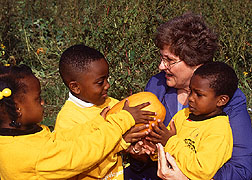
"At the University of Arkansas at Pine Bluff, we have five professionals involved to support the initiative: a nutritionist, a pediatric nutritionist, two food scientists, and a home economist," says Edith Neal, chair of the Department of Human Sciences.
Neal says her group's main focus is to improve people's lives in the Delta through nutrition. She says she appreciates the research facilities available to Delta partners.
"Pennington Biomedical has an incredible research facility, and Arkansas Children's Hospital has access to the medical community," says Neal. "In return, the four educational institutions involved bring experience in teaching research and outreach to address the special needs of the Delta."
Neal says her group will look at diabetes, cardiovascular health in adults, and iron and folate in children--all of which are linked to poor diets.
Last year, Delta NIRI began by asking 500 Delta community leaders what they saw as the key health and nutrition problems in the area. Ninety-seven percent said the top nutrition problem is that residents eat too many high-fat foods. Teen pregnancy in Arkansas and high blood pressure in Louisiana and Mississippi were considered the top health problems.
They also said residents lacked nutrition information or interest in eating a healthy diet. Three-fourths of the leaders said high food prices keep some from eating healthy foods. Sixty-seven percent said too few fruits and vegetables were available. About 80 percent of the community leaders also worried that pregnant women were not eating right.
Surveying the Situation
"The survey is very important because having the support of community leaders means buy-in from the community," says Neal. "And we find what they tell us reflects what we're seeing in epidemiological literature--especially the input from physicians, nurses, and counselors at the WIC program." WIC is USDA's Special Supplemental Food Program for Women, Infants, and Children.
Delta NIRI is now completing a survey of residents to gain more information. "I'm encouraged by the leaders' comments, because Delta NIRI can play a role in nutrition education," Bogle says. She also says the community survey may show a better nutrition awareness than many assume.
Community members have been involved in Delta NIRI's work from the start. The program trained Delta residents to do the
surveys--which proved an invaluable asset for research accuracy.
Cooking practices in these rural Southern communities can influence diet and health, which is one reason to have Delta residents participate in the survey.
For example, many Delta families make ends meet by eating wild-growing poke greens. These have about the same nutrient content as spinach or collard greens, but how people cook their greens differs.
"When a trained Delta NIRI researcher hears somebody ate poke salad they know to ask, "Okay, was that with eggs, bacon, or plain?" says Bogle. "The person's answer tells whether the food choice added protein or fat. It's where knowing cultural practices pays off."
But understanding Delta life does more than enhance survey results. It can also ensure that any programs developed are effective.
Poverty in the Delta causes nutrition barriers that are different from those
urban families face. Understanding these problems makes it easier to find workable solutions. Take, for example, the problem of providing children fresh fruit and vegetables.
Many poor families live on land unfit for gardening and are generations removed from farming know-how.
In the United States, 88.5 percent of the driving-age population own a car, but only 68 percent own one in the Delta. Add a lack of refrigeration to unreliable transportation, and produce isn't an option because of spoilage. Some Delta grocers don't even stock fresh fruits and vegetables.
Most people assume that people in the Delta are farmers. The reality is that small family farms are disappearing. And while most farms are still family owned, they are larger and fewer people are involved.
"Creating small garden plots for families is one possible solution," says Bogle. "But is this something the community will want--is it the most pressing need? These are the kinds of things Delta NIRI can help us find out."--By Jill Lee, Agricultural Research Service Information Staff.
Margaret L. Bogle is with the USDA-ARS Delta NIRI, 10825 Financial Centre Pkwy., Ste. 309, Little Rock, AR 72203; phone (501) 954-9152, fax (501) 954-9596.
"Better Diets for Delta Residents" was published in the January 1999 issue of Agricultural Research magazine.
