
United States Department of Agriculture
AgResearch Magazine


Heated Air Blasts Papaya Pests
Fresh, juicy papayas from Hawaii can be kept free of live fruit flies with a packinghouse procedure from ARS and the University of Hawaii.
Once used only on the islands of Hawaii and Kauai, the hot-forced-air technique today is on-line at packinghouses on the islands of Oahu and Molokai as well. It is credited with easing entry to profitable mainland U.S. markets and rescuing jobs that might otherwise have been lost.
Hawaii's papaya growers produced about 42 million pounds of the sweet-tasting fruit, worth about $17 million, in 1996. They specialize in two varieties—the golden-fleshed Kapoho Solo and Sunrise, a reddish-orange type.
"Commercially grown papayas from Hawaii are so carefully checked that it's unlikely fly-damaged fruit would make it to a mainland supermarket," says ARS entomologist John W. Armstrong at Hilo, Hawaii. "Our hot-forced-air process is simply extra insurance."
Called a quarantine treatment, hot-forced-air is one of three federally approved techniques. The treatment is similar to another option, called vapor heat, but differs in that vapor heat uses humidity differently. Another approach, irradiation, requires equipment not yet available in Hawaii.
Hot-forced-air kills three different kinds of crop-damaging fruit flies—the Mediterranean fruit fly, oriental fruit fly, and melon fly.
|
|
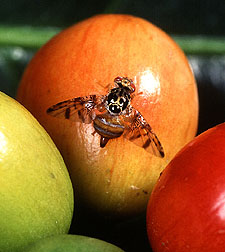
At the packinghouse, papayas are placed in a chamber typically made of stainless steel. Hot air, forced over the surface of the fruit for at least 4 hours, heats it to 117oF. Then the fruit is cooled for about an hour.
Heat-treating papayas ensures that pestiferous fruit flies can't hitchhike to vulnerable farms, orchards, and backyard gardens on the U.S. mainland.
Each of the three fly species, already ensconced in Hawaii, "could readily adapt to the warm, mild climates of California, Florida, or other Sunbelt States and wreak agricultural havoc," says Armstrong. Medfly, for instance, "ranks as one of the world's worst agricultural pests, capable of attacking the fruit of more than 300 different kinds of plants."
The 1995-96 outbreak of medfly in southern California cost an estimated $13 million.
Insect Offensive
The medfly, oriental fruit fly, and melon fly each employ the same extremely successful mode of attack, says Armstrong.
"Females use their tubelike ovipositors to pump tiny eggs into the flesh of ripening fruits and vegetables. Young maggots, or larvae, hatch from the eggs. They use the fruit or veggie for food and housing and turn it into a decaying, unmarketable mess. The developing larvae drop to the ground, form their next lifestage—a pupa—while in the soil, and later emerge as adult flies."
To garner regulatory approval, Armstrong and colleagues tested the hot-forced-air technique with a research-size chamber at the ARS Tropical Fruit, Vegetable, and Ornamental Crop Research Laboratory in Hilo. Their experiments began in 1987 and required more than a quarter-million fresh papayas, plus some 1.8 million laboratory-reared fruit flies.
|
|
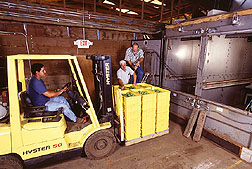
Armstrong did the work with Steven A. Brown of ARS at Hilo; James D. Hansen, now with ARS at Wapato, Washington; Edward T. Uyeda of USDA's Animal and Plant Health Inspection Service and Benjamin K.S. Hu, now retired from that agency; Michael R. Williamson, professor of biosystems engineering with the University of Hawaii, Manoa; and Paul M. Winkelman of Quarantine Technologies International, Ltd., Honolulu.
ARS has registered the process with the U.S. Patent and Trademark Office. The University of Hawaii has filed a patent application for the hot-forced-air equipment.
Sunrise Packers on Kauai started using hot-forced-air in 1993. A new packinghouse for Kauai, expected to be up and running in 1998, will boast two new hot-forced-air units.
Hawaii Fruit Growers on Molokai chose hot-forced-air in 1997 for their first-ever papaya shipments to the U.S. mainland. Those sales were so successful that the co-op is now building a second unit.
Dole Food Company Hawaii on Oahu now has mainland U.S. markets for fresh papaya as well, thanks to two hot-forced-air chambers that the company installed in 1997. Dole converted 600 acres of no-longer-profitable sugarcane fields to papaya.
|
|
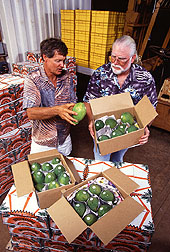
"We've rehired or newly hired more than 80 people to work in papaya production," says Dole Food Company Hawaii president, Jerry D. Vriesenga, "and we expect to hire many more as the project grows."
Hot-forced-air also zaps medflies and oriental fruit flies that might be concealed in grapefruit and oranges, according to experiments by Armstrong and co-workers. They tested a total of about 6,500 Marsh White and Marsh Red grapefruit, plus navel and Valencia oranges, with funds from the California citrus industry.
[See "What Works in Hawaii Is also Good in Texas"
Their technique would serve as an alternative process, should medfly or oriental fruit fly—perhaps stow aways in luggage or parcels of illegal fruit—ever gain a foothold in mainland citrus groves.
— By Marcia Wood, Agricultural Research Service Information Staff, 800 Buchanan St., Albany, CA 94710; phone (510) 559-6070.
JJohn W. Armstrong and Steven A. Brown are at the USDA-ARS Tropical Fruit, Vegetable, and Ornamental Crop Research Laboratory, P.O. Box 4459, Hilo, HI 96720; phone (808) 959-9138, fax (808) 959-4323.
"Heated Air Blasts Papaya Pests" was published in the January 1998 issue of Agricultural Research magazine. Click here to see this issue's table of contents.
