United States Department of Agriculture
AgResearch Magazine


Giving Baculoviruses a Better Edge
|
|
|
|
Scientific advancements built on an understanding of what nature already provides are leading to environmentally friendly crop-pest control by either biological agents or specifically designed synthetic anti-insect compounds. A case in point: research on baculoviruses.
Baculoviruses are rod-shaped DNA viruses, many of which begin their life cycle reproducing inside cells. In the nuclei of caterpillar cells infected with baculoviruses, viral progeny multiply and are incorporated into protective polyhedron-shaped protein structures called occlusion bodies. Infected caterpillars die and contaminate the leaf surfaces with the occlusion bodies. Then, healthy caterpillars ingest the occlusion bodies and release the virus when feeding on contaminated leaves, thus continuing the life cycle of infection and replication.
|
|
|
“Each year, natural baculovirus epidemics nearly wipe out populations of some caterpillar pests, such as corn earworm, cotton bollworm, tobacco budworm, and cabbage's nemesis—the diamondback moth,” says ARS microbiologist Arthur H. McIntosh, at the Biological Control of Insects Research Laboratory (BCIRL), Columbia, Missouri. If that assertion doesn't have a familiar ring to most growers of major U.S. crops, it's probably because the epidemics occur after crop damage has already been done.
Might routine sprays of baculovirus while caterpillars are still young be an ideal way to avert extensive crop damage? “Not yet, because of the economics of present biopesticide-versus-chemical control technology in most U.S. agriculture,” says McIntosh. But in some countries, like Thailand, subsistence farmers spray suspensions of last year's diseased pest-insect larvae on crops, giving the biological control agent a jump-start. And in Brazil, velvetbean caterpillars are reared to produce the baculovirus known as AgMNPV, which is marketed to control the caterpillars on 2 million acres of soybean fields. |
|
|
Lab-Grown Baculoviruses
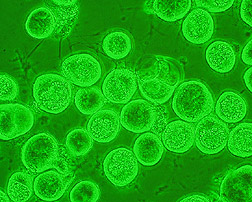
With an eye to worldwide marketing, several companies are developing technology to mass-produce baculoviruses in cultures of insect cells rather than in whole insects. Such technology is expected to save on labor costs and to keep bioinsecticides free of microbial contaminants. Besides serving as growth media for baculoviruses, insect cell cultures—particularly those from embryonic and nerve tissue—may someday be used to screen natural or synthetic chemical compounds for their potential as environmentally friendly anti-insect compounds. For example, the cultures might help to determine whether an insect growth regulator effectively disrupts development of pest insects without harming other insects.
|
|
|
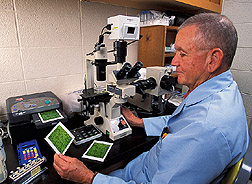
Cell cultures may also help scientists learn why certain chemicals paralyze or kill a particular pest insect or cause it to stop eating. One neuronal cell line that shows promise for helping find answers to such basic and applied research questions was developed by ARS entomologist Cynthia L. Goodman, graduate student Jennifer Wittmeyer, and McIntosh in a cooperative research and development agreement between ARS and Aventis Crop Science (formerly Rhone-Poulenc).
In hundreds of biomedical laboratories around the world, scientists are bioengineering baculoviruses grown in cell cultures to produce proteins that may be used to diagnose or prevent disease. Someday, pending sufficient research on environmental safety, proteins from genetically modified baculoviruses—or even the viruses themselves—may be produced as bioinsecticides in bioreactors, which are vats for growing large quantities of virus-infected insect cells. Recently, entomologist James J. Grasela and McIntosh developed recombinant baculoviruses containing colored fluorescent protein markers. These markers may help researchers determine more quickly if the recombinants possess desired traits, such as the ability to kill pests with low levels of virus. For baculovirus production, the researchers have established eight insect cell lines from embryos and ovaries from members of theHelicoverpa andHeliothis species (for example, cotton bollworm and corn earworm) that damage cotton, corn, tobacco, tomato, and many more crops. Given proper nutrients, one of the cell lines produced 10 times more of a baculovirus known as AcMNPV than did the other lines. This virus infects a wide range of caterpillar pests, but it is named after the host it was isolated from,Autographa californica (alfalfa looper). In experiments with a baculovirus called PxMNPVCL3, which McIntosh recently discovered in samples from infected diamondback moth caterpillars (Plutella xylostella), the caterpillars' infection levels were up to 2,000 times greater than rates of infection in caterpillars exposed to either AcMNPV or to another baculovirus discovered by BCIRL scientists. Besides being a nemesis of cabbage, diamondback moth is also a major worldwide pest of other cole crops. “Diamondback moth has developed resistance to several intensively used chemical insecticides and to toxins produced by the bacteriumBacillus thuringiensis, orBt. So the newly isolated baculovirus stands out as a potential control agent of this pest,” says McIntosh. Overcoming Obstacles Despite having environmentally friendly advantages, use of baculoviruses against pests may entail some dilemmas, which McIntosh, Goodman, Grasela, and ARS entomologist Carlo M. Ignoffo (retired) are trying to solve. The viruses' strong points, when contrasted with chemical insecticides, can also be their greatest weaknesses. For example, baculoviruses pose no direct threat to beneficial insects, but most of these viruses work only against a narrow spectrum of pest insects. And baculoviruses don't kill pest insects as rapidly as chemical insecticides. Add another wrinkle: Baculoviruses don't persist well in the environment, mainly because they are inactivated by ultraviolet-B (UV-B) rays of sunlight, which probably cause DNA damage. If they could be made a little more persistent, they might become much more practical alternatives to conventional chemical insecticides. Further research on the UV-B phenomenon may provide insights into developing better bioinsecticides through genetic engineering or even through improved production and handling techniques. In cabbage looper and corn earworm cells, the scientists found that genes like those known to be involved in repair of DNA damage in noninsect organisms may be operative, say McIntosh and Grasela. Cabbage looper cells were less sensitive to UV-B and produced more baculovirus on infection than did virus-infected corn earworm cells. Now the scientists are trying to identify the genes that help protect the cells and perhaps the virus. Each new discovery may help lead to more economical control of the bollworm/budworm pests that attack more than 30 food and fiber crops worldwide. In the United States alone, the damage these pests inflict and the costs for controlling them add up to more than $1.25 billion each year.—ByBen Hardin, formerly with ARS. This research is part of Crop Protection and Quarantine, an ARS National Program (#304) described on the World Wide Web at http://www.nps.ars.usda.gov. Arthur H. McIntosh, Carlo M. Ignoffo, Cynthia L. Goodman, and James J. Grasela are with the USDA-ARS Biological Control of Insects Research Laboratory, 1503 South Providence Rd., Research Park, Columbia, MO 65203; phone (573) 875-5361, fax (573) 875-4261. |
|
"Giving Baculoviruses a Better Edge" was published in the January 2002 issue of Agricultural Research magazine. |