
United States Department of Agriculture
AgResearch Magazine


CORN: Taking Genetic S t o c k
|
|
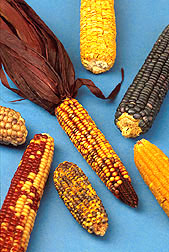 These ears of corn demonstrate some of the differences mutations maintained at the Maize Genetics Cooperation Stock Center. (K8712-1) |
One day in 1959, University of Illinois scientist John Laughnan absentmindedly popped dry corn kernels into his mouth while shelling mutant seeds off cobs. He was surprised by the sweetness of one of the kernels from a particular mutant obtained from the university's Maize Genetics Cooperation Stock Center in Urbana.
That particular mutant was known as shrunken2. Its shriveled-up kernels became what the world now knows as super-sweet corn. Sweet corn with this trait holds its sweetness, whereas traditional sweet corn with the sugary1 trait loses its sweetness rapidly after picking. In 1998, commercial sweet corn, which is now mostly shrunken2—both for fresh market and processing—was worth about $676 million. The shrunken2 mutant is just 1 of more than 3,000 stored and maintained at the stock center. "The mutants in this collection provide maize scientists with a wealth of knowledge about corn as a biological organism," says Martin M. Sachs. Director of the center, he is a maize geneticist with the Agricultural Research Service, which operates the center at the University of Illinois. "This knowledge can lead to applications that may improve corn agronomically and bring tastier and more nutritious food to our dinner tables," he says.
|
|
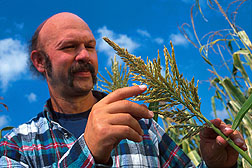 Maize geneticist Martin Sachs observes the branched tassel trait of romosa1 mutant corn. (K8710-1) |
Sachs entertains visitors by pulling out corn oddities from a plastic "shoe box" and telling corn riddles like this one: "Ever wonder how corn chips at the health food store got their purplish-blue color?"
"They're derived from purple ears of corn, and the purplish color was selected by early Native American breeders for ornamental and religious purposes," Sachs explains. "In the High Andes of South America, this purple color was selected for expression in plant tissue and was thought to protect corn from the sun's ultraviolet rays." Getting Back to Basics Most of the mutants in the collection are used mainly for basic research. This is important, says Sachs, because maize is highly regarded as a test organism for certain genetic studies. The collection represents the working stocks for maize geneticists and provides a service similar to that provided to chemists by a chemical supply house.
|
|
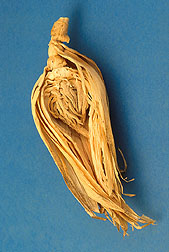 Tunicate1 mutants develop long glumes enclosing individual kernels. (K8713-1) |
The idea of the Maize Genetics Cooperation Stock Center was born in 1928. At that time, the "father" of maize genetics, Cornell University professor Rollins A. Emerson, met with a few maize workers in a New York hotel room and discussed maize linkage maps.
The center was originally located at Cornell University. The stocks were transferred to their present Illinois home in 1953. Today, the collection at the stock center is considered an international treasure. While most of the mutants are too extreme for commercial breeding, a few have affected the marketplace. Stock center researchers have discovered useful traits, such as those that affect starch quality and abundance of the amino acid lysine, which are important in animal feed. The Archer Daniels Midland Company of Decatur, Illinois, uses the product of a mutant from this center for producing its pure amylopectin, a branched starch that is an important ingredient in human foods. Some mutants produce seedlings with varied colors: yellow, albino, purple, golden, or striped. Others bear odd-shaped ears, such as one that looks like an onion bulb or another that is branched, with a tassel resembling a Christmas tree. The total collection has about 80,000 individual samples. The majority of the stocks are maintained so they can be used for specific research purposes. The Source of This Diversity Maize geneticists and breeders around the world have submitted the bulk of the genetic variations and aberrations. But most of the chromosomal aberrations in the stock center were deliberately induced by radiation during atomic bomb tests in 1946 and 1948, in an experiment to observe its effects on living organisms. Important contributions in assembling and maintaining stocks of chromosomal aberrations have been made by University of Missouri, Iowa State University, and Indiana University scientists. Others were generously submitted by farmers and breeders who found them in their fields. Maintaining the collection isn't an easy chore. Seed samples are increased by hand planting, pollination, and harvesting of each ear individually. Ears are shelled individually, too, and seed samples from each ear are stored in packets and labeled with genetic symbols. For long-term storage, the cold room is kept at 45 °F with less than 30 percent relative humidity. Toward Flood-Tolerant Corn When he has time, Sachs is able to pursue an important research interest: how corn responds to oxygen deprivation—which is what happens when water is standing in a field. In 1989, he started identifying varieties with tolerance to drowning, while he and his colleagues screened over 1,000 North American and Latin American corn lines for flood tolerance. A genetic trait for submergence tolerance could help U.S. corn withstand anaerobic stress from loss of oxygen while under water—giving farmers another kind of crop insurance. Over the years, Sachs has identified 10 different breeding lines that show a simple dominant trait for increased flood tolerance. He found the flood-tolerant corn while screening 400 genetic land races from the International Maize and Wheat Improvement Center in Mexico City. The fate of the 10 selected lines: to have their seedlings completely submerged long enough that the submergence would kill normal corn seedlings. One mutant was found to be so sensitive that its seedlings died within hours. But a few of the more tolerant varieties survived up to 6 days. The vast majority of corn lines survive 3 days of flooding under experimental conditions. For now, Sachs uses traditional breeding techniques to cross the desired trait into American corn lines. But he envisions that genetic engineering will allow him to someday fortify corn with even more flood tolerance from rice. It will still be several years in the future before Sachs has made the necessary genetic improvement in water-tolerant corn lines. But someday, seed breeders will benefit from this work—just as today's consumers have benefitted from sweet corn derived from shrunken 2.—By Linda McGraw, Agricultural Research Service Information Staff. This research is part of Plant, Microbial, and Insect Genetic Resources, Genomics, and Genetic Improvement, an ARS National Program (#301) described on the World Wide Web at http://www.nps.ars.usda.gov/programs/cppvs.htm. Martin M. Sachs is at the USDA-ARS Maize Genetics Cooperation Stock Center, University of Illinois, S-123 Turner Hall, 1102 S. Goodwin Ave., Urbana, IL 61801; phone (217) 333-6631, fax (217) 333-6064. Visit the Maize Genetics Cooperation Stock Center web page at http://www.uiuc.edu/ph/www/maize. |
|
"CORN: Taking Genetic S t o c k" was published in the January 2000 issue of Agricultural Research magazine.
|
|
