
United States Department of Agriculture
AgResearch Magazine


INTERBULL Shows How U.S. Bulls Stack Up
|
|
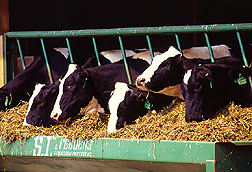
The secret is out: America's most productive dairy cows can now be bred to the world's best bulls, thanks to an international dating service for dairy cattle.
"INTERBULL—The International Bull Evaluation Service—is like a consumer report that objectively rates bulls raised worldwide, based on an extensive list of important quality standards," says Agricultural Research Service geneticist Rex L. Powell. He works at the Animal Improvement Programs Laboratory in Beltsville, Maryland.
The lab's researchers devise, test, and implement genetic evaluation techniques to improve the productivity and health of dairy cattle and goats—thereby keeping U.S. dairy producers competitive in today's marketplace. Powell's job is to ensure that quality standards for U.S. cattle remain the world's best.
"The United States is the world's top exporter of bull semen, with sales of about $60 million a year," he says.
Powell has been the U.S. representative to INTERBULL since its beginning in 1983 and serves on its board of directors. Headquartered in Uppsala, Sweden, INTERBULL boasts 34 member countries.
"INTERBULL's objective is to internationally evaluate bulls that have been properly tested in different countries—currently 20 and growing. This information enables breeders worldwide to select the best bulls from around the world to sire daughters," Powell says.
INTERBULL combines national evaluations of nearly 90,000 recent bulls from six breeds of dairy cattle. Its objectives are to improve milk yield and quality; improve resistance to diseases, like mastitis; and increase the value of dairy cows—all while protecting genetic diversity.
Each year, the laboratory processes millions of new records that track important genetic traits in daughters, such as milk production and composition. For example, how much and what quality milk does each tested animal produce? How much fat and protein are contained in the milk?
These records are the result of production testing programs of the National Dairy Herd Improvement Association and contribute to an accumulated file of about 128,000 American bulls and their 20 million daughters.
"U.S. dairy farmers and breeders need and use this information to breed the best bulls with their best dairy cows," says Powell. He is an expert on interpreting this genetic information for the entire nation and relating it to INTERBULL's international standards.
Powell's work ensures that the semen U.S. breeders and farmers purchase nationally and internationally is the best for their intended purpose, because some animals naturally do best under certain climate and production conditions. Powell's efforts also make foreign breeders and dairy farmers aware of the superiority of U.S. germplasm.
Powell is working to improve INTERBULL itself. For while the United States and Canada currently evaluate milk production four times a year, most countries and INTERBULL evaluate bulls only twice yearly. Powell would like to see international evaluations also done quarterly.
He would also like to see added to the INTERBULL evaluation list other important genetic traits, like conformation, longevity, and somatic cell count. This count is the number of body cells (largely leucocytes) per milliliter of milk and is a measure of udder infection, or mastitis.
For his work on improving genetic analysis of dairy cattle, Powell recently received the annual Award in Animal Breeding from the American Dairy Science Association. To help producers make sense of so much data, Powell ensures that most of INTERBULL's information is available in a user-friendly form on the World Wide Web at http://www.aipl.arsusda.gov/.
INTERBULL's own Web pasture can be found at http://www-interbull.slu.se/. — By Hank Becker, Agricultural Research Service Information Staff, 6303 Ivy Lane, Greenbelt, Maryland 20770, phone (301) 344-2769.
Rex L. Powell is at the USDA-ARS Animal Improvement Programs Laboratory, Bldg. 236, 10300 Baltimore Ave., Beltsville, MD 20705-2350; phone (301) 504-8334, fax (301) 504-8092.
"INTERBULL Shows How U.S. Bulls Stack Up" was published in the February 1998 issue of Agricultural Research magazine. Click here to see this issue's table of contents.
